01What are mental health conditions?
A mental health condition changes how someone feels, thinks or behaves in a way that causes distress or disrupts life. It differs from passing sadness or worry in severity, persistence and impact. Its causes involve genes, brain chemistry, stress and difficult experiences.
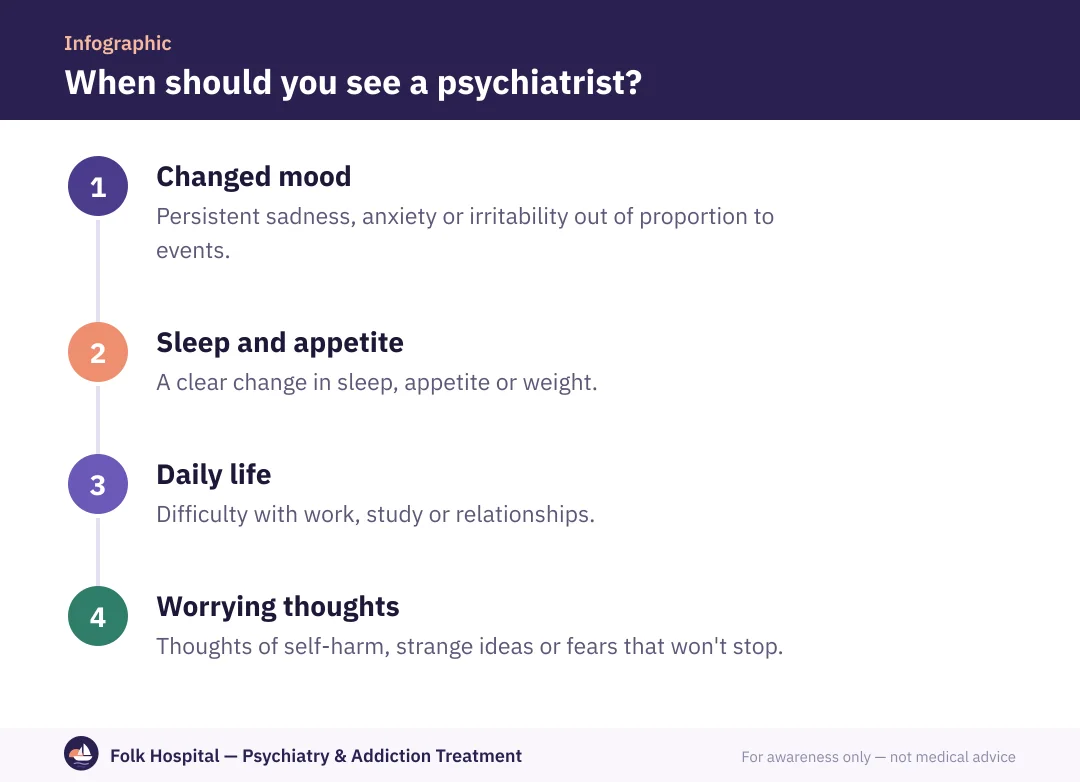
02What are the most common conditions?
| Group | Examples |
|---|---|
| Mood disorders | Depression, bipolar disorder |
| Anxiety disorders | Generalised anxiety, panic, social anxiety |
| Obsessive-compulsive | OCD |
| Psychotic disorders | Schizophrenia, psychosis |
| Trauma-related | PTSD |
| Personality disorders | Borderline, narcissistic, antisocial |
Thinking about harming yourself? You're not alone, and help is available now. Call an ambulance or the mental health hotline, or talk to someone you trust straight away.
؟Frequently asked questions
What's the difference between a psychiatrist and a psychologist?
A psychiatrist is a doctor who diagnoses, prescribes medication and manages the condition medically, while a psychologist or therapist provides talking therapy such as CBT. Many people benefit from both.
Are psychiatric medicines addictive?
Most aren't, including antidepressants and mood stabilisers. Some sedatives need caution and a set duration, which the doctor decides.
Are mental illnesses common?
Yes. They affect a large proportion of people at some point in life.
Can mental illness be cured?
Many recover or fully stabilise with the right treatment.
How is addiction related to mental illness?
They often co-occur and need integrated dual-diagnosis treatment.
Sources and references
- Mental disorders — fact sheet — World Health Organization
- Mental Disorders — U.S. National Library of Medicine — MedlinePlus
- Mental Health Medications — National Institute of Mental Health (NIMH)
- Mental disorders — fact sheet — World Health Organization
- Mental Disorders — U.S. National Library of Medicine — MedlinePlus
- Mental Health Medications — National Institute of Mental Health (NIMH)

A psychiatrist specialising in addiction and mental illness in adults and adolescents, with a focus on dual diagnosis.
For awareness only — not a substitute for medical advice. Editorial policy · View profile