- Detox treats physical dependence only; rehabilitation that follows treats the addiction itself.
- Stopping alcohol or sedatives suddenly can cause dangerous seizures, so it must be done medically.
- Each substance has its own protocol; there's no single recipe for everyone.
- After detox tolerance drops, and going back to the old dose can be fatal.
01What is detox?
When someone uses a substance regularly, the body readjusts to function with it present. If it stops suddenly, that balance is disrupted and withdrawal symptoms appear. Medical detox manages this phase safely: we stop the drug gradually or at once depending on its type, give medicines that temporarily correct the imbalance, and monitor vital signs until the body settles.
Detox isn't a treatment for addiction on its own. It prepares the body to take part in the psychological treatment that tackles the root of the problem.
The word "toxins" is common but not medically accurate. The body doesn't fill up with substances that need "flushing out"; the liver and kidneys clear the drug within days. What really needs treating is how the brain and body have adapted to the drug, which is what causes withdrawal. So "body cleanse" drinks and herbs sold online don't help and may cause harm. Read myths about cleansing drugs from the body.
02Who needs medical detox?
A person needs supervised detox if one or more of these apply:
- They use daily or almost daily, for weeks or longer.
- Withdrawal symptoms appear when a dose is late.
- They use alcohol or sedatives regularly, even at doses that seem small.
- They mix substances, such as tramadol with pregabalin or cannabis with sedatives.
- They have a history of seizures, heart or liver disease, or are pregnant.
- They've tried to stop alone and failed, or have had seizures or hallucinations on stopping before.
- They have severe depression or thoughts of self-harm.
03How long does detox take?
| Substance | Approximate withdrawal | Medical note |
|---|---|---|
| Heroin and opioids | 5–10 days | Distressing but rarely life-threatening |
| Tramadol | 7–14 days | Seizure risk at high doses |
| Alcohol | 5–7 days | Can cause delirium and seizures; needs close monitoring |
| Sedatives (benzodiazepines) | Weeks | Must be tapered gradually only |
| Crystal meth and stimulants | 7–10 days | The main risk is psychological: depression and thoughts of self-harm |
| Cannabis and strox | 7–14 days | Insomnia, irritability and anxiety; strox can cause acute symptoms |
These periods cover the acute symptoms only. Milder symptoms such as insomnia, mood swings and cravings can continue for weeks or months; this is known as protracted withdrawal. It doesn't mean detox failed, only that the brain is still regaining its balance, which is where rehabilitation comes in.
04What symptoms can be expected during detox?
Physical symptoms
- Muscle and bone pain
- Sweating, shaking and chills
- Diarrhoea, nausea and loss of appetite
- Severe insomnia
Psychological symptoms
- Anxiety, tension and irritability
- Strong cravings
- Low mood and tearfulness
- Difficulty concentrating
All of these are expected and treatable. What concerns us more are the signs that need immediate action:
- Seizures or loss of consciousness
- Hallucinations or severe confusion
- A big rise in temperature or heart rate
- Thoughts of suicide or harm
If any of these appear outside hospital, call an ambulance on 123 immediately.
Ambulance: 12305How detox differs by substance
Opioids: heroin, tramadol and painkillers
Their withdrawal resembles a severe flu: bone pain, diarrhoea, runny nose, insomnia and anxiety. The doctor uses medicines to ease each symptom and, in selected cases, may use a medical opioid at a reducing dose. With tramadol in particular, seizure risk is monitored. Details in opioid addiction treatment.
Alcohol
One of the most dangerous withdrawals. It may begin within hours with tremor, sweating and anxiety, and in severe cases seizures or delirium tremens, with confusion and hallucinations, can occur and threaten life without treatment. Sedative medicines are therefore given at calculated doses reduced daily, along with vitamin B1 (thiamine) to protect the brain from complications of the deficiency common in heavy drinkers. Read about alcohol addiction treatment.
Sedatives and sleeping pills
Such as Xanax, Rivotril and Valium. Stopping suddenly after long use can cause seizures, so detox is gradual over weeks, sometimes by switching to a longer-acting sedative and reducing it slowly. Read sedative addiction treatment.
Stimulants: crystal meth, cocaine and captagon
Physical withdrawal is milder, but the psychological side is harder: long sleep and hunger, then depression, loss of pleasure and sometimes suicidal thoughts. The focus is on psychiatric monitoring, sleep and nutrition, and treating depression if it persists. Read crystal meth addiction treatment.
Cannabis and synthetic drugs
Cannabis causes insomnia, irritability and poor appetite for a week or two. Synthetic drugs such as strox and voodoo are less predictable and can cause agitation or psychotic symptoms needing close psychiatric follow-up.
06How detox works at Folk, step by step
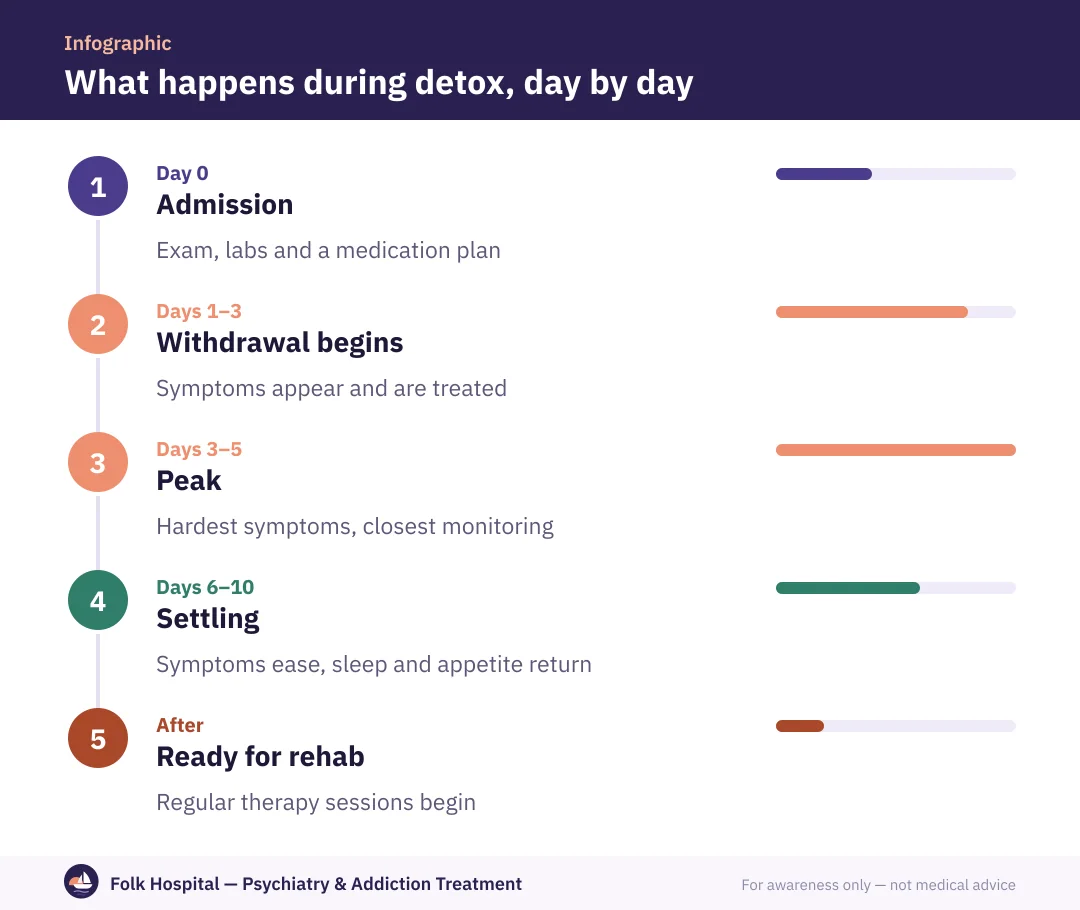
- Admission and assessmentblood and urine tests, vital signs, and a psychological interview to identify the drug, dose and any co-existing illness.
- A written medication planthe doctor chooses suitable medicines for the substance and sets the doses and how they'll be reduced.
- Round-the-clock monitoringnurses check vital signs regularly and a doctor adjusts the plan to the body's response.
- Early psychological supportshort sessions from the first days to ease anxiety and cravings and prepare for rehabilitation.
- Moving on to rehabilitationonce symptoms settle, residential care or outpatient care begins.
We measure withdrawal severity with validated medical scales, such as the COWS scale for opioids and the CIWA-Ar scale for alcohol, so medicines are given according to actual symptoms rather than fixed doses for everyone. This reduces discomfort while avoiding over-sedation.
07A day in detox
Many patients ask how they'll spend their days. The daily routine is designed to be calm and structured:
- Mornings: vital signs, and a doctor's review of symptoms and medicines.
- Regular light meals rich in fluids, because dehydration is one of the commonest complications.
- Rest and sleep in a quiet setting, with sleep medicines when needed and under supervision.
- A short session with a therapist when energy allows, starting with calming and moving towards preparation for rehabilitation.
- Light activity such as walking or breathing exercises as symptoms improve.
- Night-time monitoring, because many symptoms worsen in the evening and at night.
08Rapid detox and unrealistic promises
Some places advertise detox "in 24 hours" or "under full anaesthesia". Medical guidelines don't recommend this approach: it carries anaesthetic risks, doesn't really shorten recovery and doesn't reduce relapse. Worse still are places relying on deprivation and confinement without medicines, which make withdrawal harsher and more dangerous.
Warning signs
- A promise of complete cure in days.
- Detox without a doctor or tests.
- Locking up, restraint or violence.
- No plan after detox.
Signs of a safe place
- Medical assessment and tests before starting.
- A written medication plan and round-the-clock monitoring.
- Respect for the patient's dignity and privacy.
- A clear rehabilitation and follow-up programme after detox.
Read how to choose an addiction treatment centre.
09Why stopping suddenly at home isn't advised
Many families try to "lock" the person in a room until withdrawal passes. The problem is that this combines medical risk (dehydration, seizures, low blood pressure) with psychological risk (violence, attempts to escape, suicidal thoughts), and it often ends with a return to using at a higher dose after tolerance has dropped, when overdose risk is highest. Read can addiction be treated at home?
Important
A few days after stopping, the body's tolerance falls. Going back to the same old dose during this period can be fatal, especially with heroin and tramadol.
10The family's role during detox
- Prepare the person calmly: explain that detox lasts a limited number of days under care, and that pain will be treated.
- Bring information: the names of drugs and medicines, approximate doses, and any illnesses or allergies.
- Don't press with questions in the first days; tiredness and irritability are part of withdrawal, not their character.
- Start your own journey: family sessions help you prepare for life after discharge. See our family programme.
11What comes after detox?
The end of acute symptoms is a beginning, not an end. After detox the patient starts psychological and behavioural rehabilitation in residential care or outpatient care, depending on their needs, followed by our aftercare programme. Evidence shows that detox alone without rehabilitation is followed by relapse in most cases, while rehabilitation and follow-up clearly raise the chances of stable recovery.
؟Frequently asked questions
Is detox painful?
The symptoms are real, but medicines and medical care ease them a great deal. What makes withdrawal so painful is trying to go through it alone without treatment.
Can detox be done at home?
We don't advise it with heroin, alcohol, sedatives or high doses of any drug, because of the risk of dehydration, seizures or acute mental disturbance. The doctor decides whether a case allows outpatient follow-up.
Does addiction end when detox ends?
No. The body clears the drug, but cravings, habits and psychological causes remain, which is why rehabilitation follows.
How many days do drugs stay in the body?
It depends on the drug; some leave the blood within two days, others stay in urine and hair for weeks. Medically, what matters more is how long withdrawal lasts, not how long a test can detect the drug.
What is rapid detox under anaesthesia?
A method in which withdrawal is forced within hours under general anaesthesia. Medical guidelines don't recommend it because it doesn't reduce relapse and carries anaesthetic risks; safety lies in gradual detox with medicines and monitoring.
Can the family visit during detox?
Visits are arranged according to the patient's condition; in the first days short phone calls may be better, then visits and family sessions start once symptoms settle.
What should the patient bring?
ID, any regular medicines and medical reports, and comfortable clothes for a week. All medicines are handed to nursing staff to be given under supervision.
How do I know detox is over?
When vital signs are stable, sleep and appetite improve, and symptoms are mild enough not to need regular medicines. It's a doctor's assessment, not a fixed date.
Sources and references
- Drug misuse in over 16s: opioid detoxification (CG52) — National Institute for Health and Care Excellence (NICE)
- Alcohol-use disorders: diagnosis, assessment and management (CG115) — National Institute for Health and Care Excellence (NICE)
- Guidelines for the psychosocially assisted pharmacological treatment of opioid dependence — World Health Organization
- Treatment Approaches for Drug Addiction — DrugFacts — National Institute on Drug Abuse (NIDA)
- Opiate and opioid withdrawal — U.S. National Library of Medicine — MedlinePlus
- Drug addiction: getting help — NHS (UK)

A psychiatrist specialising in addiction and mental illness in adults and adolescents, with a focus on dual diagnosis.
For awareness only — not a substitute for medical advice. Editorial policy · View profile