01What is dual diagnosis?
We say someone has a dual diagnosis when a substance use disorder occurs alongside another mental health condition. One may start before the other, and each can feed the other in a closed loop: a depressed person uses to feel relief, the drug deepens the depression, and use increases.
This combination takes three main forms:
- A mental health condition that came first: such as anxiety or ADHD since childhood, followed by using the drug as self-medication.
- A condition caused by the drug: such as stimulant psychosis or withdrawal depression, which may improve on stopping.
- A shared vulnerability: genetic factors or early trauma that raise the risk of both.
02Which mental health conditions are most linked to addiction?
Depression
Some patients use to escape sadness and emptiness.
Anxiety and social anxiety
The drug seems a quick fix for tension, then makes it worse.
Bipolar disorder
Manic and depressive episodes push impulsive use.
ADHD
Impulsivity and poor self-control make addiction develop faster.
Personality disorders
Difficulty regulating emotions and relationships is linked to use.
PTSD
Trying to silence painful memories with drugs.
Add to these schizophrenia and psychosis, eating disorders, and chronic insomnia, which leads many people to misuse sleeping pills.
03Which came first, and why does it matter?
This is one of the hardest questions in psychiatry, because drugs themselves mimic mental illness:
| Substance | Psychiatric symptoms it can cause | What usually happens after stopping |
|---|---|---|
| Crystal meth and stimulants | Psychosis, paranoia, hallucinations, depression after stopping | Psychosis improves within days to weeks in many people but persists in some |
| Cannabis and synthetics | Anxiety, panic attacks, psychotic symptoms | Usually improve, but may reveal a vulnerability to psychosis |
| Alcohol | Depression, anxiety and sleep problems | Many improve within weeks of abstinence |
| Opioids | Depression, loss of pleasure and anxiety in withdrawal | Improve gradually; protracted symptoms may remain |
| Sedatives | Anxiety and severe insomnia on withdrawal | Need a gradual taper and treatment of the original anxiety |
So we don't rush a final diagnosis. We treat acute symptoms first for the patient's safety, then reassess after weeks without the drug. If symptoms persist or were there before the drug use, it's an independent condition needing its own treatment plan. Read about drug-induced psychosis.
04Why must both be treated together?
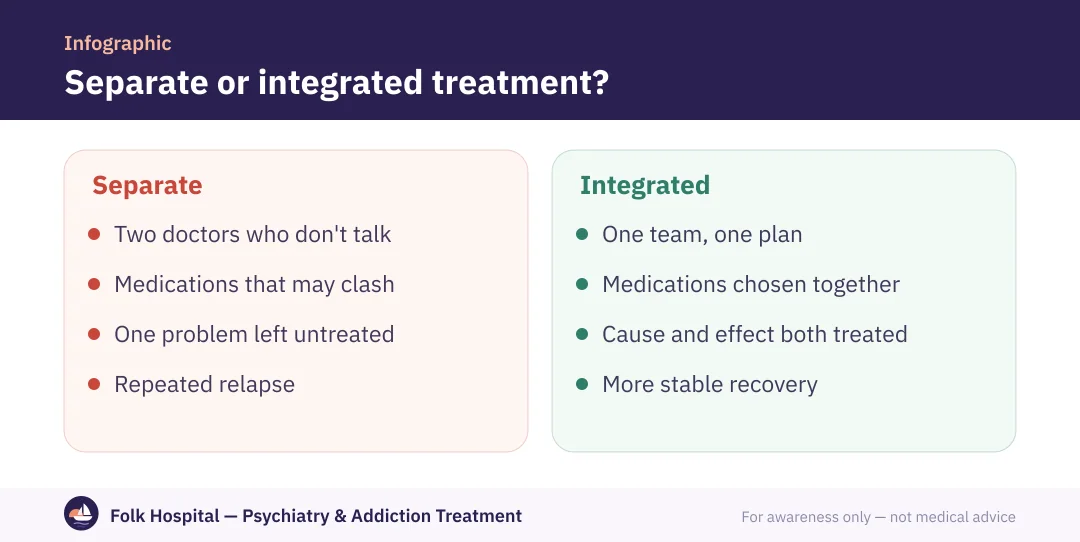
Picture someone with severe depression who uses to feel some relief. If we remove the drug without treating the depression, we may leave them facing their pain with nothing to cope, and they return to the drug at the first chance. The reverse is also true: treating depression while use continues won't work, because the drug itself deepens the depression.
In the past, patients were sent to two separate places: an addiction centre that didn't treat mental illness, and a psychiatric clinic that refused them until they stopped using. That split left the patient stuck in between. Integrated treatment means one team and one plan dealing with the whole picture.
05Signs that suggest a dual diagnosis
Watch for
- Marked sadness, anxiety or withdrawal before use began.
- Psychiatric symptoms that persist weeks after stopping.
- Sharp swings in mood, energy and sleep.
- Irrational suspicion, hearing voices or seeing things.
- Talk of death or self-harm.
- Repeated relapses despite good previous addiction treatment.
06How treatment works at Folk
- In-depth psychiatric assessmentinterviews and psychological testing, plus a review of symptoms before and after drug use began.
- Careful detoxextra monitoring of mood and thoughts during detox.
- Reassessment once stablemany symptoms become clearer, or disappear, after a few weeks without the drug.
- One integrated plancarefully chosen medication alongside cognitive behavioural therapy that addresses both the addiction and the condition.
- Long-term follow-updual diagnosis needs ongoing psychiatric follow-up after discharge.
07Medicines in dual diagnosis
Psychiatric medicines are an important part of treatment, but choosing them is different for someone with addiction:
- Antidepressants, mood stabilisers and antipsychotics generally aren't addictive and are used according to the diagnosis.
- Benzodiazepine sedatives are used with great caution and for short periods, because the risk of misuse is higher in people with a history of addiction.
- The doctor considers interactions between psychiatric medicines and any addiction treatment, such as relapse-prevention medicines.
- Adherence is monitored, because stopping suddenly is one of the commonest reasons symptoms, and then drug use, return.
Read about psychiatric medicines.
08Psychological therapy
- Cognitive behavioural therapy: works on the thoughts that feed both the condition and the drug use.
- Dialectical behaviour therapy: particularly helpful for intense emotional swings or self-harming behaviour.
- Trauma-focused therapy: for people with a history of trauma they try to silence with drugs.
- Psychoeducation: so the patient and family understand the link between the illness and the drug, and early warning signs.
09Suicide risk: a priority at every stage
Addiction combined with depression, bipolar disorder or schizophrenia raises suicide risk. So we ask clearly about suicidal thoughts at assessment and follow-up, agree a safety plan with the patient and family, and monitor more closely in the first days of withdrawal and after discharge.
- Don't leave them alone, and remove medicines and sharp objects.
- Talk calmly and ask them directly about their thoughts.
Call an ambulance on 123 or go to the nearest emergency department if the danger is immediate.
Ambulance: 12310The family's role
The family needs to understand that some of the behaviour they see is a symptom of a mental illness, not just being spoilt or badly behaved. Family sessions help them recognise warning signs of both psychiatric and addiction relapse, and support medication adherence without conflict. See our family programme and caring for a relative with mental illness.
؟Frequently asked questions
How do we know whether depression caused the addiction or resulted from it?
We watch symptoms after a period without the drug and review the person's history before they started using. If symptoms persist or pre-date the drug use, an independent condition needing its own treatment is likely.
Are psychiatric medicines addictive?
Most are not, including antidepressants and mood stabilisers. Some sedatives need caution, so the psychiatrist chooses medication carefully for anyone with a history of addiction.
Can cannabis or crystal meth cause mental illness?
Stimulants such as crystal meth can cause psychosis with hallucinations and paranoia, and cannabis is linked to a higher risk of psychosis, especially with early and heavy use. Some of these episodes improve on stopping; others reveal a vulnerability to ongoing illness.
Does someone with dual diagnosis need residential care?
Not always, but residential care is preferred when there are suicidal thoughts, psychotic symptoms, severe depression or high-risk drug use, because the first days off the drug can temporarily worsen symptoms.
Will the patient stay on psychiatric medicines for life?
It depends on the diagnosis. Some conditions need treatment for a period and then a gradual taper; others, such as bipolar disorder, need long-term preventive treatment. The doctor decides, with regular review.
Can a mental illness be treated while drug use continues?
Treatment can start, but results are usually poor because the drug deepens symptoms and interferes with medicines. So we work on both together from the start.
What are signs my son has a mental illness as well as addiction?
Marked sadness or anxiety before use began, symptoms that persist after stopping, sharp swings in mood and energy, paranoia or hallucinations, or talk of death. These need a psychiatrist's assessment.
Does dual diagnosis lower the chances of recovery?
It makes treatment more complex, but integrated treatment achieves good results. The real problem is neglecting one of the two conditions, not having both.
Sources and references
- Co-Occurring Disorders and Health Conditions — National Institute on Drug Abuse (NIDA)
- Mental disorders — fact sheet — World Health Organization
- Mental Health Medications — National Institute of Mental Health (NIMH)
- Suicide Prevention — National Institute of Mental Health (NIMH)
- Drug misuse in over 16s: psychosocial interventions (CG51) — National Institute for Health and Care Excellence (NICE)
- Psychosis and schizophrenia in adults (CG178) — National Institute for Health and Care Excellence (NICE)

A specialist in psychological rehabilitation, behaviour modification and relapse prevention, with over 15 years in addiction programmes.
For awareness only — not a substitute for medical advice. Editorial policy · View profile