01Types
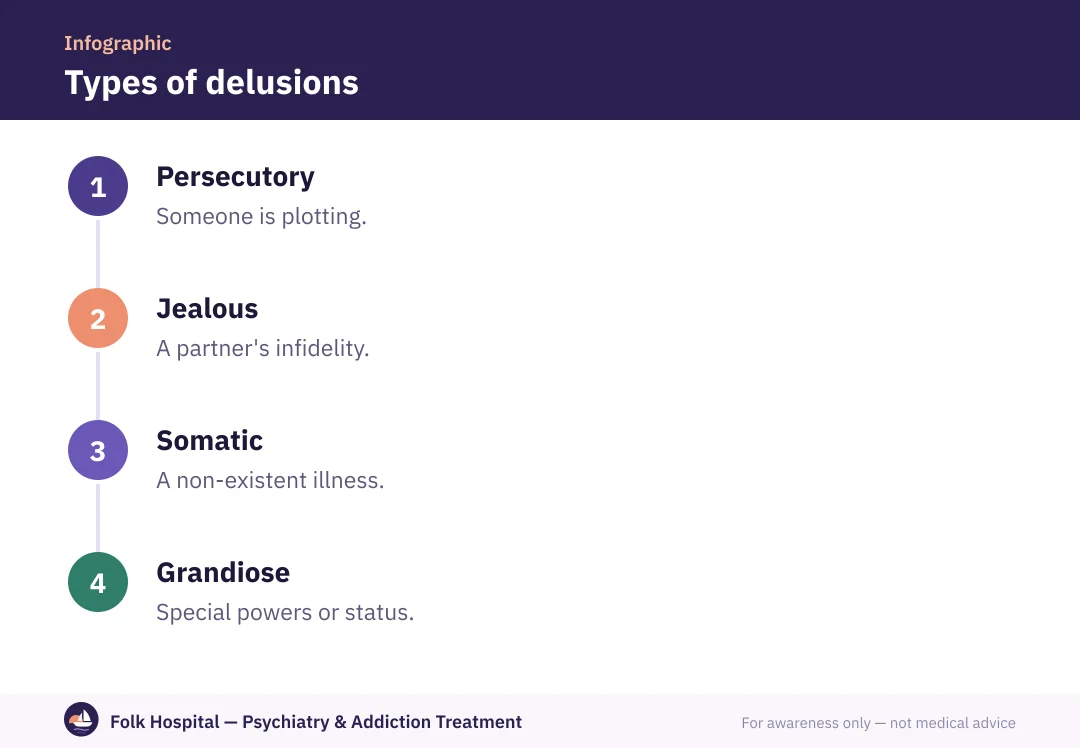
| Type | Content of the delusion |
|---|---|
| Persecutory | Someone wants to harm them |
| Jealous | Partner's infidelity |
| Somatic | A physical illness or defect |
| Grandiose | Exceptional status or ability |
| Erotomanic | An important person loves them |
Avoid
- Arguing about the delusion.
- Mockery.
Do
- Listen to their feelings.
- Focus on distress and sleep.
- Encourage assessment.
- Suicidal thoughts or intent to harm yourself or others.
- Losing touch with reality or severe agitation.
In Egypt call the ambulance on 123 or the mental-health hotline 08008880700.
Ambulance: 123Read also: psychotic disorders, paranoia, drug-induced psychosis.
؟Frequently asked questions
What is delusional disorder?
A psychotic disorder with fixed delusions without other prominent schizophrenia symptoms.
What are its types?
Persecutory, jealous, somatic, grandiose, erotomanic and mixed.
How does it differ from schizophrenia?
Delusional disorder has mostly delusions only, with better functioning than schizophrenia.
Do drugs cause it?
Stimulants can cause similar delusions and must be ruled out in diagnosis.
How do I deal with someone with a delusion?
Don't argue or agree; focus on their feelings and seek assessment.
Is it treatable?
Yes, with antipsychotics and psychotherapy; response varies.
Sources and references
- Delusional Disorder — Cleveland Clinic
- Psychosis — MedlinePlus — U.S. National Library of Medicine — MedlinePlus
- Schizophrenia — National Institute of Mental Health (NIMH)
- Delusional Disorder — Cleveland Clinic
- Psychosis — MedlinePlus — U.S. National Library of Medicine — MedlinePlus
- Schizophrenia — National Institute of Mental Health (NIMH)

A psychiatrist specialising in addiction and mental illness in adults and adolescents, with a focus on dual diagnosis.
For awareness only — not a substitute for medical advice. Editorial policy · View profile