01How do drugs cause psychosis?
Most psychosis-inducing substances raise dopamine in brain pathways that sort important from ordinary signals, or disturb the balance of other messengers. With long sleeplessness, poor nutrition and high doses, the brain loses its ability to filter signals, and hallucinations and suspicion appear. Read dopamine.
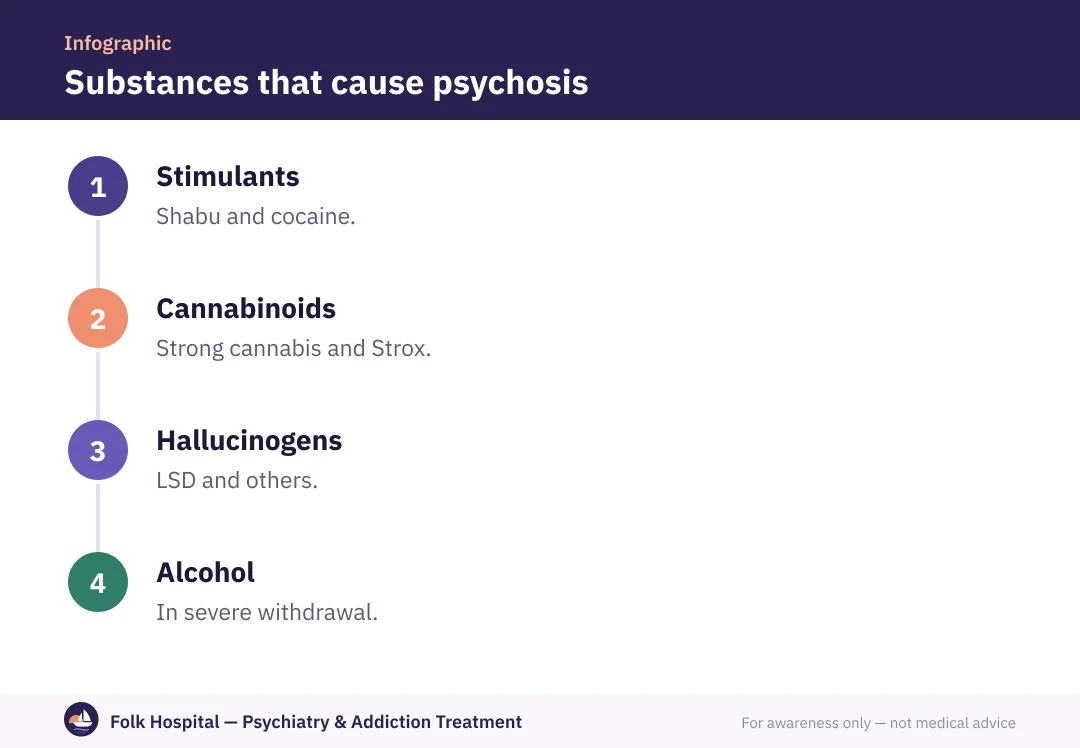
02Substances most likely to cause psychosis
| Substance | Common form of psychosis |
|---|---|
| Shabu and captagon | Persecution, auditory hallucinations, a feeling of insects under the skin |
| Strong hashish and hydro | Suspicion and ideas of reference; may unmask schizophrenia |
| Strox and synthetic cannabinoids | Acute psychosis with agitation or freezing |
| Cocaine | Suspicion and agitation, usually brief |
| Hallucinogens | Visual hallucinations, sometimes persistent psychosis |
| Alcohol withdrawal | Hallucinations; emergency delirium tremens |
| Sedative withdrawal | Confusion and hallucinations, with seizure risk |
03Signs
What the family may notice
- Intense suspicion that someone is watching or wants to harm them.
- Hearing voices or seeing things that aren't there.
- Constantly checking windows and doors.
- Scratching the skin because of a feeling of insects beneath it.
- Agitation, aggression or intense fear.
- Disconnected speech or strange ideas.
Details in drug-induced psychosis symptoms.
- Threats to harm themselves or others.
- Severe agitation or violence.
- High fever, seizures or marked confusion.
- Visual hallucinations with tremor and sweating after stopping alcohol.
Mental health hotline: 08008880700.
Ambulance: 12304Treatment
- Urgent assessmentidentify the substance and rule out physical causes and dangerous withdrawal.
- Safetyinpatient care if there's agitation or risk.
- Settling the psychosisantipsychotics for a period set by the doctor, and treatment of insomnia.
- Treating the addictionsafe detox and rehabilitation that prevents a return to the substance.
- Follow-upto see whether symptoms resolve fully or an underlying disorder exists.
Read harms of drug-induced psychosis, drug-induced psychosis treatment, psychosis and dual diagnosis.
؟Frequently asked questions
What is drug-induced psychosis?
Hallucinations, delusions or intense suspicion caused by using or withdrawing from a substance, without another psychotic disorder that explains them.
How long does drug-induced psychosis last?
Usually days to weeks after stopping; it can last longer with long-term use or high doses, and if it persists the doctor reassesses.
Does hashish psychosis turn into schizophrenia?
A share of hashish psychosis cases are later diagnosed with schizophrenia or bipolar disorder, especially in young people and those with a genetic predisposition.
Does shabu psychosis go away completely?
Many recover fully with stopping and treatment, but some have lingering symptoms or relapse quickly with any new use.
Can it be treated at home?
Severe cases or those with risk need inpatient care; milder ones may be followed as outpatients after medical assessment.
Is stopping the drug enough?
Stopping is essential, but the patient may need antipsychotics for a while, addiction treatment to prevent return, and follow-up to check for an underlying disorder.
Sources and references
- Psychosis — NHS (UK)
- Methamphetamine — research topic — National Institute on Drug Abuse (NIDA)
- Cannabis (Marijuana) — research topic — National Institute on Drug Abuse (NIDA)
- Synthetic Cannabinoids (K2/Spice) DrugFacts — National Institute on Drug Abuse (NIDA)
- Comorbidity: Substance Use and Other Mental Disorders — National Institute on Drug Abuse (NIDA)

A psychiatrist specialising in addiction and mental illness in adults and adolescents, with a focus on dual diagnosis.
For awareness only — not a substitute for medical advice. Editorial policy · View profile