01Signs
What marks avoidant personality
- Avoiding work that requires contact.
- Not entering relationships unless sure of acceptance.
- Intense fear of embarrassment.
- Persistent sense of inadequacy.
- Avoiding risks or new experiences.
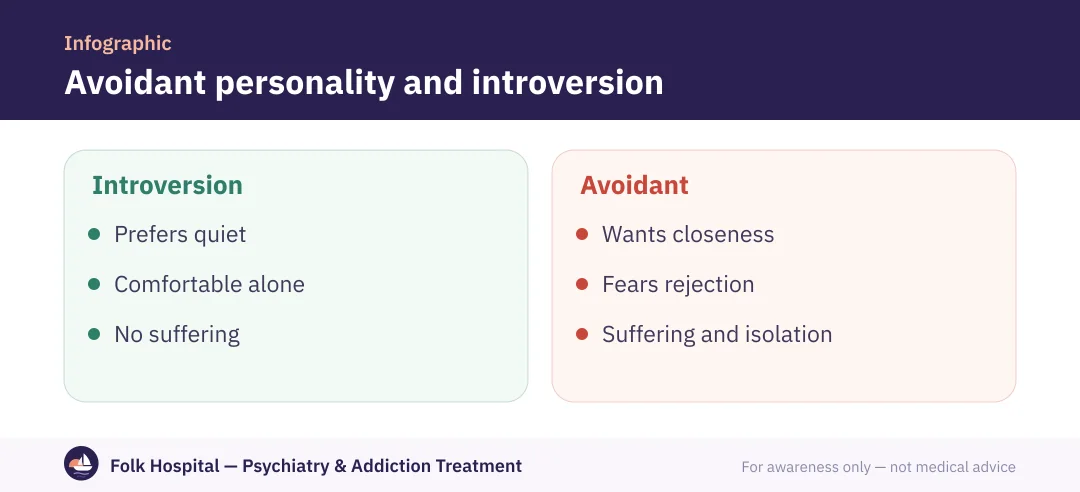
| Introversion | Avoidant personality | |
|---|---|---|
| Solitude | Comfortable | Painful |
| Motive | Preference | Fear of rejection |
| Self-image | Normal | Inadequate |
02Treatment
- Assessmentdistinguishing it from social anxiety and depression.
- Cognitive therapychallenging thoughts of inadequacy.
- Gradual exposuregraded social situations.
- Communication skillspractical training.
Read also: personality disorders, social anxiety, introversion.
؟Frequently asked questions
What is avoidant personality disorder?
A fixed pattern of intense shyness, inadequacy and fear of rejection leading to avoiding relationships.
How does it differ from introversion?
An introvert is comfortable alone; an avoidant person suffers and wishes for closeness.
How does it differ from social anxiety?
They overlap a lot; avoidant personality is broader, more stable and includes self-image.
Is it treatable?
Yes, with CBT and gradual exposure, sometimes antidepressants for co-occurring anxiety.
Is it linked to addiction?
Some use substances to ease anxiety in social situations.
How can I help an avoidant person?
With acceptance, no mockery, encouraging small steps and supporting treatment.
Sources and references
- Avoidant personality disorder — MedlinePlus — U.S. National Library of Medicine — MedlinePlus
- Personality Disorders — U.S. National Library of Medicine — MedlinePlus
- Avoidant personality disorder — MedlinePlus — U.S. National Library of Medicine — MedlinePlus
- Personality Disorders — U.S. National Library of Medicine — MedlinePlus

A psychiatrist specialising in addiction and mental illness in adults and adolescents, with a focus on dual diagnosis.
For awareness only — not a substitute for medical advice. Editorial policy · View profile