01Signs
May include
- Attributing success to luck.
- Fear of being exposed.
- Rejecting praise.
- Overworking.
- Constant comparison with others.
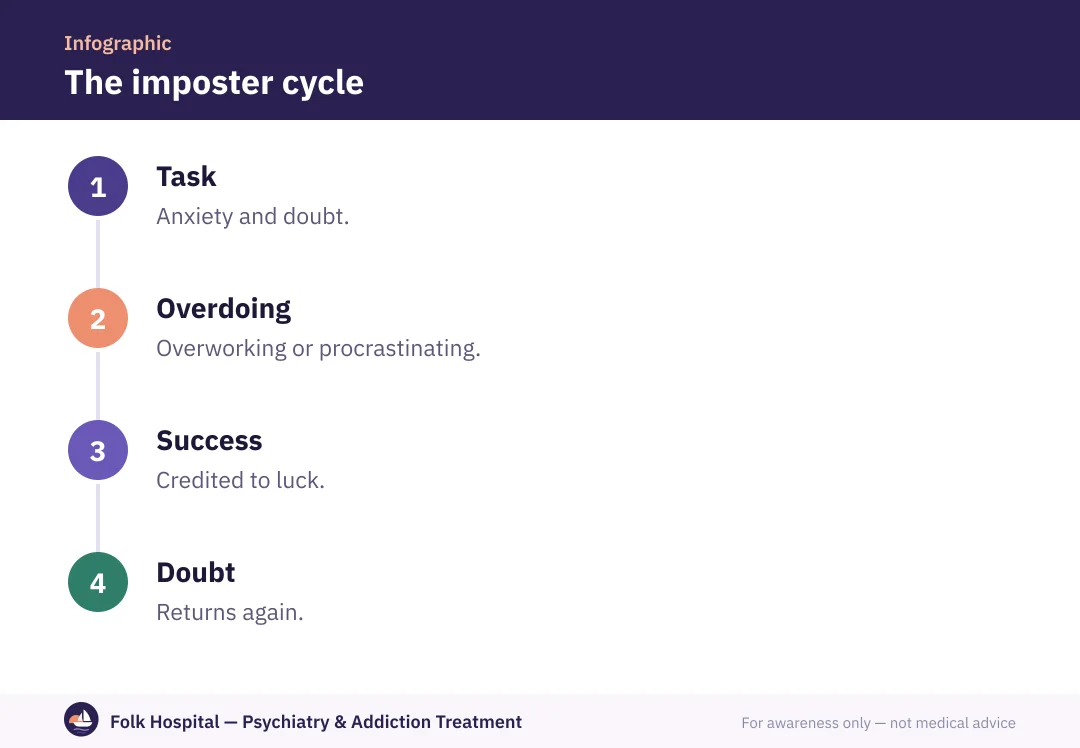
| Imposter thought | Realistic thought |
|---|---|
| «I succeeded by luck» | «I worked hard and learned» |
| «They'll find out I don't understand» | «Nobody knows everything» |
| «I must be perfect» | «Mistakes are part of learning» |
02Practical steps
- Record achievementswith evidence.
- Separate feeling from facta feeling isn't proof.
- Sharemany feel the same.
- Accept learninginstead of perfection.
Read also: low self-esteem, burnout, OCPD.
؟Frequently asked questions
What is imposter syndrome?
A persistent feeling of not deserving success and fear of being «found out».
Is it a mental illness?
Not a medical diagnosis, but a painful thinking pattern.
Who experiences it?
It's common among high achievers, students and people in competitive settings.
How is it related to perfectionism?
Perfectionism makes any shortcoming feel like proof of incompetence.
How do I overcome it?
Record achievements, question thoughts, accept mistakes and talk to others.
Does it cause burnout?
Yes. Overworking to compensate for «inadequacy» leads to exhaustion.
Sources and references
- How To Deal With Imposter Syndrome — Cleveland Clinic
- Raising low self-esteem — NHS (UK)
- How To Deal With Imposter Syndrome — Cleveland Clinic
- Raising low self-esteem — NHS (UK)

A specialist in psychological rehabilitation, behaviour modification and relapse prevention, with over 15 years in addiction programmes.
For awareness only — not a substitute for medical advice. Editorial policy · View profile