01Signs
You may notice
- Preoccupation with details and lists until the goal is lost.
- Perfectionism that delays finishing tasks.
- Difficulty delegating unless others follow their way.
- Overworking and neglecting rest.
- Sometimes difficulty discarding things.
- Stubbornness and rigid values.
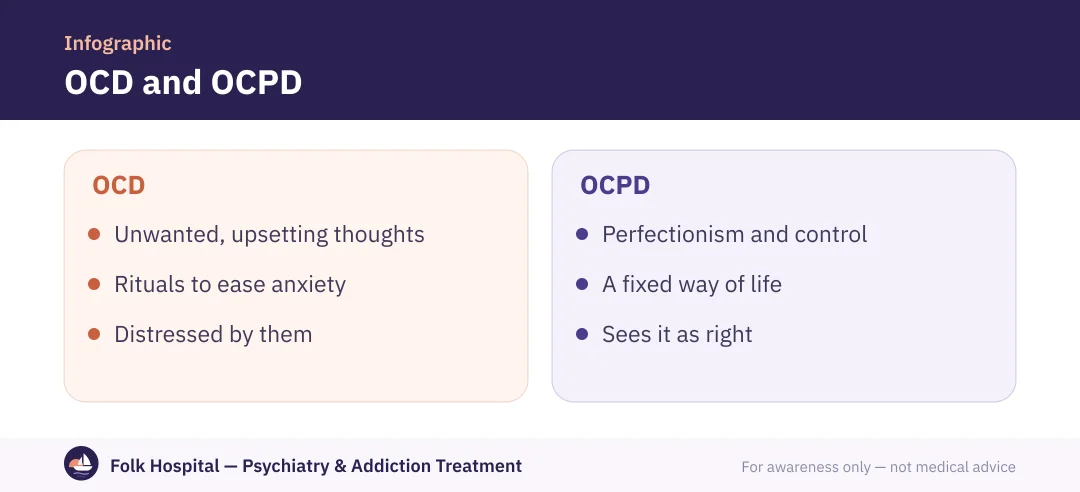
| OCD | OCPD | |
|---|---|---|
| Thoughts | Intrusive and distressing | Usually absent |
| View of own behaviour | Distressing and illogical | Right and appropriate |
| Pattern | Episodes and rituals | Constant across life |
02Treatment
- Seeing the costperfectionism's effect on life.
- Flexibility«good enough» experiments.
- Delegatingsmall steps.
- Balancetime for rest and relationships.
Read also: personality disorders, OCD, work addiction.
؟Frequently asked questions
What is OCPD?
A fixed pattern of perfectionism, preoccupation with rules and control at the expense of flexibility.
How does it differ from OCD?
OCD has distressing intrusive thoughts and compulsions the person rejects; OCPD is a pattern the person sees as right.
Is perfectionism an illness?
Not always, but it becomes a disorder when rigid and disabling.
How does it affect marriage?
Through control, strict rules and difficulty expressing emotion.
Is it treatable?
Yes, with CBT and psychotherapy that trains flexibility.
Is it linked to work addiction?
Yes, overworking is a common feature.
Sources and references
- Obsessive-compulsive personality disorder — MedlinePlus — U.S. National Library of Medicine — MedlinePlus
- Personality Disorders — U.S. National Library of Medicine — MedlinePlus
- Obsessive-compulsive personality disorder — MedlinePlus — U.S. National Library of Medicine — MedlinePlus
- Personality Disorders — U.S. National Library of Medicine — MedlinePlus

A psychiatrist specialising in addiction and mental illness in adults and adolescents, with a focus on dual diagnosis.
For awareness only — not a substitute for medical advice. Editorial policy · View profile