- Don't stay alone; ask someone close to be with you.
- Move away from anything you could hurt yourself with.
In Egypt call the ambulance on 123 or the mental-health hotline 08008880700 now.
Ambulance: 12301Signs the family may notice
May include
- Unexplained cuts or bruises.
- Wearing long sleeves in hot weather.
- Withdrawal and mood swings.
- Spending long periods alone in the bathroom or bedroom.
- Talking about self-hatred.
02What helps?
- Talking to someone trustedthe first step.
- Medical assessmentfor wounds and physical health.
- Psychological assessmentto understand the causes.
- Psychotherapyto learn emotion regulation.
- A safety planfor crisis moments.
03How should the family respond?
Harms
- Anger and punishment.
- Threats or shaming.
- Ignoring it.
Helps
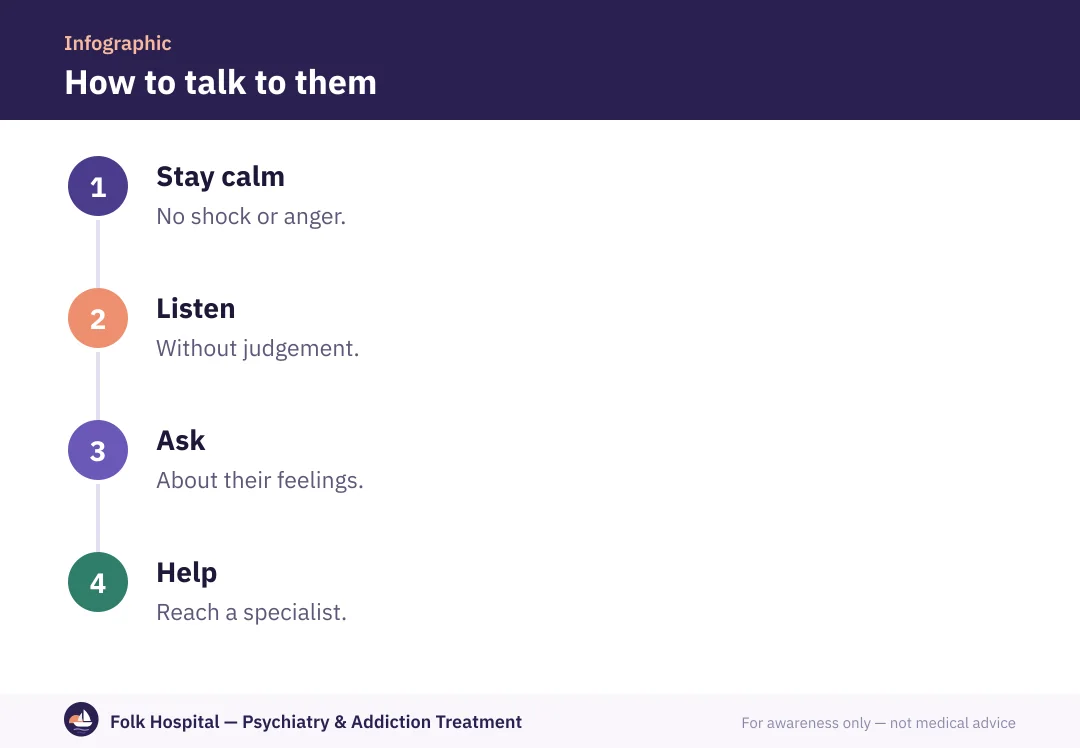
- Calm and care.
- Listening without judgement.
- Seeking specialist help.
Read also: suicidal thoughts, DBT, borderline personality.
؟Frequently asked questions
What is self-harm?
Deliberately hurting one's body as a way of coping with painful feelings.
Is self-harm a suicide attempt?
Not always, but it raises suicide risk and must be taken seriously.
Is it attention-seeking?
No. Most people who self-harm hide it; it expresses real pain.
How is it treated?
With psychotherapy such as DBT and CBT, and treating co-occurring depression, trauma or addiction.
How do I talk to my son or daughter?
Calmly, without anger or punishment; show care and seek specialist assessment.
When should I go to emergency?
With a deep wound, bleeding that won't stop, swallowing medicines or substances, or suicidal thoughts.
Sources and references
- Self-harm — NHS (UK)
- Self-harm — U.S. National Library of Medicine — MedlinePlus
- Suicide Prevention — National Institute of Mental Health (NIMH)

A psychiatrist specialising in addiction and mental illness in adults and adolescents, with a focus on dual diagnosis.
For awareness only — not a substitute for medical advice. Editorial policy · View profile