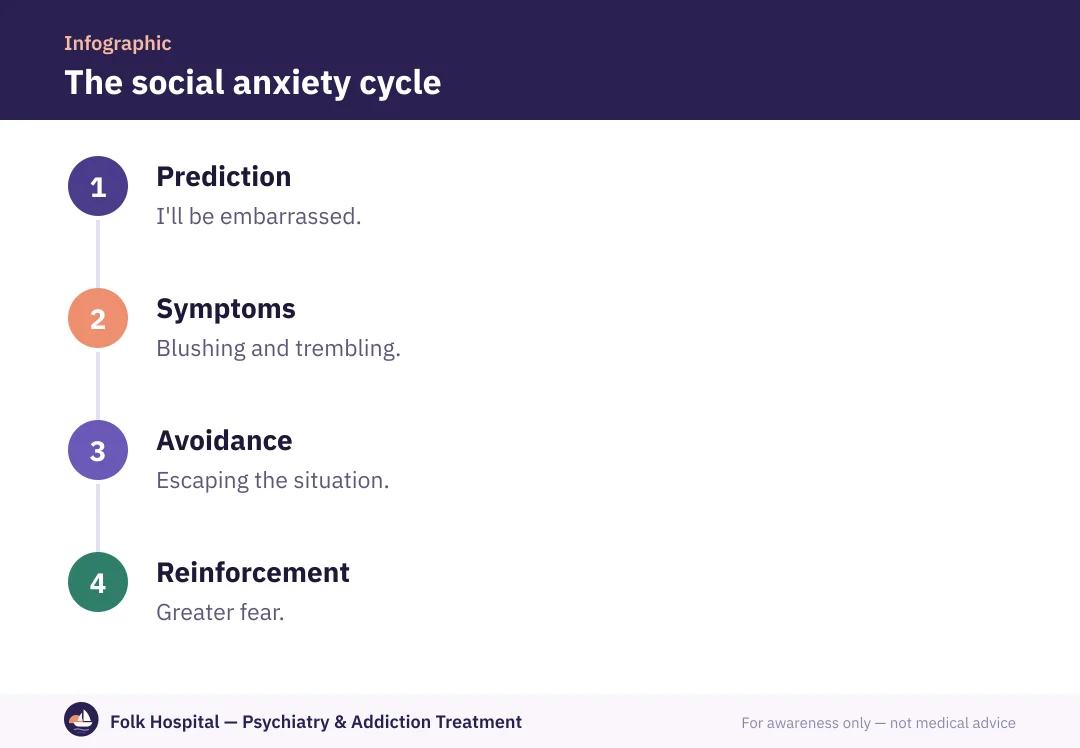
01How social anxiety works
- A social situationa meeting, conversation or event.
- Frightening thoughts«they'll notice I'm nervous» or «I'll say something stupid».
- Physical symptomsblushing, trembling and sweating.
- Safety behavioursavoiding eye contact, saying little, withdrawing.
- Afterwardsruminating over every word, so anxiety grows for next time.
02Feared situations
| Situation | Example |
|---|---|
| Performance | Speaking in a meeting or in front of a class |
| Interaction | Meeting people and starting conversations |
| Being observed | Eating or writing in front of others |
| Evaluation | Interviews and oral exams |
| Assertiveness | Objecting or saying no |
Details in social anxiety symptoms.
03Treatment
What doesn't help long-term
- Avoidance.
- Alcohol or sedatives before situations.
- Waiting for the fear to vanish on its own.
What helps
- Cognitive behavioural therapy.
- Gradual exposure to situations.
- Social skills training when needed.
- Antidepressants in moderate and severe cases.
04What to read next
؟Frequently asked questions
What is social anxiety?
Intense, persistent fear of social situations where one might be evaluated or embarrassed, leading to avoidance and affecting life.
What's the difference between shyness and social anxiety?
Shyness is a common trait that doesn't stop life; social anxiety is intense fear that drives avoidance of important situations and causes suffering.
Is social anxiety treatable?
Yes, with CBT and gradual exposure, sometimes with antidepressants.
When does social anxiety start?
Usually in adolescence; it may begin in childhood as severe shyness.
Does alcohol help in social situations?
It eases anxiety briefly but blocks recovery, leads to dependence and increases anxiety the next day.
How do I know if I have social anxiety?
If fear of embarrassment has kept you from important situations for a long time, consult a specialist; you can start with the social anxiety test.
Sources and references
- Social anxiety (social phobia) — NHS (UK)
- Anxiety Disorders — National Institute of Mental Health (NIMH)
- Anxiety disorders — fact sheet — World Health Organization
- Psychotherapies — National Institute of Mental Health (NIMH)

A psychiatrist specialising in addiction and mental illness in adults and adolescents, with a focus on dual diagnosis.
For awareness only — not a substitute for medical advice. Editorial policy · View profile