01What daily life feels like
Imagine having very thin emotional skin: a passing word or a late reply ignites intense pain that takes a long time to settle. With constant fear that others will leave, and an emptiness whose source you can't name, relationships become a field of anxiety, and quick relief, even through self-harm, becomes tempting.
02Core symptoms
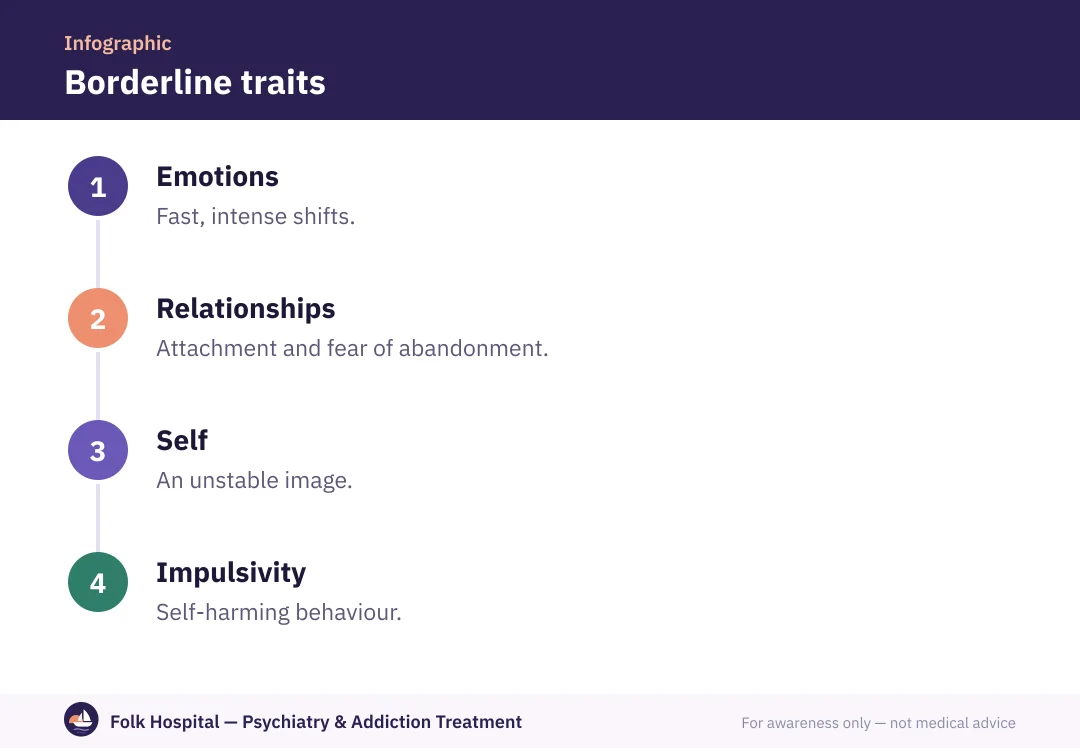
| Area | What appears |
|---|---|
| Emotions | Rapid shifts, intense anger and chronic emptiness |
| Relationships | Fear of abandonment; swinging between closeness and rejection |
| Self-image | Shifting identity and goals |
| Behaviour | Impulsivity, self-harm and suicidal threats |
Details in borderline symptoms.
- Suicidal thoughts or plans, or self-harm.
- Taking a large dose of a medicine or substance.
Mental health hotline: 08008880700.
Ambulance: 12303Treatment
- Full assessmentthe disorder and any accompanying depression, addiction or trauma.
- A safety planfor crises and suicidal thoughts.
- Dialectical behaviour therapyskills for emotion regulation, distress tolerance, relationships and mindfulness.
- Medicines for specific symptomswhen needed, cautiously.
- Involving the familyto understand the disorder and reduce conflict.
Read dialectical behaviour therapy and borderline treatment.
04What to read next
؟Frequently asked questions
What is borderline personality disorder?
A disorder marked by unstable emotions, relationships and self-image, with impulsivity, intense fear of abandonment and sometimes self-harm.
Why is it called borderline?
It was once thought to sit on the border between neurosis and psychosis; the name remains though understanding has changed.
Is BPD treatable?
Yes. DBT and other psychotherapies are effective, and many patients improve clearly.
Is there medication for BPD?
No medicine is approved for the disorder itself, but medicines are used for specific symptoms such as depression, anxiety or impulsivity; psychotherapy is the foundation.
Are people with BPD acting or manipulating?
Usually not. The behaviour expresses real pain and difficulty regulating emotions, even if it looks exaggerated to others.
How do I know if I have it?
Through a specialist psychiatric assessment; self-tests only flag the possibility.
Sources and references
- Borderline Personality Disorder — National Institute of Mental Health (NIMH)
- Personality disorder — NHS (UK)
- Psychotherapies — National Institute of Mental Health (NIMH)

A psychiatrist specialising in addiction and mental illness in adults and adolescents, with a focus on dual diagnosis.
For awareness only — not a substitute for medical advice. Editorial policy · View profile