01Signs
After emotional trauma
- Difficulty trusting others.
- Fear of closeness or over-attachment.
- Repeated thoughts about what happened.
- Self-blame.
- Insomnia and loss of appetite.
Delays recovery
- Numbing with substances or overwork.
- Revenge and monitoring.
- A quick replacement relationship.
Helps
- Expressing feelings.
- Trusted support.
- Psychotherapy.
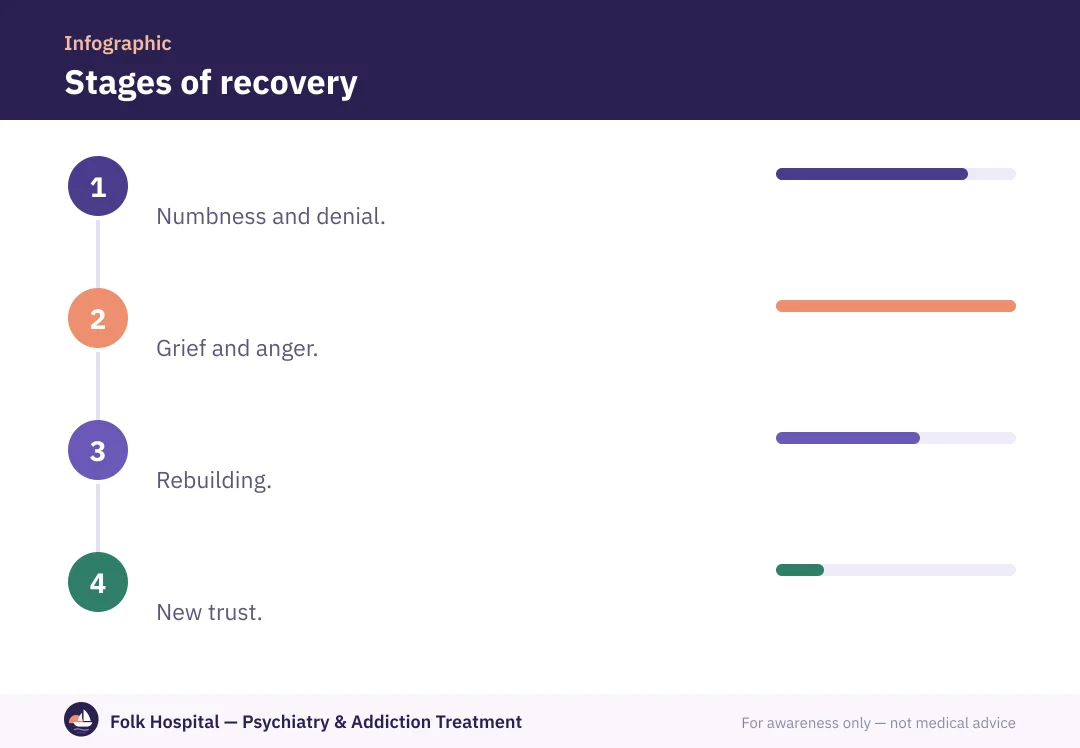
02Stages of recovery
- Acknowledging the painwithout denial.
- Safetydistance from the source of harm.
- Understandingwhat happened without self-blame.
- Rebuildingtrust and relationships gradually.
Read also: psychological trauma, love addiction, low self-esteem.
؟Frequently asked questions
What is emotional trauma?
A deep psychological effect of a painful relational experience such as betrayal, abandonment or abuse.
What are its symptoms?
Difficulty trusting, fear of closeness, low self-esteem, insomnia and emotional swings.
How long does it last?
It varies; many improve within months with support, but it can persist without treatment.
Does it cause depression?
It can lead to depression, anxiety or PTSD.
How do I recover?
By allowing grief, social support, self-care and psychotherapy.
Should I start a new relationship quickly?
Recovering first is better, to avoid repeating painful patterns.
Sources and references
- PTSD (post-traumatic stress disorder) — overview — NHS (UK)
- Post-Traumatic Stress Disorder — National Institute of Mental Health (NIMH)
- Mental disorders — fact sheet — World Health Organization
- PTSD (post-traumatic stress disorder) — overview — NHS (UK)
- Post-Traumatic Stress Disorder — National Institute of Mental Health (NIMH)
- Mental disorders — fact sheet — World Health Organization

A psychiatrist specialising in addiction and mental illness in adults and adolescents, with a focus on dual diagnosis.
For awareness only — not a substitute for medical advice. Editorial policy · View profile