01Main groups
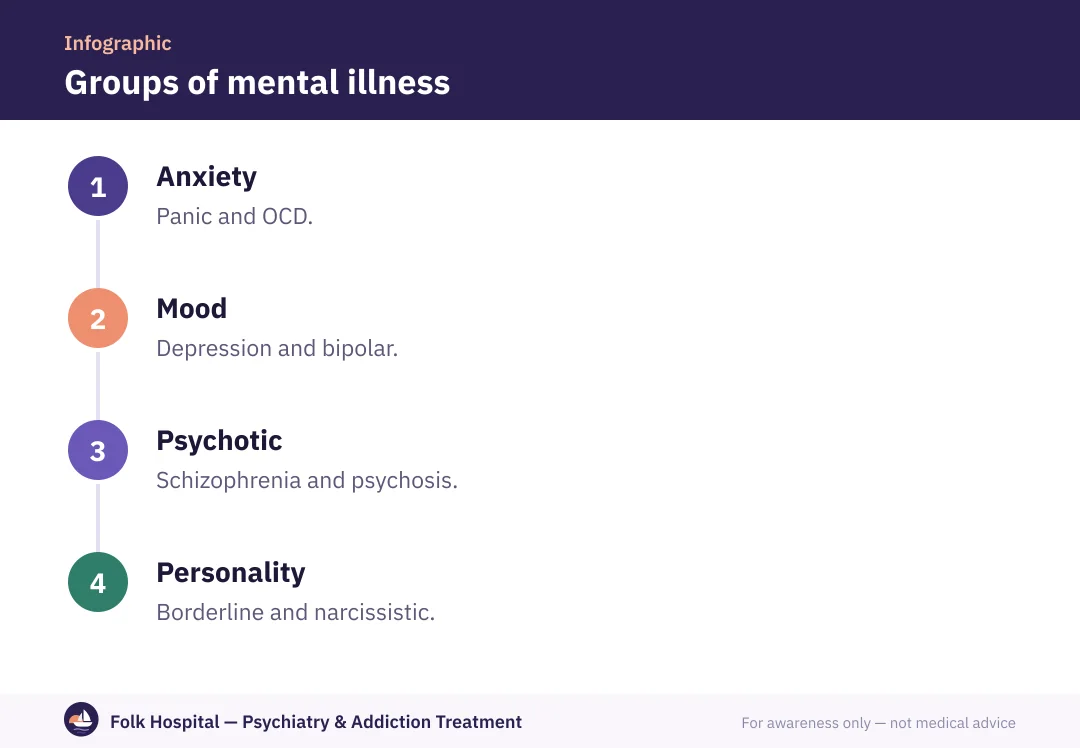
| Group | Examples | Core feature |
|---|---|---|
| Mood disorders | Depression, bipolar | Changes in mood and energy |
| Anxiety disorders | GAD, panic, phobias | Excessive fear and worry |
| Psychotic disorders | Schizophrenia, delusional disorder | Losing touch with reality |
| Personality disorders | Borderline, narcissistic | Fixed patterns in thinking and relationships |
| Psychological states | Stress, burnout, trauma | Response to circumstances |
| Other disorders | ADHD, eating, sleep | Varied |
02How the doctor reaches a diagnosis
- Interviewsymptoms, duration and impact on life.
- Historyfamily, medical and substance use.
- Examinationto rule out physical causes.
- Scalesquestionnaires help but don't decide alone.
- Plantreatment suited to the diagnosis.
Read also: causes of mental illness, mental vs psychological illness, psychological tests.
؟Frequently asked questions
What are the types of mental illness?
Mood, anxiety, psychotic, personality and stress-related conditions, plus others such as eating, sleep, developmental disorders and addiction.
Who makes a psychiatric diagnosis?
A psychiatrist or qualified therapist after interview and full assessment.
Can a person have more than one disorder?
Yes, such as depression with anxiety, or a mental disorder with addiction.
Is a psychiatric diagnosis a stigma?
No. It's a medical description that guides treatment; the person is more than their diagnosis.
Which references are used for classification?
Doctors rely on the International Classification of Diseases and the Diagnostic and Statistical Manual.
Is addiction a mental illness?
Yes. Substance use disorders are classed as mental disorders.
Sources and references
- Mental disorders — fact sheet — World Health Organization
- Mental Disorders — U.S. National Library of Medicine — MedlinePlus
- Mental Health Medications — National Institute of Mental Health (NIMH)

A psychiatrist specialising in addiction and mental illness in adults and adolescents, with a focus on dual diagnosis.
For awareness only — not a substitute for medical advice. Editorial policy · View profile