01Core signs
A persistent pattern of
- Repeatedly breaking laws and norms.
- Lying, deceit and manipulation for personal gain.
- Impulsivity and failure to plan.
- Aggression and fights.
- Recklessness and disregard for the safety of self or others.
- Irresponsibility at work and with money.
- Lack of remorse and justifying harm to others.
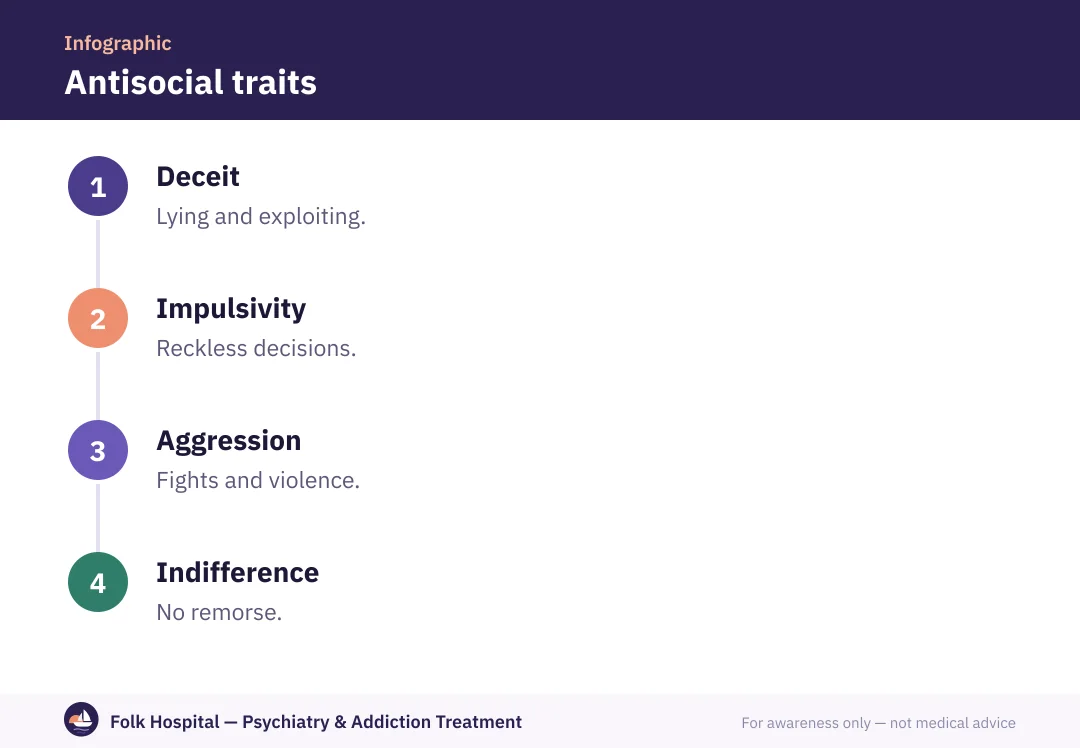
Details in antisocial personality symptoms.
02How it differs from other conditions
| Condition | The difference |
|---|---|
| Occasional criminal behaviour | May not be a lasting pattern since youth |
| Narcissistic personality | Focus on admiration and superiority more than law-breaking |
| Borderline personality | Impulsivity with fear of abandonment, self-harm and remorse |
| Drug effects | Behaviour linked to use and improving with stopping |
03The disorder and addiction
The disorder is strongly linked to addiction, and substances increase impulsivity and violence, so addiction treatment is an important part of the plan. Read antisocial personality and addiction.
- Threats of violence or harm to someone.
- Domestic violence.
- Danger to children.
Call the police on 122 or an ambulance on 123.
Ambulance: 123Read causes of the disorder, its harms and manipulative personality.
؟Frequently asked questions
What is antisocial personality disorder?
A persistent pattern of disregarding others' rights, with lying, deceit, impulsivity, aggression, irresponsibility and lack of remorse, starting in childhood or adolescence.
Is it the same as psychopathy?
They overlap, but psychopathy is a narrower concept focused on emotional coldness and lack of empathy, and isn't a separate formal diagnosis in current classifications.
Is it treatable?
It's hard to treat, but some behavioural programmes reduce violence and substance use, and treating co-occurring addiction matters.
Is it linked to addiction?
Yes, strongly, and addiction increases impulsivity, violence and legal trouble.
Does it improve with age?
Some symptoms, especially impulsivity and aggression, may lessen after middle age.
How do you protect yourself from someone like this?
With clear boundaries, not being taken in by promises, and seeking legal or police help when there's danger.
Sources and references
- Antisocial personality disorder — NHS (UK)
- Personality disorder — NHS (UK)
- Comorbidity: Substance Use and Other Mental Disorders — National Institute on Drug Abuse (NIDA)

A psychiatrist specialising in addiction and mental illness in adults and adolescents, with a focus on dual diagnosis.
For awareness only — not a substitute for medical advice. Editorial policy · View profile