01What happens during a panic attack?
The body has an alarm system that prepares it to fight or flee danger: adrenaline rises, heart and breathing speed up, and muscles tense. In a panic attack this alarm fires without real danger, so the person reads the physical symptoms as catastrophe («my heart will stop», «I'm losing my mind»), fear grows and symptoms intensify in a self-feeding loop. Read adrenaline.
02Common symptoms
Symptoms of an attack
- Palpitations or a racing heart.
- Breathlessness or a choking feeling.
- Chest pain or pressure.
- Dizziness or feeling faint.
- Sweating, trembling, chills or hot flushes.
- Tingling in the limbs.
- A sense of unreality or detachment from yourself.
- Fear of dying, going mad or losing control.
Details in panic attack symptoms.
03What to do during an attack
- Name ittell yourself «this is a panic attack; frightening, but it will pass».
- Breathe slowlyin for 4 seconds, out for 6; a long out-breath calms the body.
- Stay put if you canfleeing teaches the brain the place is dangerous, so attacks recur there.
- Return to your sensesname five things you see, four you can touch and three you hear.
- Don't fight the symptomslet them rise and fall; resisting makes them stronger.
- This is your first attack and your heart has never been checked, especially with cardiac risk factors.
- The chest pain differs from your usual attacks or spreads to the arm or jaw.
- You actually faint, or have weakness on one side.
- Symptoms began after taking stimulants or other substances.
04Panic or heart: how to tell
| Panic attack | Possible heart attack | |
|---|---|---|
| Onset | Sudden, often with fear or stress | With exertion or none, in people with risk factors |
| Peak | Within 10 minutes, then subsides | Pain persists or worsens |
| Type of pain | Sharp or stabbing, often shifting | Pressure or squeezing, may spread to arm or jaw |
| With slow breathing | Usually improves | Doesn't improve |
Don't rely on the table alone: if in doubt, get a medical check.
05Treatment
Cognitive behavioural therapy is the core treatment: the patient learns to interpret symptoms accurately, then gradually faces the sensations and places they fear. The doctor may add an antidepressant from a class that doesn't cause dependence. Sedatives are used only very briefly. Details in panic disorder treatment.
06What to read next
؟Frequently asked questions
What's the difference between a panic attack and panic disorder?
A panic attack is a single event many people experience once in life. Panic disorder is recurrent unexpected attacks with ongoing worry about having more and changes in behaviour to avoid them.
Is a panic attack dangerous?
The attack itself isn't life-threatening despite its intensity, but a first attack or any unusual chest pain needs a medical check to rule out heart or other causes.
How long does a panic attack last?
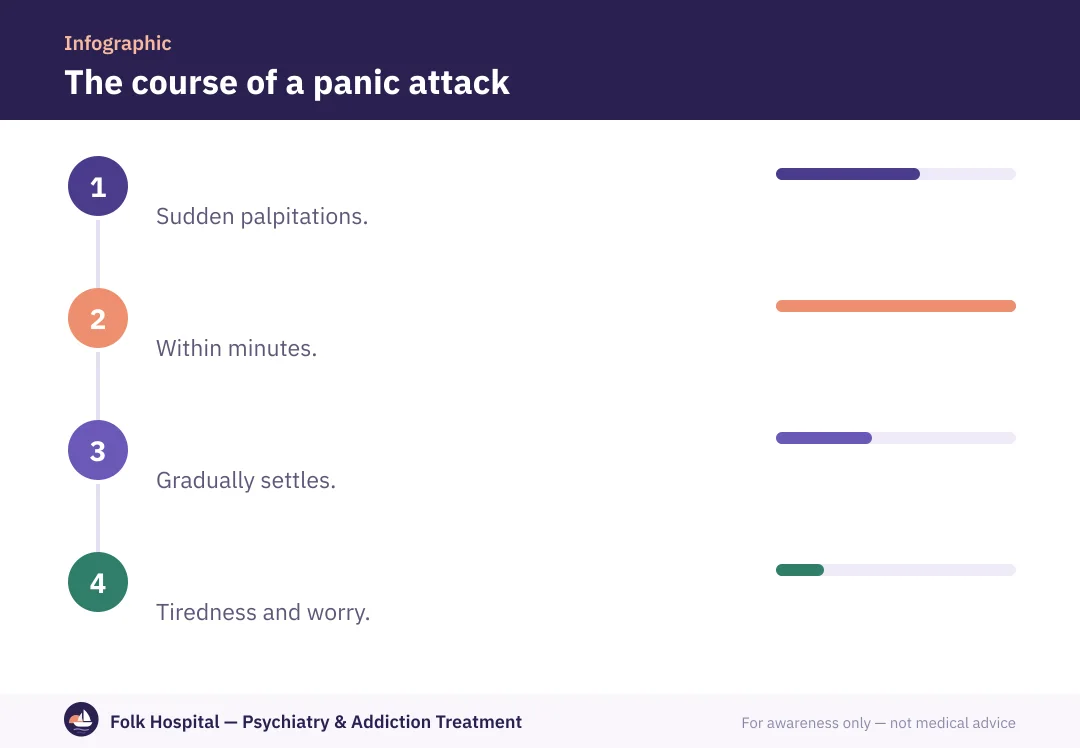
It peaks within about 10 minutes, most subside within 20 to 30 minutes, and tiredness and worry may linger.
Can panic disorder be cured?
Yes. It responds well to treatment, and many patients improve clearly within weeks to months of cognitive behavioural therapy, sometimes with medication.
What should I do during an attack?
Breathe slowly, remind yourself it's a panic attack and will pass, try to stay where you are rather than flee, and ground yourself through your senses.
Are sedatives a treatment for panic?
They may be used very briefly on a doctor's decision, but they're not a long-term treatment because they can cause dependence. The main treatment is psychological, with suitable antidepressants when needed.
Sources and references
- Panic disorder — NHS (UK)
- Anxiety Disorders — National Institute of Mental Health (NIMH)
- Anxiety disorders — fact sheet — World Health Organization
- Psychotherapies — National Institute of Mental Health (NIMH)

A psychiatrist specialising in addiction and mental illness in adults and adolescents, with a focus on dual diagnosis.
For awareness only — not a substitute for medical advice. Editorial policy · View profile