01Normal response or disorder
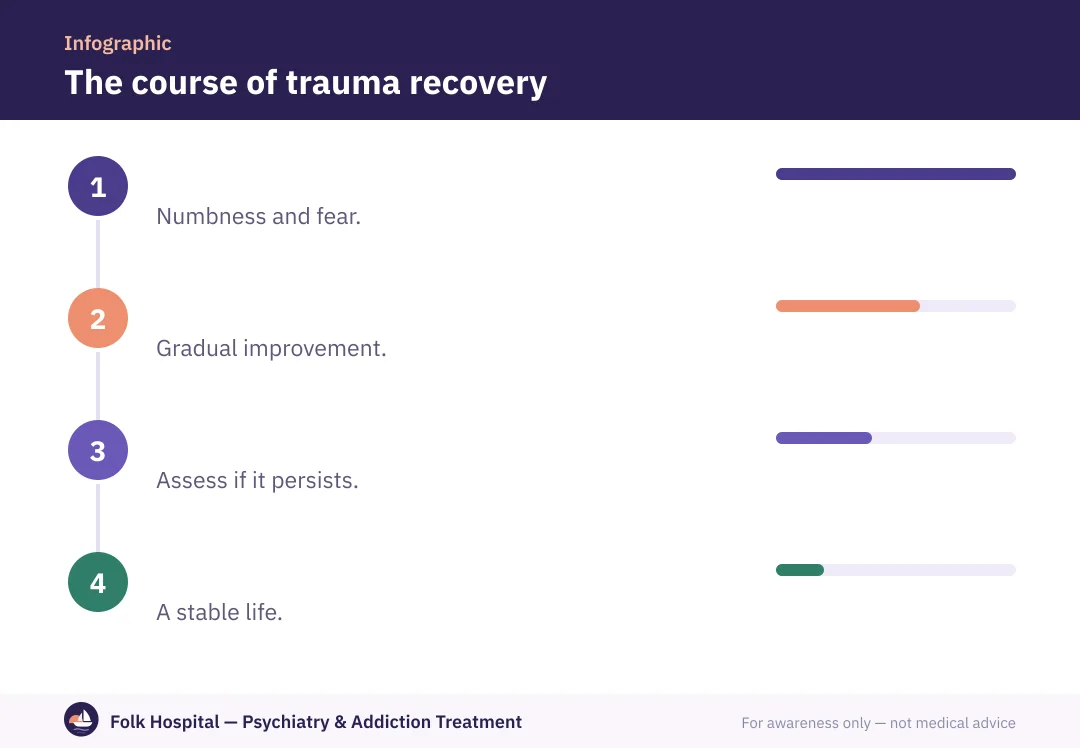
| Acute response | PTSD | |
|---|---|---|
| Timing | Days and weeks | Over a month |
| Severity | Settles gradually | Persists or worsens |
| Life | Returns gradually | Disrupted |
02Right after the event
- Safetyfirst.
- Supportbeing with trusted people.
- Basicssleep and food.
- Avoid substancesalcohol and non-prescribed sedatives.
- Follow-upseek assessment if symptoms persist.
- Suicidal thoughts or intent to harm yourself or others.
- Losing touch with reality or severe agitation.
In Egypt call the ambulance on 123 or the mental-health hotline 08008880700.
Ambulance: 123Read also: PTSD, emotional trauma, PTSD test.
؟Frequently asked questions
What is psychological trauma?
The effect of a threatening or terrifying event beyond a person's coping ability.
What are the first symptoms?
Shock, fear, insomnia, nightmares and hypervigilance.
When does it become PTSD?
When symptoms last over a month and disrupt life.
Are children affected?
Yes, and symptoms may show in behaviour, play and sleep.
How is trauma linked to addiction?
Many use substances to numb memories, complicating the condition.
How is it treated?
With trauma-focused CBT and other specialist therapies, and medication when needed.
Sources and references
- PTSD (post-traumatic stress disorder) — overview — NHS (UK)
- Post-Traumatic Stress Disorder — National Institute of Mental Health (NIMH)
- Mental disorders — fact sheet — World Health Organization
- PTSD (post-traumatic stress disorder) — overview — NHS (UK)
- Post-Traumatic Stress Disorder — National Institute of Mental Health (NIMH)
- Mental disorders — fact sheet — World Health Organization

A psychiatrist specialising in addiction and mental illness in adults and adolescents, with a focus on dual diagnosis.
For awareness only — not a substitute for medical advice. Editorial policy · View profile