01Types of hallucinations
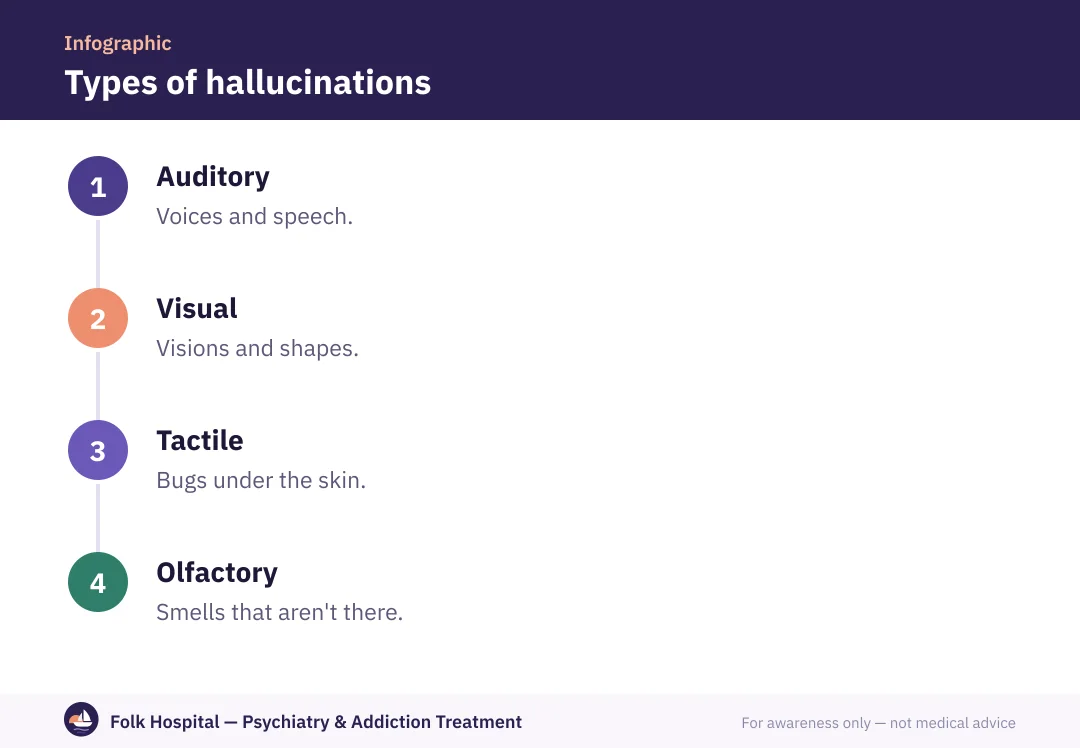
| Type | What happens | Common causes |
|---|---|---|
| Auditory | Voices talking, commenting or commanding | Schizophrenia, psychosis, bipolar disorder, psychotic depression |
| Visual | Seeing people, animals or lights | Drugs, alcohol withdrawal, fever, dementia, epilepsy |
| Tactile | Insects on or under the skin | Stimulants, alcohol withdrawal |
| Smell and taste | Strange odours or tastes | Epilepsy, some brain disorders |
| On falling asleep or waking | Brief images or sounds | Usually normal |
02When are hallucinations normal?
- When falling asleep or waking: hearing your name or a fleeting image.
- After a bereavement: sensing the person's presence or hearing their voice for a while.
- With severe sleep deprivation or exhaustion.
In these cases they're brief, and the person usually knows they aren't real.
03When are they a sign of illness?
Signs that call for assessment
- Repeated or persistent hallucinations.
- Complete conviction that they're real.
- Voices commanding actions or threatening.
- Accompanying suspicion, delusions or changed behaviour.
- Accompanying confusion, fever or severe headache.
- Threats to harm themselves or others.
- Severe agitation or violence.
- High fever, seizures or marked confusion.
- Visual hallucinations with tremor and sweating after stopping alcohol.
Mental health hotline: 08008880700.
Ambulance: 12304Treatment by cause
Read causes of hallucinations, hallucination treatment, psychosis, drug-induced psychosis and alcohol withdrawal.
؟Frequently asked questions
What are hallucinations?
Perceiving something that isn't there through a sense, such as hearing voices or seeing things others don't, with a feeling that it's real.
Are hallucinations always a sign of madness?
No. Hallucinations on falling asleep or waking are normal, and they can occur with fever, sleep deprivation or grief. Persistent hallucinations need assessment.
What's the difference between auditory and visual hallucinations?
Auditory ones are commoner in schizophrenia and psychosis; visual ones are commoner with drugs, withdrawal and physical illnesses such as dementia and fever.
Do drugs cause hallucinations?
Yes, especially hallucinogens, stimulants and synthetic cannabinoids, and withdrawal from alcohol and sedatives.
What is delirium tremens?
An emergency during severe alcohol withdrawal, with confusion, hallucinations, tremor, sweating and fever, needing hospital care immediately.
How are hallucinations treated?
By treating the cause: antipsychotics for psychosis, medical detox for withdrawal, treatment of physical illness, plus psychological support.
Sources and references
- Psychosis — NHS (UK)
- Schizophrenia — National Institute of Mental Health (NIMH)
- Alcohol withdrawal — U.S. National Library of Medicine — MedlinePlus

A psychiatrist specialising in addiction and mental illness in adults and adolescents, with a focus on dual diagnosis.
For awareness only — not a substitute for medical advice. Editorial policy · View profile