01Signs
For six months or more
- Frequent temper outbursts.
- Constant arguing with parents and teachers.
- Deliberate defiance of rules.
- Deliberately annoying others.
- Blaming others for mistakes.
- Spite and vindictiveness.
Makes it worse
- Shouting and harsh punishment.
- Backing down on rules under pressure.
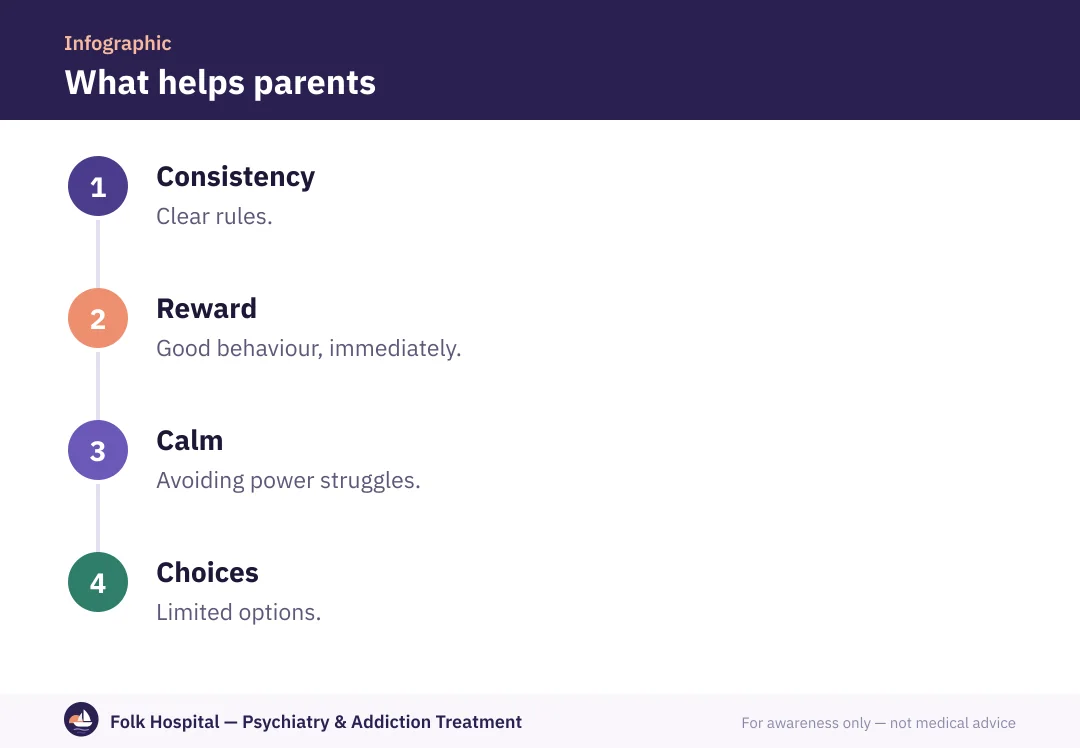
Helps
- Few, consistent rules.
- Praising good behaviour immediately.
- Calm, predictable consequences.
02Treatment plan
- Assessmentruling out ADHD, anxiety and depression.
- Parent trainingconsistent, positive methods.
- Child therapyanger-control skills.
- School coordinationa shared plan.
Read also: children's mental health, ADHD, anger.
؟Frequently asked questions
What is ODD?
A persistent pattern of anger, arguing, defying rules and vindictiveness in a child for at least six months.
How does it differ from normal stubbornness?
Normal stubbornness is intermittent and a phase; ODD is severe, persistent and disrupts family and school.
What causes it?
A mix of the child's temperament, genetic factors, parenting styles and family stress.
How is it treated?
Parent training in consistent methods, behavioural therapy for the child, and treating co-occurring conditions.
Does it need medication?
There's no specific medicine, but treating co-occurring ADHD can help.
Does it lead to addiction?
Untreated, it can develop into conduct disorder, raising substance-use risk in adolescence.
Sources and references
- Oppositional defiant disorder — MedlinePlus — U.S. National Library of Medicine — MedlinePlus
- Child Behavior Disorders — U.S. National Library of Medicine — MedlinePlus
- Oppositional defiant disorder — MedlinePlus — U.S. National Library of Medicine — MedlinePlus
- Child Behavior Disorders — U.S. National Library of Medicine — MedlinePlus

A psychiatrist specialising in addiction and mental illness in adults and adolescents, with a focus on dual diagnosis.
For awareness only — not a substitute for medical advice. Editorial policy · View profile