01Types of tic
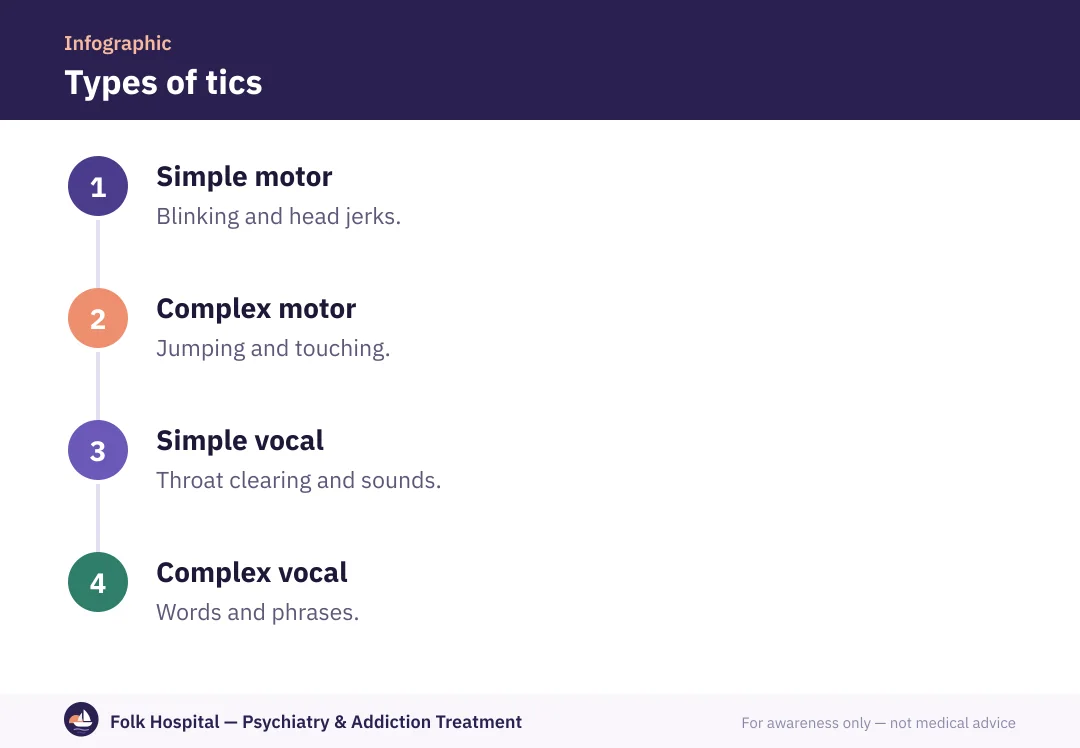
| Type | Simple | Complex |
|---|---|---|
| Motor | Blinking, head jerks, shoulder shrugs | Jumping, touching objects, sequences of movements |
| Vocal | Throat clearing, sniffing, short sounds | Repeating words or phrases, rarely inappropriate words |
Details in Tourette symptoms.
02What increases tics?
Increases them
- Stress and anxiety.
- Fatigue and lack of sleep.
- Intense excitement.
- Drawing attention to the tics.
Reduces them
- Focusing on an enjoyable activity.
- Calm and rest.
- Enough sleep.
- People around ignoring the tics.
03Treatment
- Educationfor the child, family and school.
- Behavioural therapy for ticstraining a competing response.
- Treating co-occurring conditionsADHD, OCD or anxiety.
- Medicationfor severe tics that cause harm or disrupt life.
Read Tourette treatment, ADHD and OCD.
؟Frequently asked questions
What is Tourette syndrome?
A neurological disorder starting in childhood, with repeated involuntary motor and vocal tics lasting over a year.
Does Tourette mean involuntary swearing?
No. Involuntary swearing occurs in only a minority of people with it.
Can a child control their tics?
They may suppress them briefly with effort, but they usually return stronger; they aren't a choice.
Can Tourette be cured?
There's no cure, but tics ease for many after adolescence, and effective behavioural and medical treatments exist.
What conditions accompany Tourette?
ADHD, OCD, anxiety and learning difficulties.
How should I treat a child with Tourette?
Ignore the tics as much as possible, don't blame or imitate them, inform the school and focus on reducing stress.
Sources and references
- Tourette's syndrome — NHS (UK)
- Obsessive-Compulsive Disorder — National Institute of Mental Health (NIMH)

A psychiatrist specialising in addiction and mental illness in adults and adolescents, with a focus on dual diagnosis.
For awareness only — not a substitute for medical advice. Editorial policy · View profile