01What distinguishes pathological narcissism?
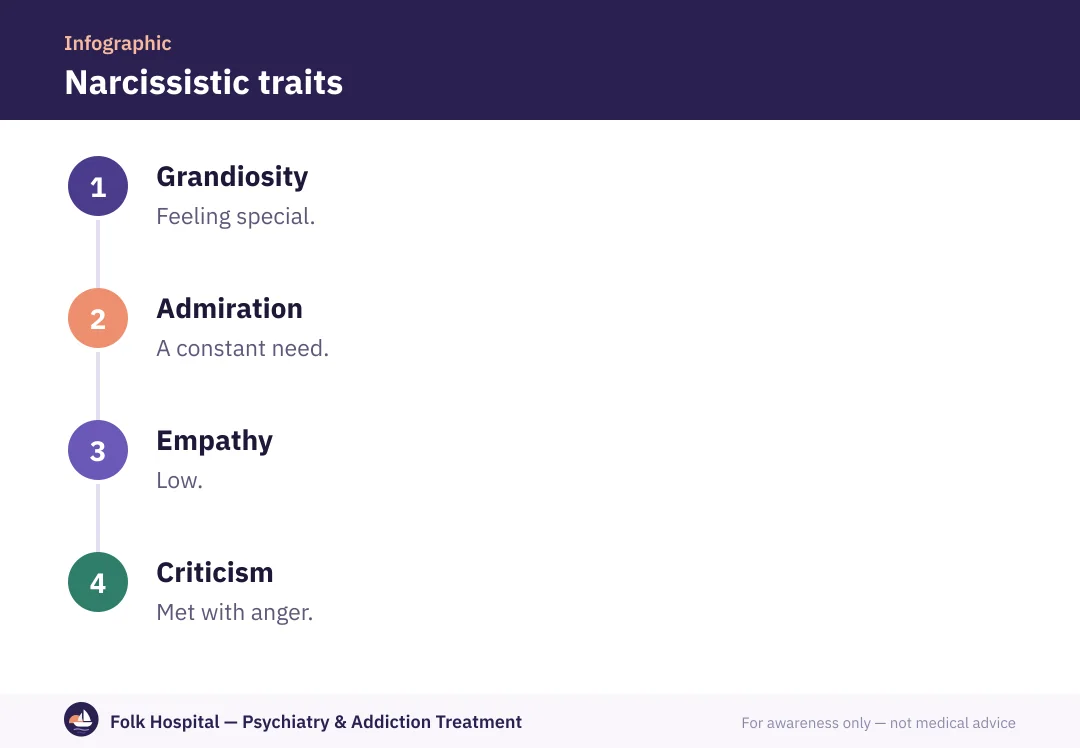
| Healthy confidence | Pathological narcissism |
|---|---|
| Valuing oneself while seeing faults | An inflated self-image that admits no faults |
| Accepting constructive criticism | Rage or collapse in the face of criticism |
| Empathy for others | Limited empathy and exploiting others |
| Success without constant admiration | A constant need for admiration and superiority |
02Overt and covert narcissism
Overt narcissism
- Boasting and love of the spotlight.
- Dominating conversations.
- Obvious arrogance.
Covert narcissism
- Extreme sensitivity to criticism.
- Feeling wronged and unappreciated.
- Withdrawal and silent envy.
Details in narcissism symptoms.
03Narcissism and co-occurring problems
The disorder may come with depression after failure or rejection, addiction to alcohol or stimulants, and anxiety. These are often the reasons people seek help.
- Suicidal thoughts after failure or losing a relationship.
- Violence or threats within the family.
Hotline 08008880700; ambulance 123.
Ambulance: 12304Treatment
There's no medicine for narcissism itself. Treatment rests on psychotherapy to understand the fragility behind the inflated image and improve relationships, plus treatment of any depression or addiction.
05What to read next
؟Frequently asked questions
What is narcissistic personality disorder?
A persistent pattern of inflated self-importance, need for admiration and limited empathy that affects relationships and work.
Is every arrogant person a narcissist?
No. Arrogance or overconfidence are common traits; the disorder is a severe, lasting pattern causing clear problems.
Does a narcissist know they are one?
Usually they don't see the problem in themselves and blame others, though some recognise certain traits.
Is narcissism treatable?
It's difficult but possible, especially with long-term psychotherapy when the person is motivated to change.
Is narcissism hereditary?
Genes play a role in temperament, but early experiences such as neglect, over-indulgence or harsh criticism matter.
What types of narcissism are there?
People speak of overt, grandiose narcissism and covert, fragile, sensitive narcissism; the formal diagnosis is single.
Sources and references
- Personality disorder — NHS (UK)
- Psychotherapies — National Institute of Mental Health (NIMH)

A psychiatrist specialising in addiction and mental illness in adults and adolescents, with a focus on dual diagnosis.
For awareness only — not a substitute for medical advice. Editorial policy · View profile