01Addiction or adaptation?
| Addiction | Physical adaptation | |
|---|---|---|
| Craving | Present | Absent |
| Self-escalating doses | Common | Absent |
| Continuing despite harm | Yes | No |
| Symptoms on sudden stopping | Yes | Yes |
| Solution | Addiction treatment | Gradual tapering |
02Medicines by dependence risk
Real dependence risk
- Benzodiazepine sedatives.
- Similar sleeping pills.
- Stimulants when misused.
- Librax, as it contains a sedative.
Not addictive
- Antidepressants.
- Antipsychotics.
- Mood stabilisers such as Lamictal.
- Buspar.
03Common myths
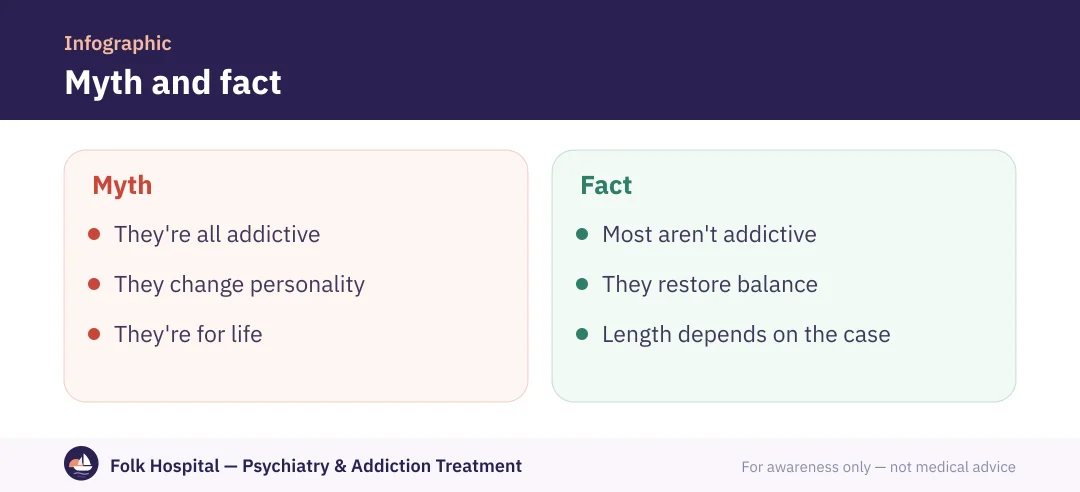
- «Psychiatric medicine is a narcotic»most medicines cause no high or craving.
- «I'll be hooked forever»they can be stopped with a gradual plan.
- «Medicine is only for the insane»it's used for common conditions like anxiety and depression.
- «Herbs are safer»some interact dangerously with medicines.
Read the psychiatric medicines guide, antidepressant withdrawal and sedative addiction.
؟Frequently asked questions
Are psychiatric medicines addictive?
Most aren't; the key exceptions are benzodiazepine sedatives and some stimulants when misused.
What's the difference between addiction and adaptation?
Addiction is craving and compulsive use despite harm; adaptation is the body adjusting, causing withdrawal when stopped suddenly.
Will I need medicine for life?
Not necessarily. Many stop after a stable period with a plan; some chronic conditions need longer treatment.
Do psychiatric medicines damage the brain?
No. Evidence suggests treating the illness protects the brain and life from the effects of untreated illness.
Why do I get symptoms when I miss a dose?
Because the body has adapted, especially with short-acting medicines; that isn't addiction.
Can addiction be treated with psychiatric medicines?
Yes. Some medicines help with withdrawal, relapse prevention and co-occurring disorders.
Sources and references
- Mental Health Medications — National Institute of Mental Health (NIMH)
- Antidepressants — overview — NHS (UK)
- Prescription Medicines — research topic — National Institute on Drug Abuse (NIDA)
- Mental Health Medications — National Institute of Mental Health (NIMH)
- Antidepressants — overview — NHS (UK)
- Prescription Medicines — research topic — National Institute on Drug Abuse (NIDA)

A psychiatrist specialising in addiction and mental illness in adults and adolescents, with a focus on dual diagnosis.
For awareness only — not a substitute for medical advice. Editorial policy · View profile