01Signs
May include
- Memory gaps for everyday events.
- Finding things they don't remember buying.
- Sensing internal voices or identities.
- Depersonalisation and derealisation.
- Depression, anxiety and sometimes self-harm.
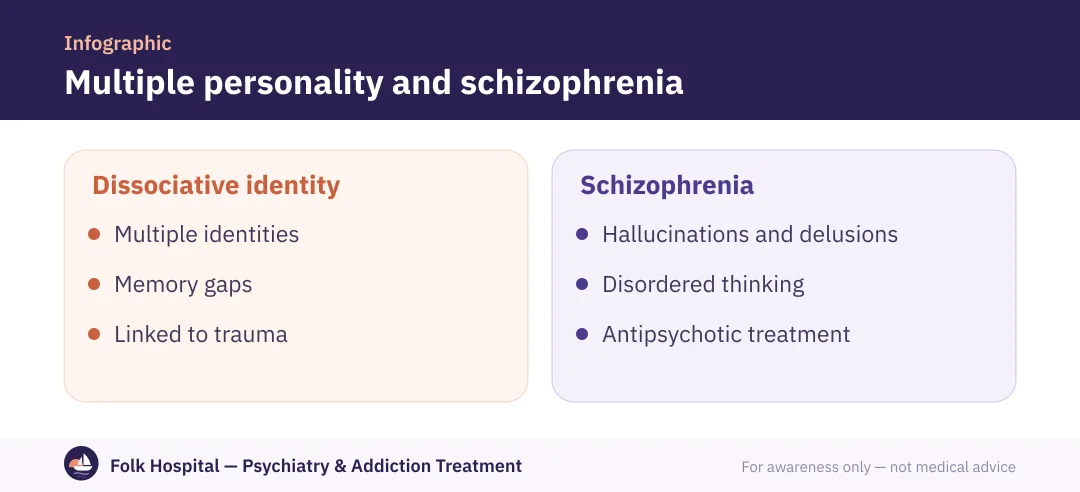
| DID | Schizophrenia | |
|---|---|---|
| Origin | Trauma | Biological and genetic factors |
| Memory | Gaps | Not a core feature |
| Psychosis | Usually not | Yes |
02Treatment
- Safety and stabilisationfirst.
- Skillsemotion regulation and grounding.
- Trauma processinggradually.
- Integrationimproving communication between states.
- Suicidal thoughts or intent to harm yourself or others.
- Losing touch with reality or severe agitation.
In Egypt call the ambulance on 123 or the mental-health hotline 08008880700.
Ambulance: 123Read also: depersonalisation, PTSD, psychological trauma.
؟Frequently asked questions
What is DID?
Two or more identity states taking turns in control, with memory gaps.
Is it schizophrenia?
No. Schizophrenia is an entirely different psychotic disorder.
What causes it?
It's linked to severe, repeated childhood trauma as a way of coping with pain.
Is it real?
Yes, it's a recognised diagnosis, though rare and debated in diagnosis.
How is it treated?
With long-term specialist psychotherapy focused on safety, stabilisation and trauma processing.
Is it linked to addiction?
Yes. Substance use and self-harm are common and need integrated treatment.
Sources and references
- Dissociative disorders — NHS (UK)
- Post-Traumatic Stress Disorder — National Institute of Mental Health (NIMH)
- Dissociative disorders — NHS (UK)
- Post-Traumatic Stress Disorder — National Institute of Mental Health (NIMH)

A psychiatrist specialising in addiction and mental illness in adults and adolescents, with a focus on dual diagnosis.
For awareness only — not a substitute for medical advice. Editorial policy · View profile