01What happens in schizophrenia?
Schizophrenia is linked to disrupted function in certain brain circuits and messengers, especially dopamine and glutamate, and to changes in brain development that start years before symptoms. The result is difficulty telling inner thoughts from outer reality, and organising thinking and motivation. Read dopamine and glutamate.
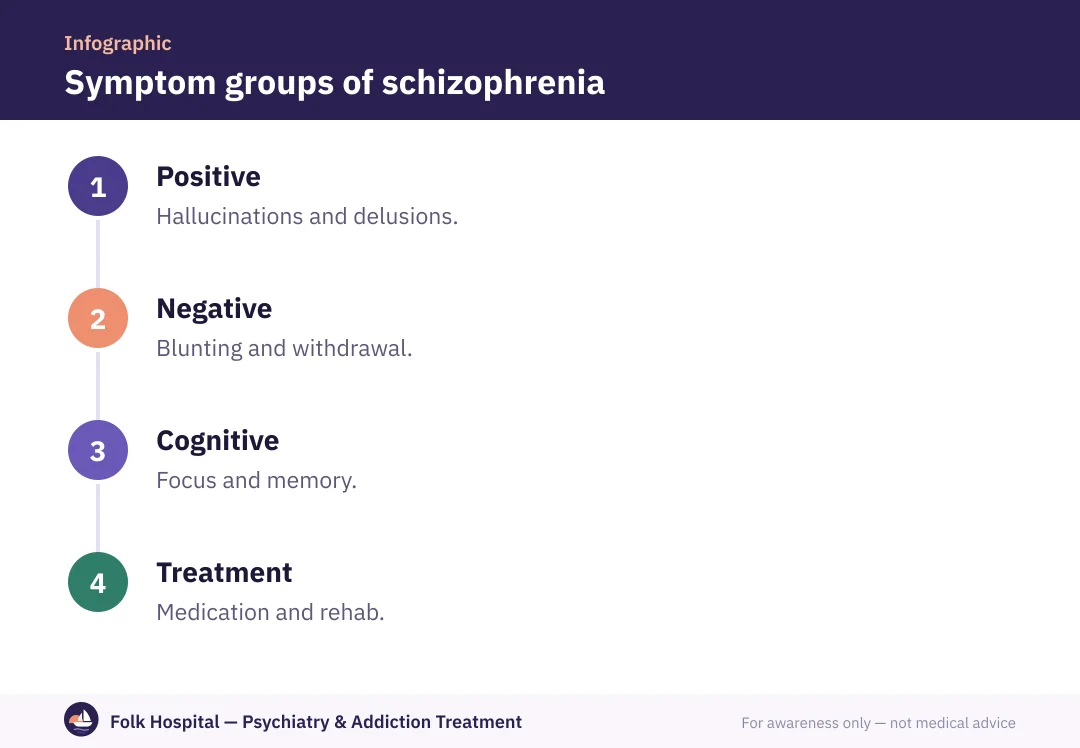
02Symptom groups
| Group | Examples |
|---|---|
| Positive | Auditory hallucinations, persecutory or referential delusions, disorganised speech |
| Negative | Flat emotion, little speech, lost motivation, withdrawal |
| Cognitive | Poor concentration and working memory, difficulty planning |
Details in schizophrenia symptoms.
03Stages of the illness
- Early stagewithdrawal, slipping at school, odd ideas and poor sleep.
- Acute episodeclear hallucinations and delusions and a big change in behaviour.
- Recovery stagepositive symptoms improve with treatment; negative ones may remain.
- Stability and follow-uplong-term treatment, rehabilitation and relapse prevention.
- Talk of suicide or harming themselves or others.
- Acting on commands from voices.
- Refusing food and drink or severe self-neglect.
- Severe agitation, or confusion with fever after a new medicine.
Mental health hotline: 08008880700.
Ambulance: 12304Treatment
It rests on regular antipsychotics, sometimes long-acting injections for those who find daily tablets hard, plus psychological therapy, vocational and social rehabilitation and family education. Clozapine is used for cases that don't respond to two treatments. Read schizophrenia treatment and antipsychotics.
05What to read next
؟Frequently asked questions
What is schizophrenia?
A chronic mental disorder causing hallucinations, delusions and disordered thinking, with flat emotion, withdrawal and concentration problems, affecting daily life.
Is schizophrenia a split personality?
No. Schizophrenia doesn't mean multiple personalities; «split personality» is a popular name for dissociative identity disorder, a different condition.
Can schizophrenia be cured?
It's usually chronic, but it's managed successfully with treatment, and a share of patients improve greatly and live independently.
Are people with schizophrenia violent?
Most aren't, and they're more likely to be victims. The risk of violence rises with drug use and lack of treatment.
Is schizophrenia hereditary?
Genes play an important role: a first-degree relative raises the risk, but doesn't make it inevitable.
Does someone with schizophrenia need medication for life?
Many need long-term treatment to prevent relapse; the doctor decides dose and duration case by case.
Sources and references
- Schizophrenia — overview — NHS (UK)
- Schizophrenia — National Institute of Mental Health (NIMH)
- Schizophrenia — fact sheet — World Health Organization

A psychiatrist specialising in addiction and mental illness in adults and adolescents, with a focus on dual diagnosis.
For awareness only — not a substitute for medical advice. Editorial policy · View profile