
01Signs
You may notice
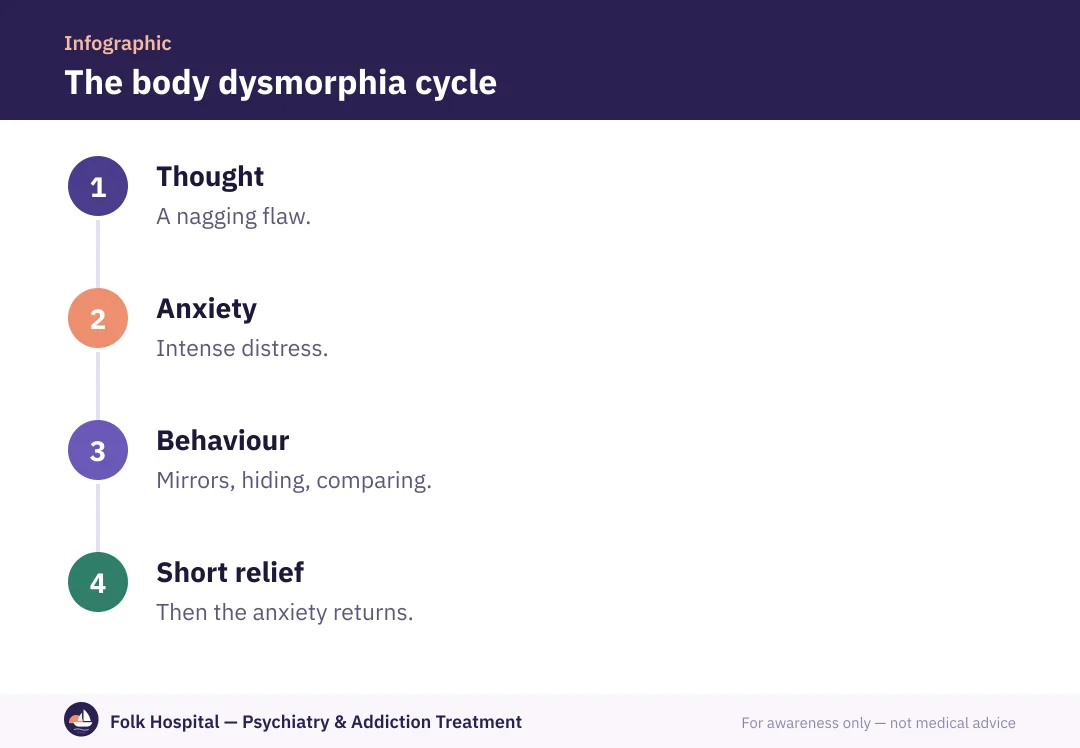
- Long mirror-checking or avoiding mirrors entirely.
- Hiding a body part with clothes or make-up.
- Constant comparison with others.
- Seeking reassurance about appearance.
- Repeated cosmetic procedures.
| Normal concern for appearance | BDD | |
|---|---|---|
| Time | Little | Hours daily |
| Impact | Not disabling | Disrupts life |
| Satisfaction after change | Present | Brief or absent |
- Suicidal thoughts or intent to harm yourself or others.
- Losing touch with reality or severe agitation.
In Egypt call the ambulance on 123 or the mental-health hotline 08008880700.
Ambulance: 123Read also: OCD, anabolic steroids, eating disorders.
؟Frequently asked questions
What is BDD?
Constant preoccupation with an imagined or slight flaw, with repetitive behaviours like checking and hiding.
Does cosmetic surgery fix it?
Usually not; the preoccupation moves to another area or dissatisfaction remains.
How is it related to OCD?
They share repetitive thoughts and compulsions and are classed together.
What is muscle dysmorphia?
A form, mostly in men, of feeling the body is too small, which can lead to steroids.
How is it treated?
With CBT using exposure and response prevention, and antidepressants.
Is it dangerous?
It can cause severe depression and suicidal thoughts, needing serious attention.
Sources and references
- Body dysmorphic disorder (BDD) — NHS (UK)
- Obsessive-Compulsive Disorder — National Institute of Mental Health (NIMH)
- Body dysmorphic disorder (BDD) — NHS (UK)
- Obsessive-Compulsive Disorder — National Institute of Mental Health (NIMH)

A psychiatrist specialising in addiction and mental illness in adults and adolescents, with a focus on dual diagnosis.
For awareness only — not a substitute for medical advice. Editorial policy · View profile