01Degrees of paranoia
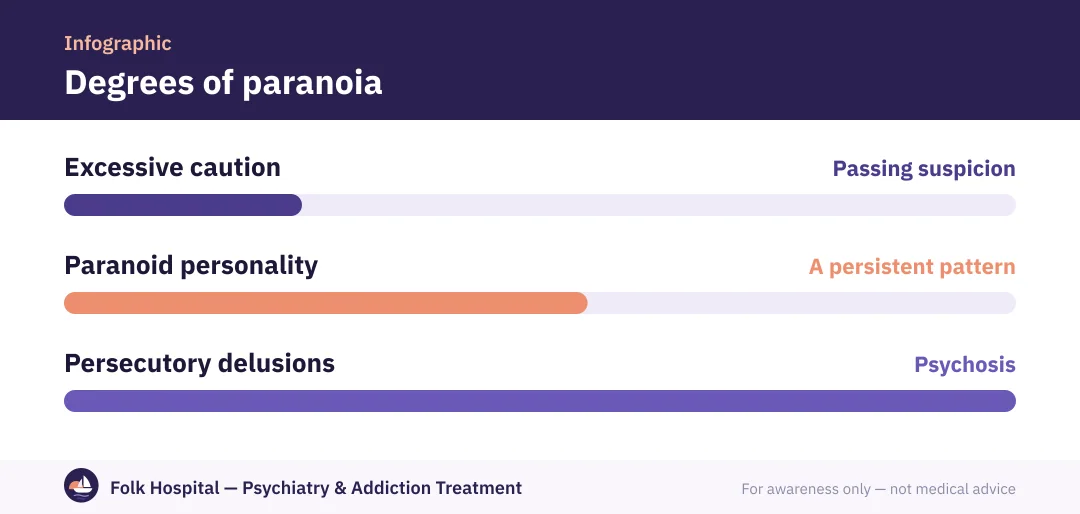
| Degree | What happens | Examples |
|---|---|---|
| Passing suspicion | Occurs under stress or fatigue and fades | «Are they talking about me?» then forgotten |
| Paranoid traits | Persistent suspicion of motives affecting relationships | Paranoid personality |
| Persecutory delusions | Fixed conviction of a plot, unchanged by evidence | Psychosis, schizophrenia, delusional disorder |
02Common causes
- Drugs: shabu, captagon, hashish and strox. Read hashish paranoia.
- Sleep loss and severe exhaustion.
- Stress and trauma, including real betrayal or harm.
- Mental disorders: psychosis, schizophrenia, severe depression and bipolar disorder.
- Physical causes in older people, such as dementia.
03Signs
Signs you may notice
- Reading ordinary words and actions as hostile.
- Difficulty trusting even close people.
- Constantly checking phones or belongings.
- Feeling watched or followed.
- Holding grudges and not forgiving.
- Withdrawing for protection from «danger».
Details in paranoia symptoms.
- Threats to harm those they believe are plotting against them.
- Carrying a weapon «for self-defence» because of suspicion.
- Refusing food for fear of poisoning.
- Suspicion with hallucinations or after stimulant use.
Call an ambulance on 123 or the hotline on 08008880700.
Ambulance: 12304Treatment
It starts by determining the degree and cause, then stopping substances, cognitive behavioural therapy that helps test thoughts, and antipsychotics if there are delusions. Read paranoia treatment and pathological jealousy.
؟Frequently asked questions
What is paranoia?
Excessive, unjustified suspicion that others mean harm or deception, ranging from a personality trait to a fixed delusion in psychosis.
Is paranoia a mental illness?
It can be a symptom of disorders such as schizophrenia, delusional disorder or paranoid personality disorder, or a drug effect; it isn't always a diagnosis in itself.
Does hashish cause paranoia?
Yes. Hashish, especially strong strains, is a common cause of suspicion and anxiety, which can develop into psychosis in some.
How do I deal with a suspicious person?
Calmly and clearly, without arguing about or confirming their suspicions, respecting their feelings, and encouraging a psychiatric assessment if it affects their life.
Is paranoia treatable?
Yes, by treating the cause, cognitive behavioural therapy, antipsychotics in psychotic cases, and stopping drugs.
What's the difference between caution and paranoia?
Caution is proportionate to reality and changes with evidence; paranoia is exaggerated and fixed despite contrary evidence.
Sources and references
- Psychosis — NHS (UK)
- Schizophrenia — National Institute of Mental Health (NIMH)
- Personality disorder — NHS (UK)
- Methamphetamine — research topic — National Institute on Drug Abuse (NIDA)

A psychiatrist specialising in addiction and mental illness in adults and adolescents, with a focus on dual diagnosis.
For awareness only — not a substitute for medical advice. Editorial policy · View profile