01What does «spectrum» mean?
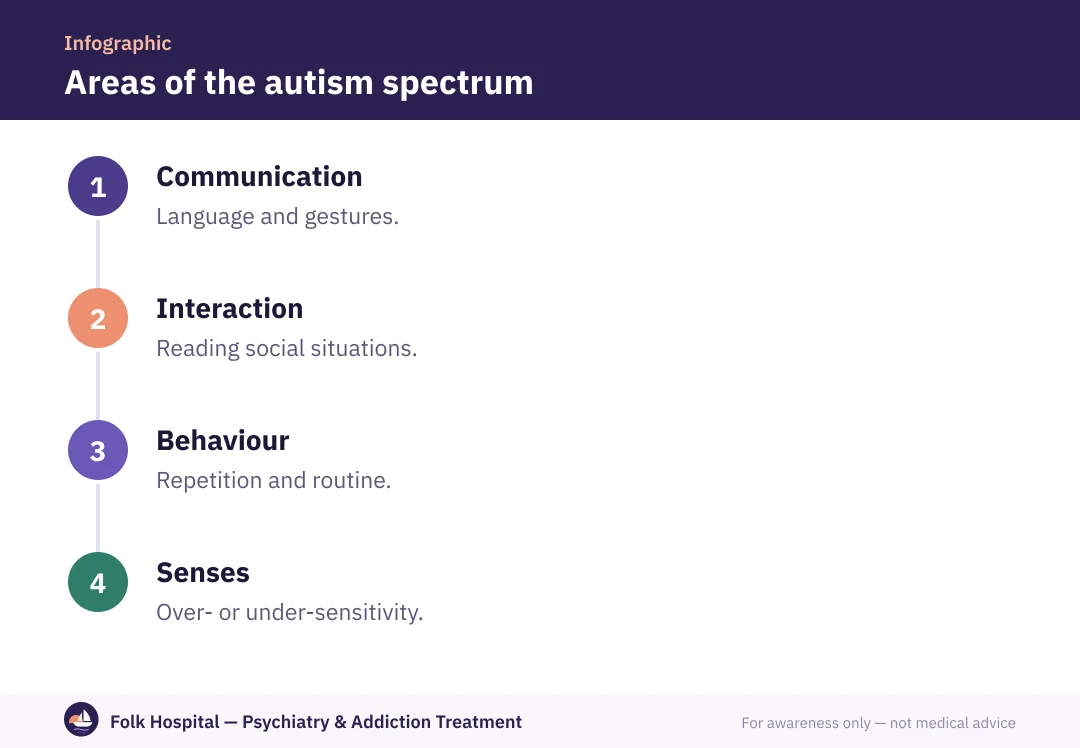
No two autistic people are alike. Some don't speak and need constant care; others speak fluently and excel in particular areas but find the unwritten social rules hard. So doctors now describe the level of support needed rather than the old subtypes. Read levels of autism.
02The two core areas
| Area | Examples |
|---|---|
| Communication and social interaction | Limited eye contact, difficulty reading feelings and cues, difficulty making friends |
| Behaviours and interests | Repetitive movements, insistence on routine, narrow intense interests, sensitivity to sounds or textures |
Details in autism symptoms.
03Early signs worth assessing
See the doctor if you notice
- Not responding to their name by around one year.
- Not pointing or sharing interest.
- Delayed speech or losing words already learned.
- Limited eye contact and shared smiling.
- Repetitive movements or intense distress at change.
04Support and treatment
- Early diagnosisa multidisciplinary assessment.
- Behavioural and communication interventionskills and speech programmes.
- Occupational and sensory therapyfor daily skills and sensitivities.
- Suitable educationinclusion or support as needed.
- Family supportparent training and care for the carers.
05What to read next
؟Frequently asked questions
What is autism?
A developmental condition affecting communication and social interaction, with repetitive behaviours and interests and different sensory sensitivity, appearing in childhood.
Is autism a mental illness?
It's classified as a neurodevelopmental condition, a different way the brain develops and works, not a mental illness in the usual sense.
Can autism be cured?
It isn't cured in the sense of disappearing, but early intervention greatly improves skills and independence, and many lead productive lives.
Do vaccines cause autism?
No. Extensive research has shown no link between vaccines and autism.
When do signs of autism appear?
Usually in the first two years, such as poor eye contact, delayed speech and not responding to their name.
Is there medication for autism?
No medicine treats autism itself, but medicines are used for accompanying problems such as agitation, anxiety or sleep difficulties; the foundation is behavioural and educational intervention.
Sources and references
- Autism Spectrum Disorder — National Institute of Mental Health (NIMH)
- Mental disorders — fact sheet — World Health Organization

A psychiatrist specialising in addiction and mental illness in adults and adolescents, with a focus on dual diagnosis.
For awareness only — not a substitute for medical advice. Editorial policy · View profile