01Signs
You may notice
- Rooms unusable because of clutter.
- Intense distress when discarding anything.
- Excessive acquiring of unnecessary items.
- Difficulty making decisions.
- Embarrassment preventing visitors.
| Collecting | Hoarding | |
|---|---|---|
| Organisation | Organised | Chaotic |
| Effect | Enjoyable | Disabling |
| Home | Usable | Overcrowded |
02Treatment
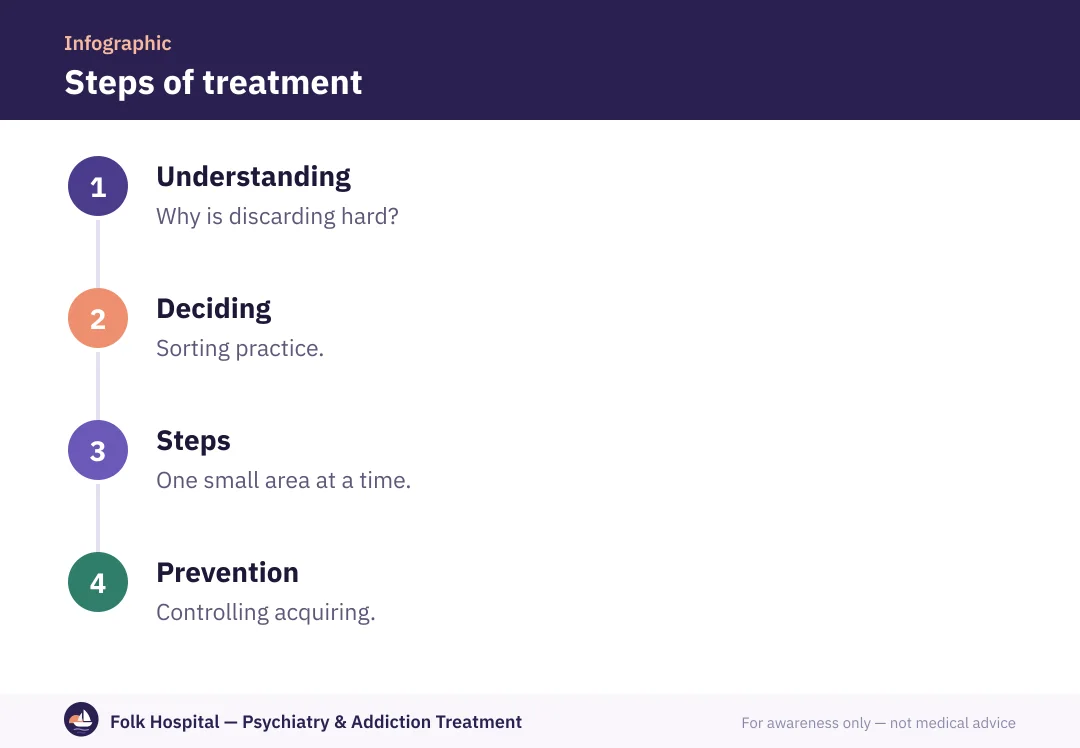
- Motivationunderstanding clutter's effect on life.
- Reducing acquiringsmall steps.
- Sortinggradual decisions about items.
- Maintenancepreventing new build-up.
Read also: OCD, shopping addiction, OCPD.
؟Frequently asked questions
What is hoarding disorder?
Persistent difficulty discarding things, leading to accumulation that disrupts the home.
How does it differ from collecting?
Collecting is organised, purposeful and enjoyable; hoarding is chaotic, disabling and painful.
Does forced clearing solve it?
Usually not; it causes severe distress and accumulation returns.
How is it related to OCD?
It's classed in the OCD and related disorders group.
How is it treated?
With CBT, training in decisions and sorting, and reducing acquiring.
Does it affect older people?
Yes, it becomes more evident with age.
Sources and references
- Hoarding disorder — NHS (UK)
- Obsessive-Compulsive Disorder — National Institute of Mental Health (NIMH)
- Hoarding disorder — NHS (UK)
- Obsessive-Compulsive Disorder — National Institute of Mental Health (NIMH)

A psychiatrist specialising in addiction and mental illness in adults and adolescents, with a focus on dual diagnosis.
For awareness only — not a substitute for medical advice. Editorial policy · View profile