01Sources of grandiosity
| Source | What marks it |
|---|---|
| Narcissism | A fixed pattern since early adulthood |
| Mania | An episode with little sleep and high energy |
| Psychosis | A fixed unrealistic delusion |
| Stimulants | Linked to drug use |
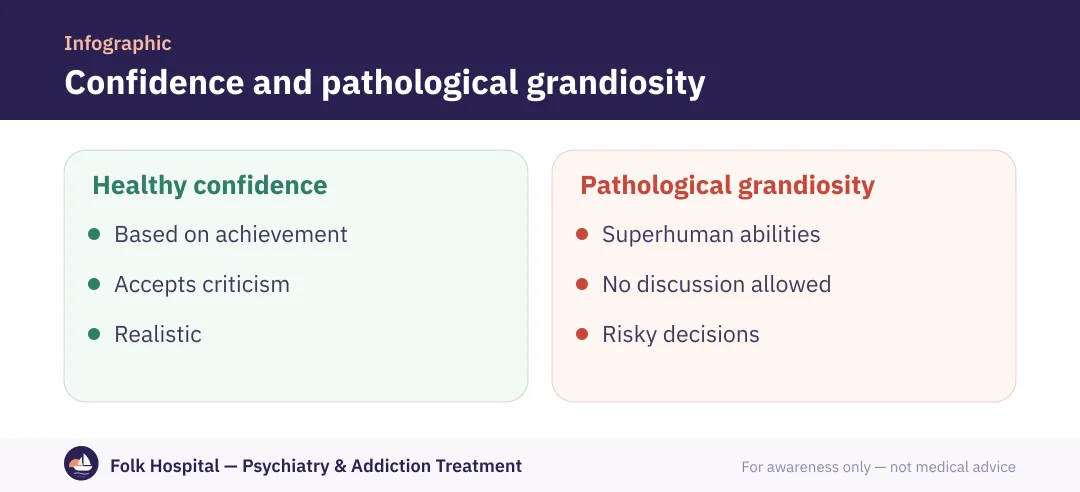
Healthy confidence
- Realistic.
- Accepts criticism.
- Respects others.
Grandiosity
- Exaggerated.
- Rejects any criticism.
- Belittles others.
- Suicidal thoughts or intent to harm yourself or others.
- Losing touch with reality or severe agitation.
In Egypt call the ambulance on 123 or the mental-health hotline 08008880700.
Ambulance: 12302What the family can do
- Notice sudden changeespecially with little sleep.
- Protect financesduring impulsivity.
- Avoid arguingabout delusions.
- Seek urgent assessmentwith mania or psychosis.
Read also: bipolar disorder, cocaine, personality disorders.
؟Frequently asked questions
What is grandiosity?
An exaggerated sense of importance or ability, which may be a trait, a symptom of illness or a delusion.
How does it differ from self-confidence?
Confidence is realistic and flexible; grandiosity is exaggerated and unaffected by reality.
Is grandiosity narcissism?
It can be, but it also appears in mania, psychosis and substance use.
Do drugs cause grandiosity?
Yes, especially cocaine and meth, and the effect can persist with drug-induced psychosis.
How is it treated?
By cause: mood stabilisers for mania, antipsychotics for delusions, psychotherapy for narcissism.
Is it dangerous?
It can be, if it leads to overspending, risk-taking or violent confrontation.
Sources and references
- Bipolar Disorder — National Institute of Mental Health (NIMH)
- Delusional Disorder — Cleveland Clinic
- Personality Disorders — U.S. National Library of Medicine — MedlinePlus
- Bipolar Disorder — National Institute of Mental Health (NIMH)
- Delusional Disorder — Cleveland Clinic
- Personality Disorders — U.S. National Library of Medicine — MedlinePlus

A psychiatrist specialising in addiction and mental illness in adults and adolescents, with a focus on dual diagnosis.
For awareness only — not a substitute for medical advice. Editorial policy · View profile