01Common forms
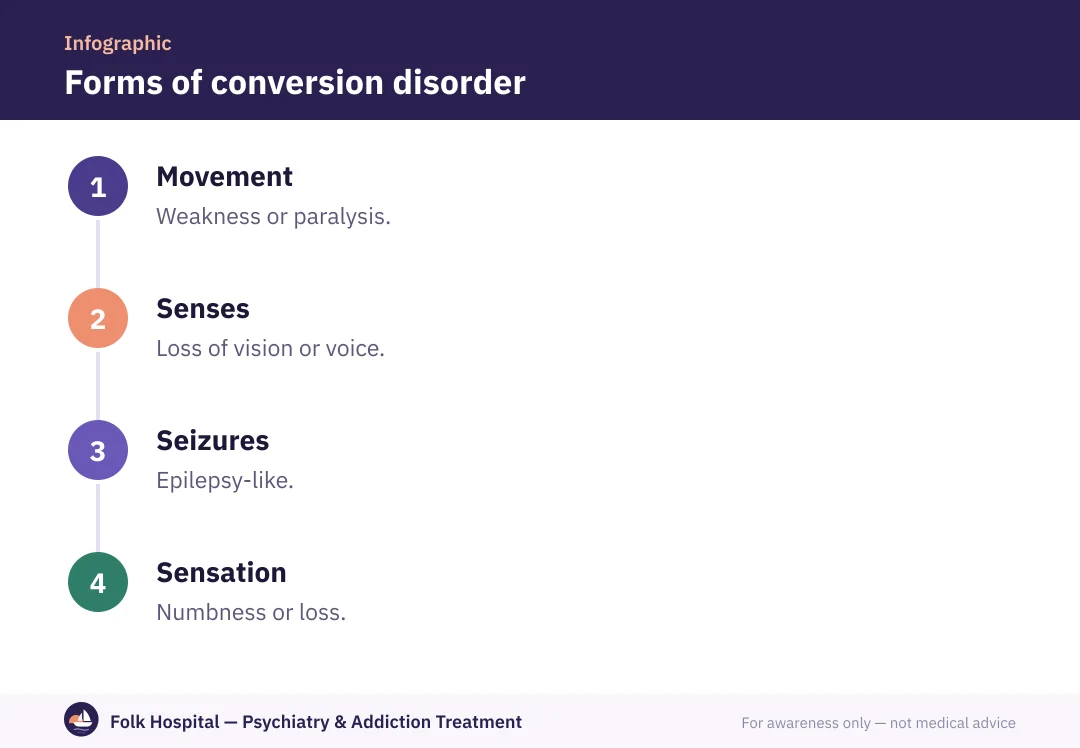
| Symptom | Example |
|---|---|
| Motor | Weakness or paralysis of a limb |
| Sensory | Numbness or loss of sensation |
| Attacks | Seizure-like attacks without epileptic activity |
| Speech and vision | Loss of voice or blurred vision |
A common mistake
- Accusing the patient of pretending.
- Endless repeated tests.
The right approach
- Confirming the symptoms are real.
- A clear diagnosis and treatment plan.
02Treatment
- Neurological assessmentto rule out physical causes.
- Explaining the diagnosisclearly and respectfully.
- Psychotherapyfor stress and trauma.
- Physiotherapyto restore function.
Read hysteria symptoms, psychosomatic disorders and histrionic personality.
؟Frequently asked questions
What is hysteria?
An old term for physical or neurological symptoms without a clear physical cause, now called functional neurological disorder.
Is the patient pretending?
No. The symptoms are real and unintentional, unlike malingering.
What are its symptoms?
Weakness or paralysis, loss of voice, non-epileptic seizures, vision or sensory disturbance.
What causes it?
An interaction between stress, trauma and how the brain processes signals.
How is it treated?
Explaining the condition, psychotherapy, physiotherapy and treating co-occurring anxiety or depression.
Is hysteria the same as histrionic personality?
No. Histrionic personality is a different personality disorder.
Sources and references
- Functional neurological disorder — MedlinePlus — U.S. National Library of Medicine — MedlinePlus
- Somatic symptom disorder — MedlinePlus — U.S. National Library of Medicine — MedlinePlus

A psychiatrist specialising in addiction and mental illness in adults and adolescents, with a focus on dual diagnosis.
For awareness only — not a substitute for medical advice. Editorial policy · View profile