- OCD involves distressing intrusive thoughts and repeated actions to relieve anxiety.
- People with OCD usually know their thoughts are exaggerated but can't stop them.
- Compulsions relieve briefly and strengthen the obsession.
- Exposure and response prevention is the most effective treatment.
- Some antidepressants help, sometimes at higher doses.
01What is OCD?
OCD isn't just liking things clean or tidy. It's a condition in which distressing thoughts break into the mind against the person's will, causing intense anxiety, and they turn to acts or rituals to get rid of it. Over time this cycle consumes hours of the day and disrupts work and relationships.
In short: OCD = obsessions (intrusive distressing thoughts) + compulsions (rituals to ease anxiety), consuming time and causing suffering.
02How does OCD work?
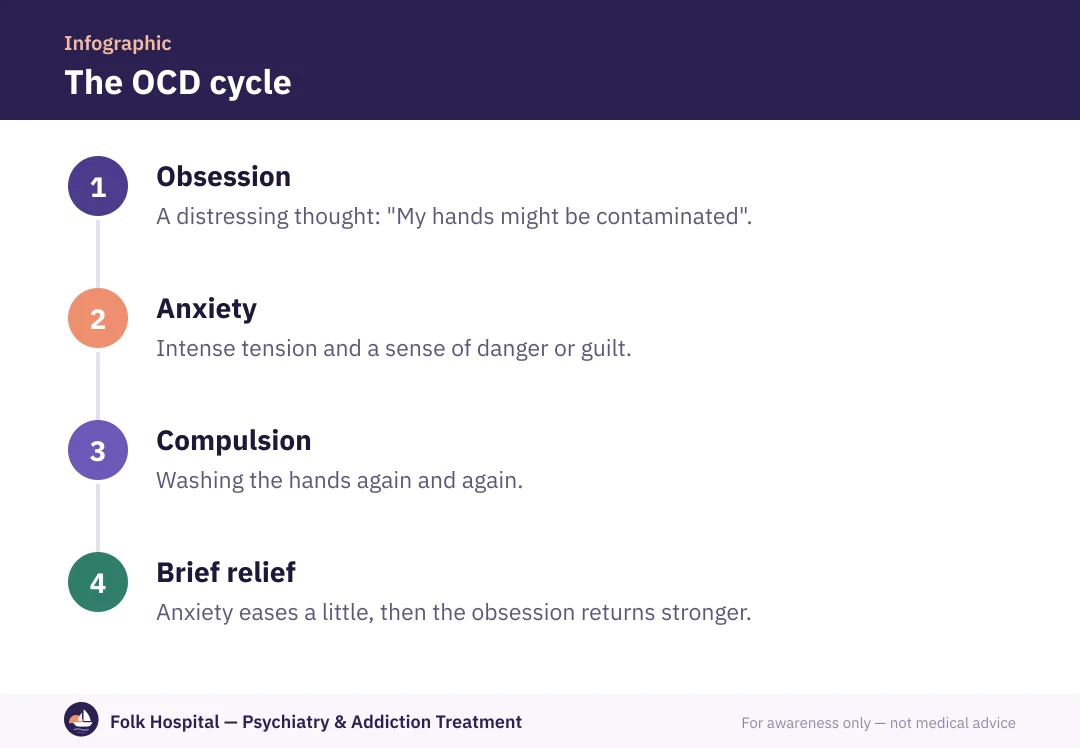
The problem isn't having disturbing thoughts; everyone has them sometimes. It's that someone with OCD gives them dangerous meaning and feels they must do something to prevent them. The compulsion brings a little relief, so the brain learns the thought was a real danger, and it returns stronger.
03What are the most common types?
Contamination OCD
Fear of germs or impurity and repeated washing.
Doubt and checking
Repeatedly checking doors, gas and actions.
Religious OCD
Excessive worry about purity, prayer and blasphemy.
Taboo thoughts
Unwanted intrusive violent or sexual thoughts.
For details read types of OCD.
04How is OCD treated?
- Diagnosisassessing the type, severity, time and impact of obsessions, plus any depression or anxiety.
- Exposure and response preventiongradually facing what triggers the obsession without performing the compulsion, so the brain learns anxiety settles on its own.
- Medicationantidepressants at doses suited to OCD, which take longer to work.
- The family's rolegradually stepping back from joining in rituals and repeated reassurance.
Details in OCD treatment.
05What to read next
؟Frequently asked questions
Does an obsession mean I want what I'm thinking about?
No. Obsessions are intrusive thoughts the person rejects and feels disgust or fear about, and that rejection is exactly what makes them distressing. They don't mean desire or intent.
Can OCD be cured?
Most people improve a great deal with treatment, and many live without OCD disrupting their life, even if some thoughts still appear at times.
Is OCD genetic?
Genes play a role and the chance is higher with an affected relative, but environment and experience contribute too. Read causes of OCD.
Is OCD a lack of faith?
No. It's a mental disorder with causes in the brain, and the distressing thoughts hurt precisely because they go against the person's values.
Does OCD turn into madness?
No. OCD isn't psychosis, and people with it usually recognise their thoughts are exaggerated.
Sources and references
- Obsessive-Compulsive Disorder — National Institute of Mental Health (NIMH)
- Obsessive compulsive disorder (OCD) — overview — NHS (UK)
- Psychotherapies — National Institute of Mental Health (NIMH)

A psychiatrist specialising in addiction and mental illness in adults and adolescents, with a focus on dual diagnosis.
For awareness only — not a substitute for medical advice. Editorial policy · View profile