01What happens in psychosis?
Every moment the brain processes a flood of information and decides what matters and what doesn't. In psychosis this filtering breaks down, often linked to excess dopamine activity in certain brain pathways: ordinary things take on special, frightening meaning, the person hears their thoughts as voices, or becomes convinced people are plotting against them. Read dopamine.
02The core signs
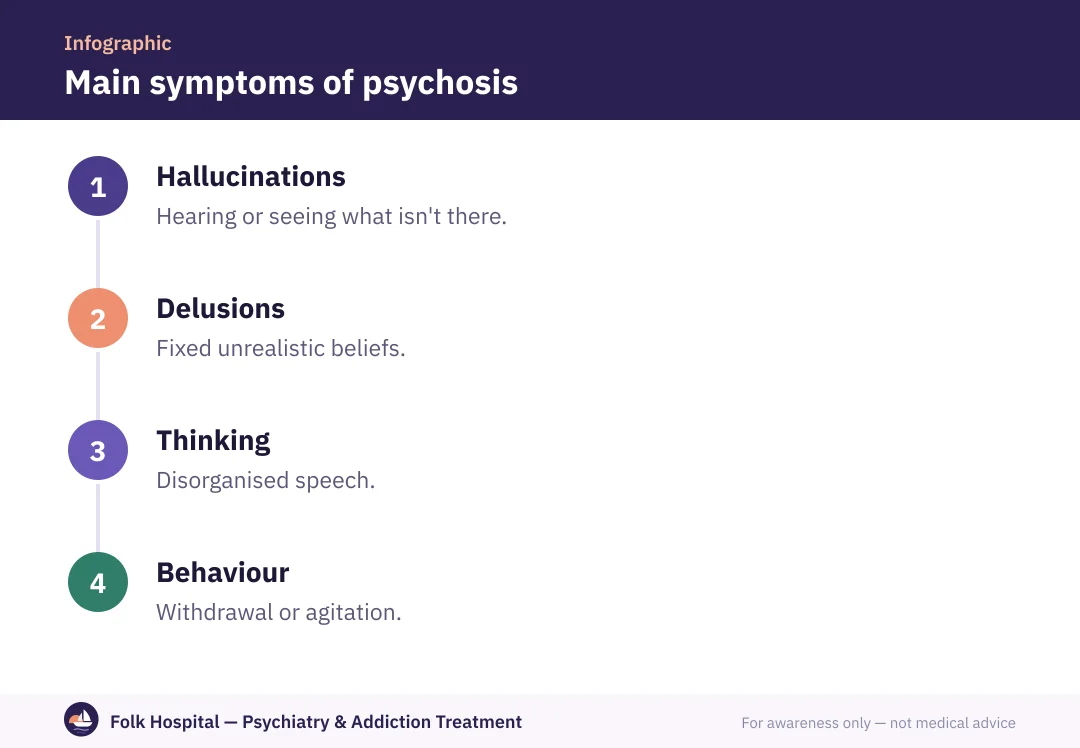
| Sign | What it means | Example |
|---|---|---|
| Hallucinations | Perceiving something that isn't there | Hearing voices commenting on their actions |
| Delusions | A fixed false belief unchanged by evidence | Conviction that neighbours are watching them |
| Disordered thinking | Disconnected speech or jumping between ideas | Answers unrelated to the question |
| Changed behaviour | Withdrawal, agitation or neglect | Stopping work and personal hygiene |
Details in psychosis symptoms.
03Causes of psychosis
- Mental disorders: schizophrenia, bipolar disorder and psychotic depression.
- Drugs: shabu, hashish, strox, hallucinogens and alcohol withdrawal. Read drug-induced psychosis.
- Physical causes: brain infections, epilepsy, tumours, gland disorders and some medicines.
- Severe stress and prolonged sleep loss in predisposed people.
Details in causes of psychosis.
- Threats to harm themselves or others, or talk of suicide.
- Acting on commands the person hears.
- Severe agitation or refusing food and drink.
- Confusion with fever or seizures, or after taking a substance.
Mental health hotline: 08008880700.
Ambulance: 12304Treatment
- Urgent assessmentmedical examination, tests and questions about substances to rule out physical causes.
- Medicationantipsychotics reduce hallucinations and delusions within days to weeks.
- Safetyinpatient care if there's risk or refusal of treatment.
- Rehabilitationpsychological therapy, family support and a gradual return to work or study.
- Relapse preventionsticking with medication, avoiding drugs and regular sleep.
Read psychosis treatment and antipsychotics.
05What to read next
؟Frequently asked questions
What is psychosis?
A state in which a person can't distinguish what is real from what isn't, with hallucinations, delusions or disordered thinking.
Is psychosis madness?
«Madness» is an inaccurate, stigmatising word. Psychosis is a medical condition with causes and treatment, and many people recover fully or improve greatly.
Can psychosis be cured?
It depends on the cause. Psychosis from drugs or stress can resolve completely; psychosis linked to schizophrenia or bipolar disorder needs longer treatment but can be managed successfully.
Is psychosis hereditary?
Genes play a role in some causes, such as schizophrenia and bipolar disorder, but onset also depends on other factors such as drugs and stress.
Can hashish cause psychosis?
Yes, especially strong strains, use in adolescence, and in people with a genetic predisposition.
What should I do if a relative shows signs of psychosis?
Talk calmly without arguing about their beliefs, seek an urgent psychiatric assessment, and call an ambulance if they or others are at risk.
Sources and references
- Psychosis — NHS (UK)
- Schizophrenia — National Institute of Mental Health (NIMH)
- Schizophrenia — fact sheet — World Health Organization
- Comorbidity: Substance Use and Other Mental Disorders — National Institute on Drug Abuse (NIDA)

A psychiatrist specialising in addiction and mental illness in adults and adolescents, with a focus on dual diagnosis.
For awareness only — not a substitute for medical advice. Editorial policy · View profile