01Types
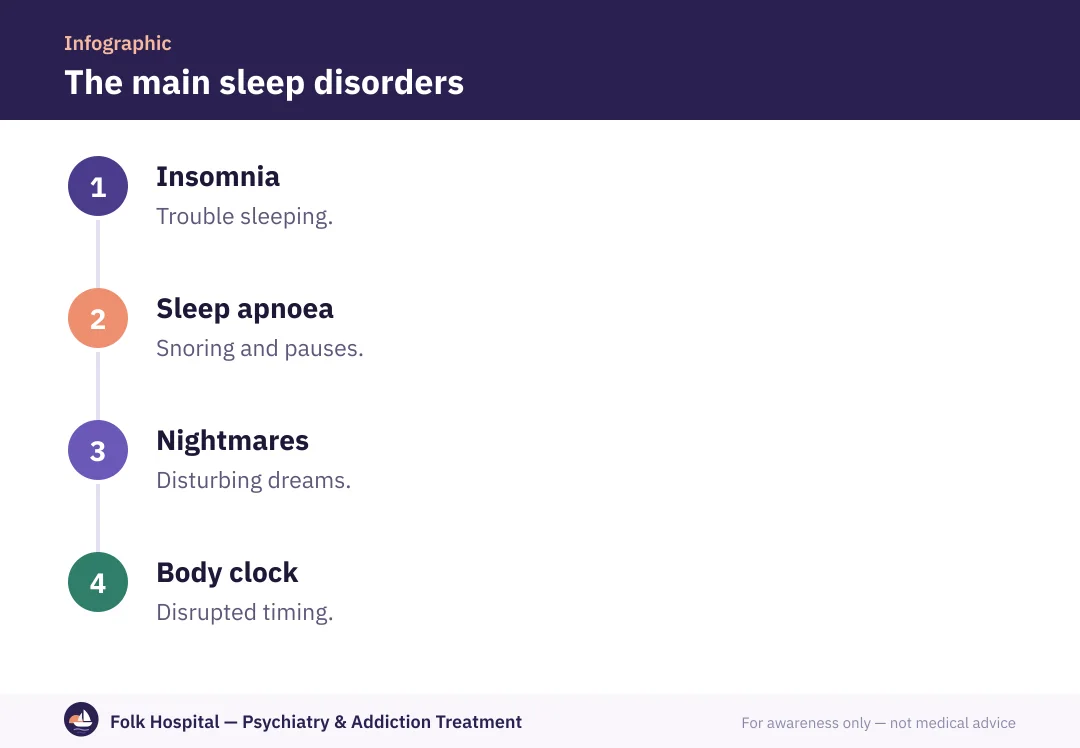
| Disorder | Main sign |
|---|---|
| Insomnia | Trouble falling or staying asleep |
| Sleep apnoea | Snoring, pauses in breathing, daytime sleepiness |
| Narcolepsy | Sudden daytime sleep attacks |
| Restless legs | Urge to move the legs at night |
| Circadian | Sleeping at unsuitable times |
| Nightmares | Repeated disturbing dreams |
02Healthy sleep habits
- Fixed timesfor sleeping and waking.
- Fewer screensbefore bed.
- Avoid stimulantsin the evening.
- A quiet roomdark and comfortable.
- Get upif you can't sleep.
Read also: insomnia, melatonin, insomnia test.
؟Frequently asked questions
What types of sleep disorders are there?
Insomnia, hypersomnia, apnoea, narcolepsy, restless legs, circadian disorders and nightmares.
How is sleep related to mental health?
Both ways: mental disorders disrupt sleep, and poor sleep worsens them.
Does alcohol help sleep?
It may speed sleep onset but ruins quality and causes repeated waking.
Why can't I sleep after quitting drugs?
Insomnia is one of the best-known withdrawal symptoms and improves gradually.
Are sleeping pills the answer?
They help short-term; CBT for insomnia is better long-term.
When do I need a sleep study?
With heavy snoring and pauses in breathing, excessive daytime sleepiness, or strange behaviours in sleep.
Sources and references
- Sleep Disorders — U.S. National Library of Medicine — MedlinePlus
- Sleep problems — Every Mind Matters — NHS (UK)
- Insomnia — NHS (UK)
- Sleep Disorders — U.S. National Library of Medicine — MedlinePlus
- Sleep problems — Every Mind Matters — NHS (UK)
- Insomnia — NHS (UK)

A psychiatrist specialising in addiction and mental illness in adults and adolescents, with a focus on dual diagnosis.
For awareness only — not a substitute for medical advice. Editorial policy · View profile