01How do we choose the right programme for you?
We start with an assessment that answers specific questions: which substance? For how long? Is there dangerous withdrawal? Is there depression, anxiety or another condition? How supportive is the home environment? Based on the answers we build a plan from the programmes below and review it every week.
02How do the programmes differ?
| Programme | For whom? | Where? |
|---|---|---|
| Detox | People with physical dependence | In hospital |
| Residential rehab | Moderate and severe cases | In hospital |
| Outpatient care | Mild cases or after a residential stay | Clinic |
| Dual diagnosis | Addiction with a mental illness | Inpatient or outpatient |
| Family programme | Relatives | Regular sessions |
| The 12 steps | Long-term support | Groups |
| Aftercare and relapse prevention | Everyone who completes treatment | Clinic and online |
03Common treatment paths
The programmes aren't separate choices but pieces that fit together. These are illustrative examples of common paths; the actual plan is set after assessment:
- Daily use of a drug that causes withdrawal (such as heroin, tramadol or alcohol)detox → residential rehab → outpatient care → aftercare, with the family programme throughout.
- Occasional use of a drug without dangerous withdrawal (such as cannabis)intensive outpatient care → stabilisation → aftercare, with family sessions.
- Addiction with depression, psychosis or bipolar disorderdetox → residential care within dual diagnosis → outpatient care with a psychiatrist → long follow-up.
- A person refusing treatmentthe family programme first, so the family learns how to persuade them, then assessment once they accept.
- Someone treated elsewhereassessment → aftercare and relapse prevention, with the 12 steps for those it suits.
04How do we decide the level of care?
The choice between residential and outpatient care rests on clear factors:
Factors pointing to a residential stay
- Dangerous withdrawal expected (alcohol, sedatives, high doses).
- Mixing several substances.
- Suicidal thoughts, psychosis or severe depression.
- Drugs available at home, or violence.
- Failed previous outpatient attempts.
Factors that allow outpatient care
- No dangerous withdrawal.
- One substance and less intense use.
- A stable mental state.
- A supportive family and a safe home.
- Keeping appointments.
05What do all the programmes share?
- A medical and psychological assessment at the start, and regular reassessment.
- A written plan the patient and family know.
- Evidence-based treatment: CBT, motivational interviewing and group therapy, with medicines when needed.
- Family involvement at every stage.
- Confidentiality and respect for the patient's dignity.
- Follow-up after discharge, because the first months carry the highest risk.
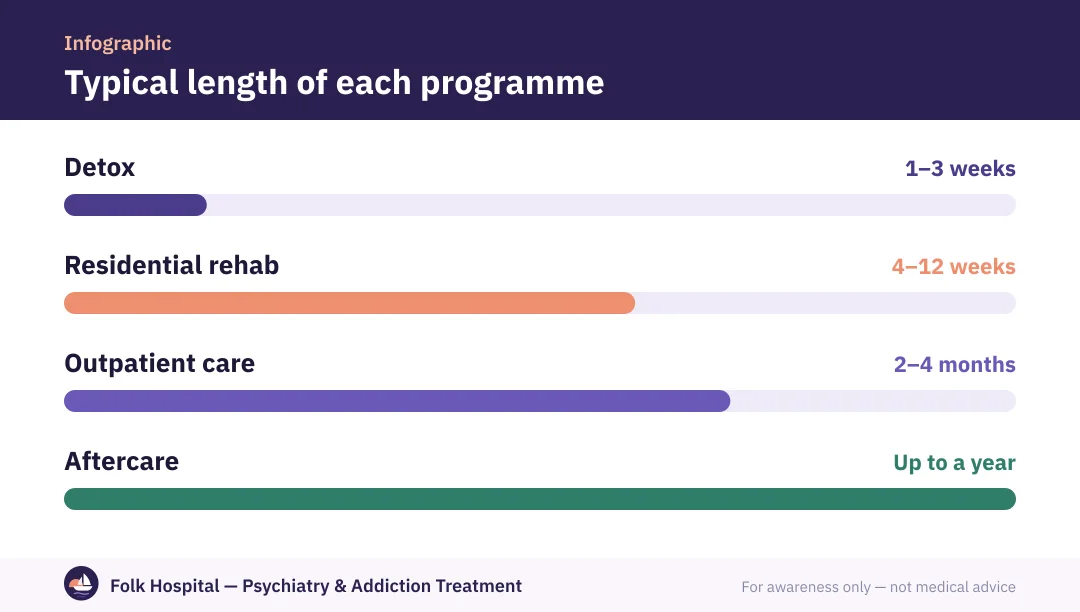
06How long does the treatment journey take?
| Stage | Approximate length |
|---|---|
| Detox | Days to two weeks, longer with sedatives |
| Intensive rehabilitation | Four to twelve weeks |
| Follow-up | About a year, longer if needed |
Research shows that staying in treatment long enough is one of the most important factors in success, so we encourage completing the journey rather than stopping after one stage. Read about the stages of addiction treatment and the cost of treatment.
؟Frequently asked questions
Do I have to start with detox?
If there's physical dependence on the drug, yes, because stopping suddenly without supervision can be dangerous. If use is occasional and light, the patient may start directly with outpatient care.
Can more than one programme be combined?
That's the norm. Most patients go through detox, then rehabilitation, with the family programme alongside, then aftercare after discharge.
How long does the whole treatment journey take?
The intensive phase usually takes one to three months, then follow-up continues for about a year. It varies with the drug, mental state and response.
Who decides the right programme?
The doctor decides after assessment, in agreement with the patient and family. We always explain why we chose that path and what the alternatives are.
Can I move from one programme to another?
Yes. A patient may move from residential to outpatient care as they improve, or the reverse if difficulties arise or use recurs.
Are the programmes only for addiction?
The seven programmes are mainly for addiction treatment; there's a separate psychiatric unit for mental health conditions without addiction.
Sources and references
- Treatment Approaches for Drug Addiction — DrugFacts — National Institute on Drug Abuse (NIDA)
- Drug misuse in over 16s: psychosocial interventions (CG51) — National Institute for Health and Care Excellence (NICE)
- Drug addiction: getting help — NHS (UK)
A specialist in psychological rehabilitation, behaviour modification and relapse prevention, with over 15 years in addiction programmes.
For awareness only — not a substitute for medical advice. Editorial policy · View profile