01The cognitive triangle
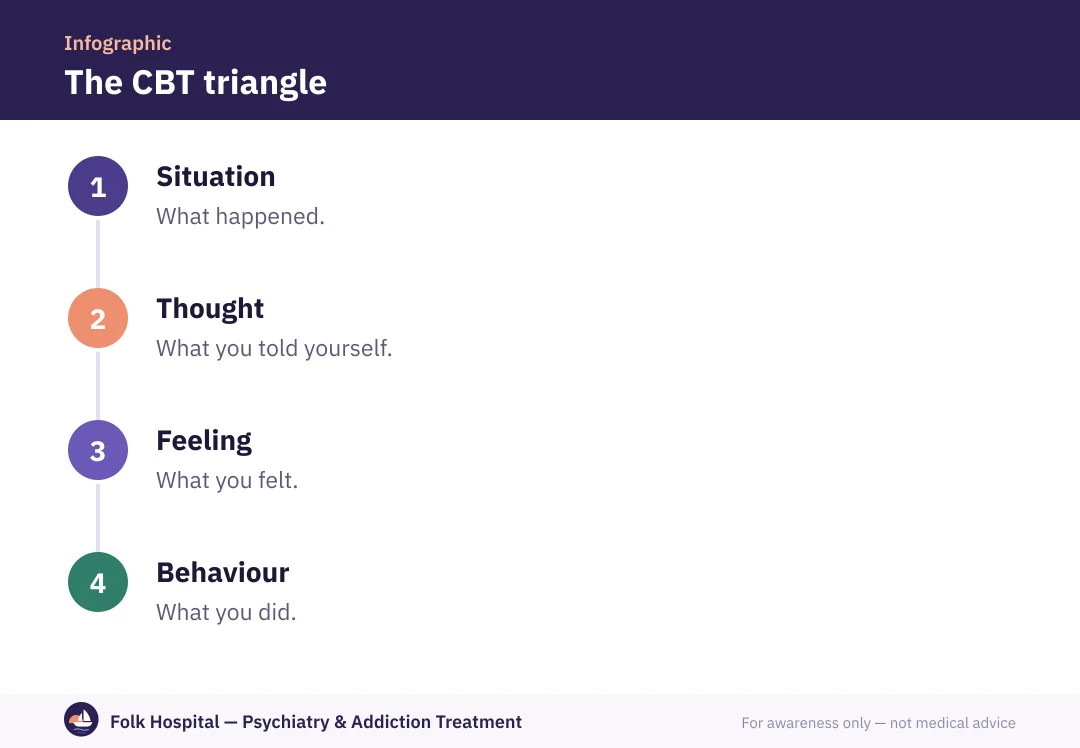
| Situation | Thought | Feeling | Behaviour |
|---|---|---|---|
| A colleague didn't say hello | «They don't like me» | Sadness | Avoidance |
| Same situation | «Maybe they didn't see me» | Calm | Greeting later |
02How sessions run
- Assessment and goalswhat do you want to change?
- Educationunderstanding the thought–feeling–behaviour cycle.
- Monitoring thoughtsrecording them in real situations.
- Testing themlooking for evidence and alternatives.
- Behavioural experimentstrying a new behaviour and watching the result.
- Relapse preventiona plan for the future.
03What it's used for
Read psychiatric therapies and the psychiatric hospital.
؟Frequently asked questions
What is CBT?
A structured psychotherapy that helps change thoughts and behaviours keeping a mental-health problem going.
What conditions does it treat?
Depression, anxiety, OCD, panic, eating disorders, insomnia, addiction and others.
How many sessions?
Usually a set number of weekly sessions decided by the therapist according to the condition.
Does it involve homework?
Yes. Practice between sessions is the basis of improvement.
Can it be combined with medication?
Yes, and combining is often better in moderate and severe cases.
Does it work online?
Yes. Remote sessions are effective for many conditions.
Sources and references
- Cognitive behavioural therapy (CBT) — overview — NHS (UK)
- Psychotherapies — National Institute of Mental Health (NIMH)

Written byDr. Mahmoud ElsawyConsultant in psychiatry and addiction treatment
A psychiatrist specialising in addiction and mental illness in adults and adolescents, with a focus on dual diagnosis.
For awareness only — not a substitute for medical advice. Editorial policy · View profile