01Why does the family need treatment?
Families of people with addiction live through years of anxiety, lies, fear and conflict. Over time, habits form at home that aim to "contain" the problem but in reality keep it going: covering for the person, paying their debts, shouting and then giving in. The family programme rebuilds these relationships on a healthy footing.
The family itself is affected too: insomnia, chronic anxiety, depression, parents disagreeing about how to respond, and siblings feeling neglected because all the attention goes to the patient. Healing these wounds isn't a luxury; it's a condition for the patient returning to a home that can support them.
02Help that harms without meaning to
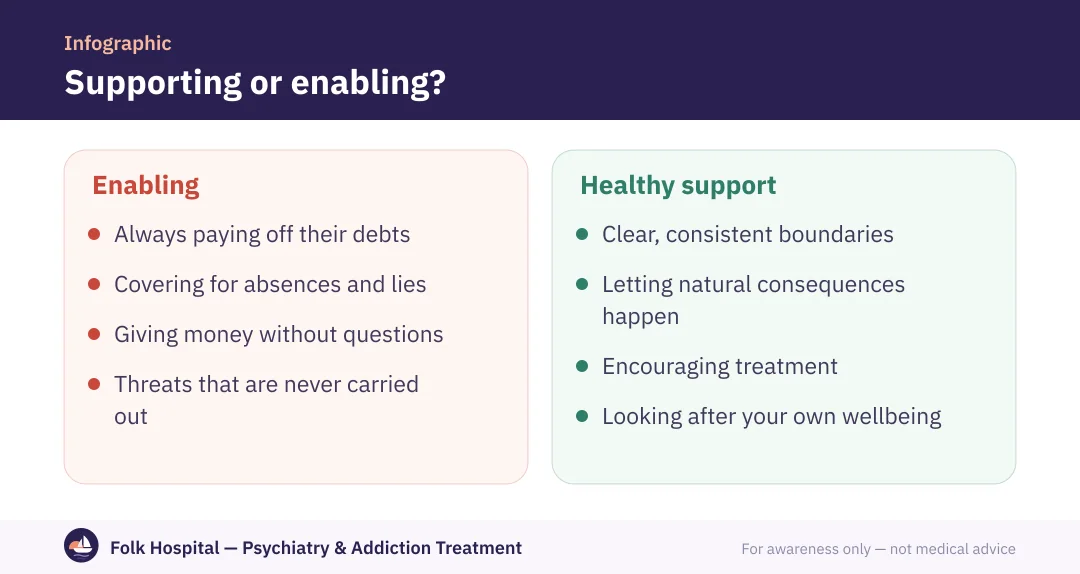
Therapists call some behaviours enabling, meaning they make it easier to keep using, even though they're meant to protect:
Behaviours that prolong addiction
- Paying their debts or fines every time.
- Lying to relatives or work to cover absences.
- Giving cash without asking.
- Ignoring the problem in the hope it goes away.
- Shouting and threatening, then backing down.
Behaviours that support recovery
- Letting the consequences of their actions fall on them, safely.
- Calm honesty with those who need to know.
- Paying for specific needs directly, not in cash.
- Talking clearly about the problem and seeking help.
- A few clear boundaries that are actually kept.
The aim isn't harshness, but for the person to feel the real cost of using, while also feeling that the road to treatment is open and supported.
03What happens in family sessions?
- Understanding the illnesssimple talks on how addiction affects the brain and behaviour, so families stop blaming themselves or the patient in ways that hurt.
- Communication skillshow to talk without accusing, and how to say no without a fight.
- Setting boundariesagreeing clear rules about home, money and behaviour, with consequences that are actually followed through.
- Joint sessionstherapist-led meetings that bring the patient and family together to repair what's been broken.
- Support for the familyspace for family members to talk about their own distress and regain their balance.
04Communication skills: practical examples
How you speak makes a big difference. Sentences that start with an accusation push the person to defend themselves and lie, while sentences that describe your feelings and ask for something specific open the door to conversation:
| Instead of saying | Try saying |
|---|---|
| You're a liar and an addict and you've wrecked this house. | I'm very worried about you since your hours changed and you started asking for a lot of money. |
| If you loved us you'd stop. | I know stopping is hard, and I want us to find help together. |
| This is the last time I forgive you. | If you use again I'll do this, and I'll stick to it because I love you. |
| What did you do today? Where were you? | How was your day? Is anything bothering you? |
It's best to talk when the person isn't under the influence, away from moments of anger, and with one voice agreed among family members.
05Setting boundaries without turning it into a battle
Good boundaries are few, clear and enforceable. For example:
- No cash; we buy what's needed directly.
- No using and no drugs in the house.
- No verbal or physical violence; if it happens we get help immediately.
- Help is always available if they decide to start treatment.
A boundary that isn't kept loses its value, so in sessions we agree boundaries the family can genuinely keep, and practise enforcing them calmly.
06If the person refuses treatment
Many families wait for the person to "be convinced" before seeking help. But research on family training programmes, including an approach known as CRAFT, indicates that teaching families positive communication and how to reward healthy behaviour clearly increases the chances of the person entering treatment, compared with harsh confrontation. Start with yourself, and read how to convince someone to get treatment. In dangerous situations, read about involuntary treatment.
07The family during the stay and after discharge
- During residential care: weekly sessions, arranged visits, and learning what the patient is learning so you speak the same language.
- Before discharge: a joint session to write a home agreement covering schedules, money, follow-up and what happens after a slip.
- After discharge: spaced-out sessions to follow how everyone is adjusting and handle trust as it slowly returns. Read our guide to life after rehab.
08Don't forget yourself
Looking after yourself is part of treatment
Enough sleep, talking to someone you trust, returning to your own activities, and not carrying the whole burden alone. An exhausted family can't support anyone, and caring for yourself isn't selfish.
If there are children at home, they need a simple explanation suited to their age, reassurance that what's happening isn't their fault, and protection from any violence or frightening situations.
For more practical advice, read our family guide and addiction and marriage.
؟Frequently asked questions
Should I attend even if my son refuses treatment?
Yes, and it's one of the most useful things you can do. A change in how the family responds is often what moves the person toward treatment.
Who attends family sessions?
Parents or a spouse, and sometimes older siblings. The therapist helps decide who attends each session depending on its aim.
How many family sessions are there?
It varies, but usually one a week while the patient is in treatment, then spaced-out sessions in the first months after discharge.
Am I the reason my son became addicted?
Addiction is an illness with many genetic, psychological and environmental causes, and no single person creates it. Blaming yourself drains you without helping him; it's better to focus on what you can do now.
Should I give him money if he asks?
Don't give cash that could go on drugs. You can pay for specific needs directly, such as food and transport, and agree this with the therapist.
Should I throw him out of the house?
A hard decision that shouldn't be made in a moment of anger. In sessions we discuss workable boundaries and a safety plan, and when temporary separation is needed to protect the rest of the family.
What do I tell the children?
Simple words suited to their age: that their father or brother is ill and getting treatment, and that it isn't their fault. The therapist can help you find the words.
Can sessions be attended remotely?
Some sessions can be arranged remotely for relatives in other cities or countries, though joint sessions with the patient are better in person.
Sources and references
- Treatment Approaches for Drug Addiction — DrugFacts — National Institute on Drug Abuse (NIDA)
- Drug misuse in over 16s: psychosocial interventions (CG51) — National Institute for Health and Care Excellence (NICE)
- Alcohol-use disorders: diagnosis, assessment and management (CG115) — National Institute for Health and Care Excellence (NICE)
- Drug addiction: getting help — NHS (UK)

A specialist in psychological rehabilitation, behaviour modification and relapse prevention, with over 15 years in addiction programmes.
For awareness only — not a substitute for medical advice. Editorial policy · View profile