Opioids are among the oldest substances people have used for pain, and they remain some of medicine's most important drugs. But the very quality that makes them effective, soothing physical and emotional pain together, is what makes them so addictive. Many people start tramadol to stay awake, cope with hard physical work or delay ejaculation, then find they need it just to get out of bed.
01How do opioids affect the brain?
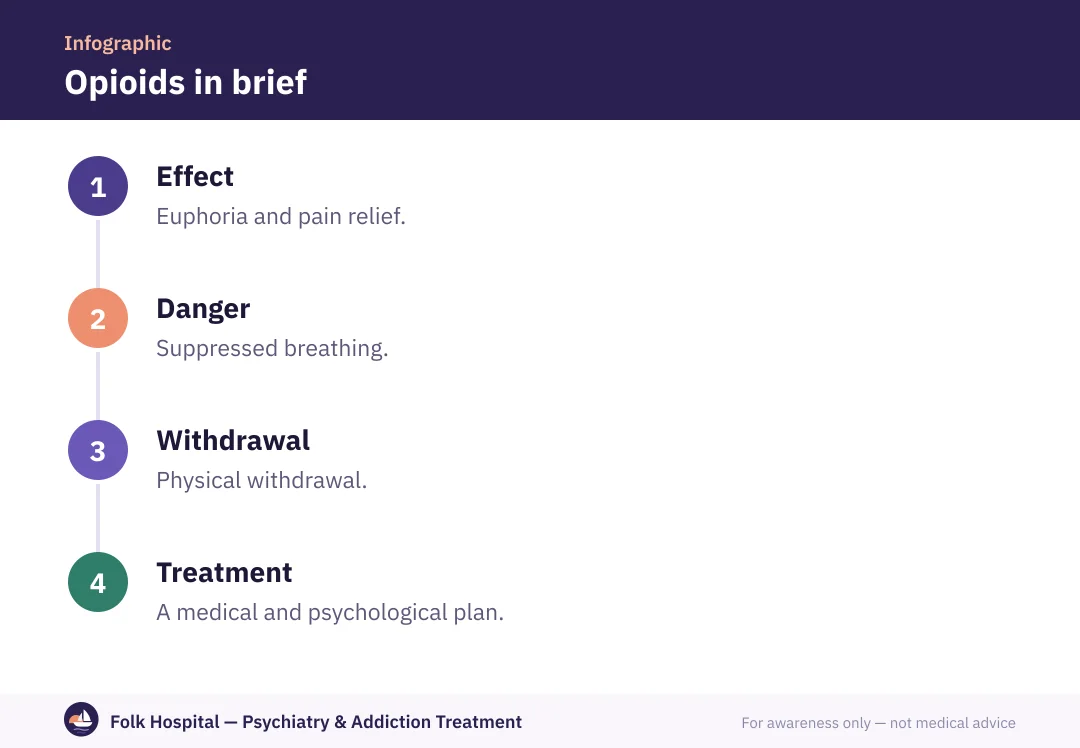
Opioids bind to «mu» receptors in the brain, reducing pain signals and raising dopamine in the reward pathway, which brings a feeling of warmth and ease. At the same time they act on the brainstem, where breathing is controlled, and slow it down; this is the cause of death in overdose. With repeated use the body makes less of its own painkillers (endorphins), so pain and anxiety are worse when the drug is absent, and the person ends up using to avoid withdrawal rather than to feel high.
02The best-known substances in this group
| Substance | Common form | What sets it apart |
|---|---|---|
| Tramadol | Tablets | The most widespread in Egypt; can cause seizures |
| Heroin | Powder, snorted or injected | Highly addictive with a high overdose risk |
| Fentanyl | Patches or powder | Many times stronger than morphine |
| Morphine | Injections or tablets | A core hospital painkiller |
| Codeine | Cough syrup and tablets | A weaker opioid that gets misused |
| Opium | Gummy resin | The natural source of this family |
| Tapentadol | Tablets | A strong painkiller misused as a tramadol substitute |
| Oxycodone | Tablets | A strong painkiller with fast dependence |
| Pethidine | Injections | A hospital painkiller |
| Nalbuphine | Injections | Misused despite its limited effect |
| Krokodil | Injected liquid | Crudely made and destroys tissue |
| Methadone | Liquid or tablets | Used as supervised substitution treatment |
| Buprenorphine | Tablets under the tongue | Substitution treatment that is safer for breathing |
03Signs you may notice in someone using them
Common signs
- Drowsiness and nodding off mid-conversation.
- Pinpoint pupils.
- Chronic constipation and itching.
- Poor appetite and weight loss.
- Injection marks, or long sleeves in summer.
- Yawning, runny nose, watery eyes and sweating when a dose is late.
04Health and mental-health risks
- Slowed breathing and death from overdose, more likely with sedatives or alcohol.
- Seizures with tramadol, especially at high doses.
- Hepatitis and HIV infection from injecting and sharing equipment.
- Sexual dysfunction and hormonal problems with long use.
- Severe constipation and dental problems.
- Depression, isolation, and social and financial decline.
- No response to calling or shaking.
- Very slow, irregular breathing or strange snoring.
- Blue lips and nails.
- Pinpoint pupils with unconsciousness.
Put the person on their side and watch their breathing until the ambulance arrives. There's an opioid antidote (naloxone) that reverses overdose and is used by paramedics and doctors.
Ambulance: 12305What is withdrawal like?
Withdrawal from short-acting opioids starts within hours of the last dose and peaks on days two and three. Long-acting ones such as methadone start later and last longer. Withdrawal is painful but rarely fatal on its own, except with severe dehydration or other illnesses.
- Early symptomsanxiety, yawning, runny nose and eyes, sweating and insomnia.
- Peak (days 2–3)bone and muscle pain, diarrhoea, vomiting, chills and strong cravings.
- Improvement (after 5–7 days)physical symptoms settle, while insomnia, low mood and cravings last for weeks.
06How does treatment differ?
Opioids are almost the only family with internationally approved medicines for the addiction itself, used within a programme that includes psychological support. The doctor chooses between stable substitution treatment and blocking treatment after detox, depending on the case. Details in opioid addiction treatment and opioid withdrawal.
Substitution treatment
- Methadone or buprenorphine at a stable dose.
- Prevents withdrawal and reduces cravings.
- Lowers deaths from overdose.
Blocking treatment
- Naltrexone after detox ends.
- Blocks the effect of opioids.
- Causes no dependence but needs commitment.
07Read also
؟Frequently asked questions
What are opioids?
A group of natural and manufactured substances acting on opioid receptors in the brain, including morphine, codeine, tramadol, heroin and fentanyl.
Is tramadol an opioid?
Yes. Tramadol is a synthetic opioid that also acts on serotonin and noradrenaline, which is why it can cause seizures at high doses.
What are the signs of an opioid overdose?
Deep drowsiness and no response, slow or irregular breathing, blue lips and pinpoint pupils. Call an ambulance on 123 immediately.
Is opioid withdrawal dangerous?
It's very painful but rarely fatal on its own. The bigger danger is relapse afterwards: tolerance has dropped, so the old dose can kill.
Is there medicine for opioid addiction?
Yes. Approved medicines such as buprenorphine, methadone and naltrexone are used within a full programme on a doctor's decision.
Do strong painkillers after surgery cause addiction?
Short prescribed use with follow-up rarely leads to addiction. The risk rises with long use, unsupervised dose increases, or a past history of addiction.
Sources and references
- Opioids — research topic — National Institute on Drug Abuse (NIDA)
- Opioid overdose — fact sheet — World Health Organization
- Medications to Treat Opioid Use Disorder — Research Report — National Institute on Drug Abuse (NIDA)
- Guidelines for the psychosocially assisted pharmacological treatment of opioid dependence — World Health Organization
- Opiate and opioid withdrawal — U.S. National Library of Medicine — MedlinePlus

A psychiatrist specialising in addiction and mental illness in adults and adolescents, with a focus on dual diagnosis.
For awareness only — not a substitute for medical advice. Editorial policy · View profile