01Why does opioid withdrawal happen?
With regular use the body produces fewer of its own painkillers and ramps up brain centres responsible for alertness and stress to counter the drug's depressant effect. When the drug suddenly disappears, that excess activity shows in full: anxiety, sweating, diarrhoea, pain and insomnia. In other words, withdrawal is roughly the opposite of the opioid's effect: it caused constipation, so diarrhoea appears; it relieved pain, so bone pain appears; it caused drowsiness, so insomnia appears.
02Common symptoms
Physical and psychological symptoms
- Runny nose, watery eyes and repeated yawning.
- Sweating, chills and goosebumps.
- Bone and muscle pain and cramps.
- Diarrhoea, nausea, vomiting and stomach cramps.
- Dilated pupils.
- Insomnia, anxiety and irritability.
- Strong cravings.
03Timeline by substance
| Substance | Onset | Peak | Acute symptoms ease |
|---|---|---|---|
| Heroin | 6–12 hours | Days 2–3 | 5–7 days |
| Tramadol | 12–24 hours | Days 2–4 | About a week, sometimes longer |
| Codeine | 12–24 hours | Days 2–3 | 5–7 days |
| Methadone | 24–48 hours or more | Days 3–8 | Two weeks or more |
The figures are approximate and vary with dose, duration of use, health and other substances.
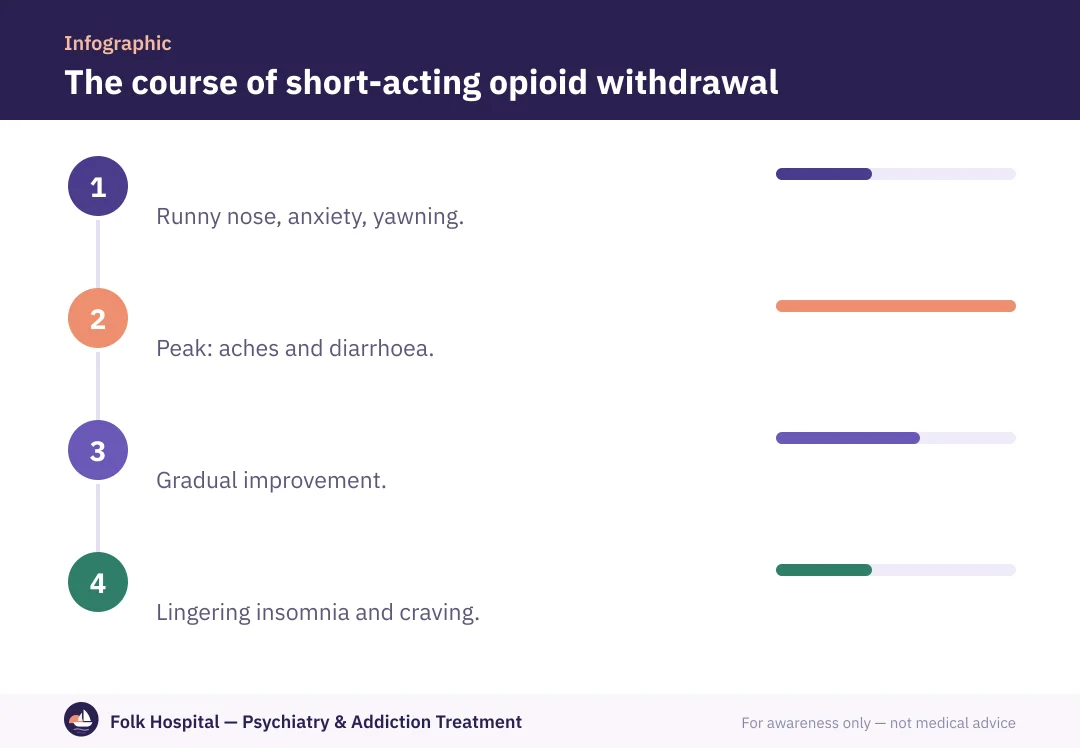
04Stages of withdrawal
- Early stageanxiety, yawning, runny nose and eyes, sweating and insomnia.
- Peak stagebone pain, diarrhoea, vomiting, chills and strong cravings; this is when most people trying alone relapse.
- Easing stagephysical symptoms gradually settle and appetite returns.
- Lingering symptomsinsomnia, fatigue, low mood and situational cravings, which can last weeks or months.
05What makes withdrawal dangerous?
Opioid withdrawal alone rarely kills, but the risk rises in specific situations:
- Dehydration from vomiting and diarrhoea, especially in older people and those with heart or kidney disease.
- Mixing with sedatives or alcohol, whose withdrawal can cause seizures.
- High-dose tramadol, because of the seizure risk during use and withdrawal.
- Pregnancy, because stopping abruptly can harm the baby.
- Suicidal thoughts with severe low mood.
- Vomiting or diarrhoea that won't stop, with dizziness or little urine.
- Seizures or loss of consciousness.
- Chest pain or severe palpitations.
- Thoughts of, or threats of, self-harm.
If the person uses again after detox and becomes deeply drowsy or breathes slowly, it may be an overdose: put them on their side and call an ambulance.
Ambulance: 12306How is withdrawal managed medically?
Detox with symptom medicines
- Medicines for anxiety, insomnia, diarrhoea, nausea and pain.
- Replacing fluids and salts.
- Suitable for milder cases.
Detox with a tapering medical opioid
- Buprenorphine or methadone at gradually falling doses.
- Makes withdrawal much milder.
- Or becomes long-term substitution treatment if the doctor decides so.
The doctor scores withdrawal severity on validated scales every few hours to adjust medication. The aim is to get the patient through this stage safely and with as little pain as possible, then start rehabilitation straight away. Read opioid addiction treatment and detox.
07What comes after withdrawal?
Withdrawal is the start of treatment, not the end. Cravings, insomnia and low mood need psychological rehabilitation and follow-up, and the doctor may add a medicine that reduces relapse. Family support makes a big difference, so start with the family guide.
؟Frequently asked questions
When do opioid withdrawal symptoms start?
With short-acting substances such as heroin and tramadol, within 6 to 24 hours of the last dose; with long-acting ones such as methadone, within one to two days or more.
How long does opioid withdrawal last?
Acute physical symptoms settle within 5 to 10 days with short-acting substances and can stretch to two weeks or more with methadone. Insomnia, anxiety and cravings can last weeks or months.
Can opioid withdrawal kill?
It's rarely fatal on its own, but it can become dangerous with severe dehydration, heart disease, pregnancy, or when mixed with sedatives and alcohol. The greatest danger is overdose on relapse afterwards.
How can I ease opioid withdrawal at home?
We don't recommend detoxing at home without a medical assessment, especially with high doses or other substances. A doctor uses medicines to ease each symptom and may use a medical opioid at tapering doses.
How does tramadol withdrawal differ from heroin withdrawal?
Both are opioid withdrawal, but tramadol sometimes adds symptoms such as severe anxiety, tingling and confusion because of its serotonin effect, while heroin withdrawal usually starts faster and harder.
Do symptoms come back after withdrawal ends?
Lingering symptoms such as insomnia, fatigue, low mood and cravings can last weeks or months and are treated within rehabilitation and follow-up.
Should a pregnant woman stop opioids suddenly?
No. Stopping abruptly during pregnancy can harm the baby, and she needs a specialist plan, usually with stable substitution treatment and obstetric follow-up.
Sources and references
- Opiate and opioid withdrawal — U.S. National Library of Medicine — MedlinePlus
- Guidelines for the psychosocially assisted pharmacological treatment of opioid dependence — World Health Organization
- Opioids — research topic — National Institute on Drug Abuse (NIDA)
- Medications to Treat Opioid Use Disorder — Research Report — National Institute on Drug Abuse (NIDA)
- Opioid overdose — fact sheet — World Health Organization

A psychiatrist specialising in addiction and mental illness in adults and adolescents, with a focus on dual diagnosis.
For awareness only — not a substitute for medical advice. Editorial policy · View profile