Some people promote hallucinogens as «mind-expanding» and non-addictive. In fact most classic psychedelics don't cause physical dependence like opioids, but their effects are unpredictable, and a single night can turn into panic, an accident, or the start of a mental illness. And what's sold on the street as LSD or «paper» may be a different, stronger and more dangerous synthetic.
01How do hallucinogens affect the brain?
Classic psychedelics such as LSD and psilocybin (the active substance in mushrooms) activate serotonin 5-HT2A receptors in the cortex, disrupting how sensory information is integrated: colours and sounds seem different and the sense of time and self changes. Dissociatives such as ketamine block glutamate NMDA receptors, so the person feels cut off from their body and surroundings; at high doses they may be unable to move or speak. Tropicamide is an eye drop that gets injected; its anticholinergic effect causes delirium rather than classic hallucinations.
02The best-known substances in this group
| Substance | Common form | What sets it apart |
|---|---|---|
| LSD | Small paper tabs or drops | Very potent at tiny doses and lasts many hours |
| Magic mushrooms | Dried mushrooms | Contain psilocybin; risk of poisoning by look-alike toxic fungi |
| Ketamine | Powder or injection | A medical anaesthetic causing dissociation; can cause dependence |
| Blue elephant | Tablets or paper | A street name; contents not guaranteed |
| «Paper» | Soaked paper | May contain synthetics more dangerous than LSD |
| Tropicamide | Injected eye drops | Causes delirium and injection risks |
03Signs you may notice in someone using them
Common signs
- Very dilated pupils.
- Talking about colours, sounds or shapes that aren't there.
- Laughing or intense fear without clear reason.
- Detachment and unresponsiveness with ketamine.
- Staying up and strange or risky behaviour.
- Small coloured paper squares or unknown tablets.
04Health and mental-health risks
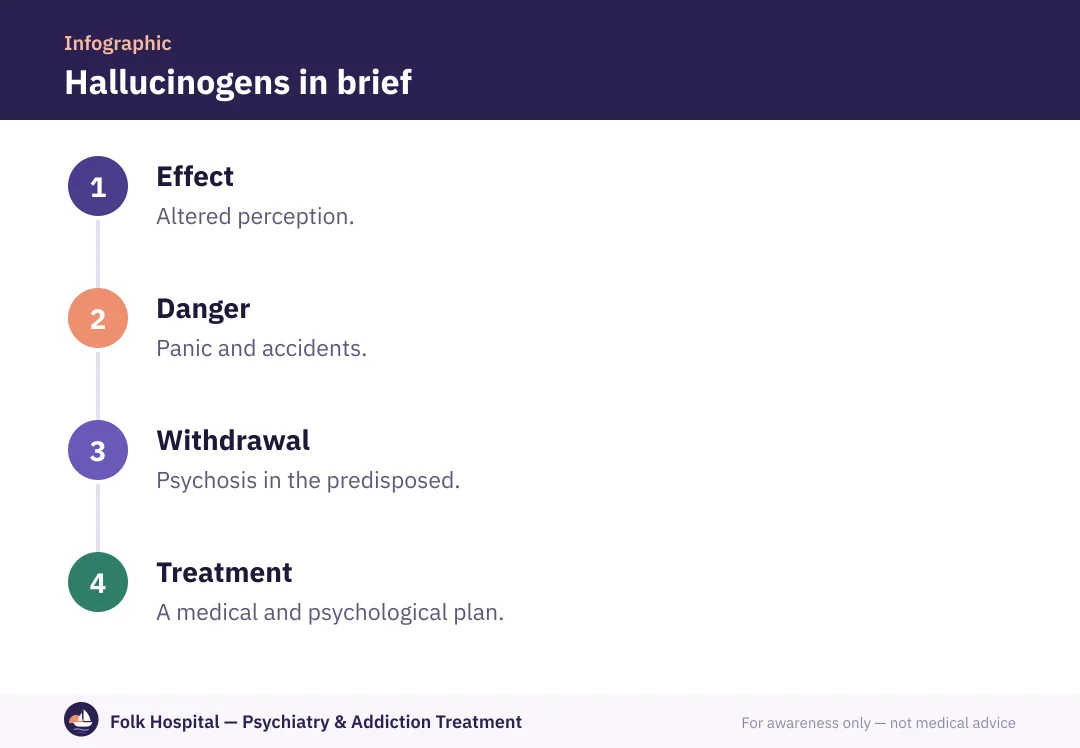
- A «bad trip»: panic and fear of dying or going mad.
- Accidents and falls from heights while hallucinating.
- Triggering psychosis or bipolar disorder in those predisposed.
- Persistent perception disturbances after stopping in some people.
- With ketamine: bladder damage, dependence and memory problems.
- Poisoning from toxic fungi mixed with mushrooms.
- Seizures or very high temperature.
- Severe agitation with a risk of harm to self or others.
- Unconsciousness or slow breathing, especially with ketamine.
- Vomiting and severe abdominal pain after eating mushrooms.
Stay calm with the person somewhere safe and dimly lit, reassure them the effect will pass, and never leave them alone near a window or road.
Ambulance: 12305What is withdrawal like?
Classic psychedelics don't usually cause clear physical withdrawal, but anxiety and poor sleep may follow. Ketamine, after repeated use, can cause strong cravings, low mood and fatigue on stopping.
- Right after usefatigue, anxiety and difficulty sleeping.
- The following days and weeksperceptual flashbacks or anxiety may return and need assessment if they persist.
- With ketaminecravings and low mood that can last weeks, and a bladder check if urinary symptoms appear.
06How does treatment differ?
Treatment focuses on psychiatric assessment of any psychosis, anxiety or depression that appeared after use, then cognitive behavioural therapy and rehabilitation. With ketamine, urological and memory assessment is added. Someone who developed psychosis usually needs specialist psychiatric care and longer follow-up.
07Read also
؟Frequently asked questions
Are hallucinogens addictive?
Most classic psychedelics don't cause physical dependence like opioids, but rapid tolerance and compulsive repeat use can occur. Ketamine in particular can cause real dependence.
What is a bad trip?
A frightening experience while hallucinating, with panic or fear of dying or losing one's mind, sometimes with dangerous behaviour. It usually settles as the effect wears off but can leave lasting anxiety.
Can LSD cause madness?
It can trigger psychosis or a mental disorder in people with a personal or family predisposition, and some people keep having perception disturbances after stopping.
Are mushrooms natural and safe?
Natural doesn't mean safe. The effect is unpredictable, and sometimes the greatest danger is confusing them with toxic fungi that can cause liver failure.
How does ketamine harm the bladder?
Repeated use can cause bladder inflammation and damage, showing as pain, frequent urination and blood in the urine, which can be severe.
Do hallucinogens have therapeutic uses?
Some are being researched under tightly controlled medical conditions, and ketamine has specific medical uses. That's entirely different from street use.
Sources and references
- Hallucinogens — research topic — National Institute on Drug Abuse (NIDA)
- Psilocybin (Magic Mushrooms) — National Institute on Drug Abuse (NIDA)
- Ketamine — National Institute on Drug Abuse (NIDA)
- Drugs, Brains, and Behavior: The Science of Addiction — National Institute on Drug Abuse (NIDA)

A psychiatrist specialising in addiction and mental illness in adults and adolescents, with a focus on dual diagnosis.
For awareness only — not a substitute for medical advice. Editorial policy · View profile