01Positive symptoms
What psychosis adds
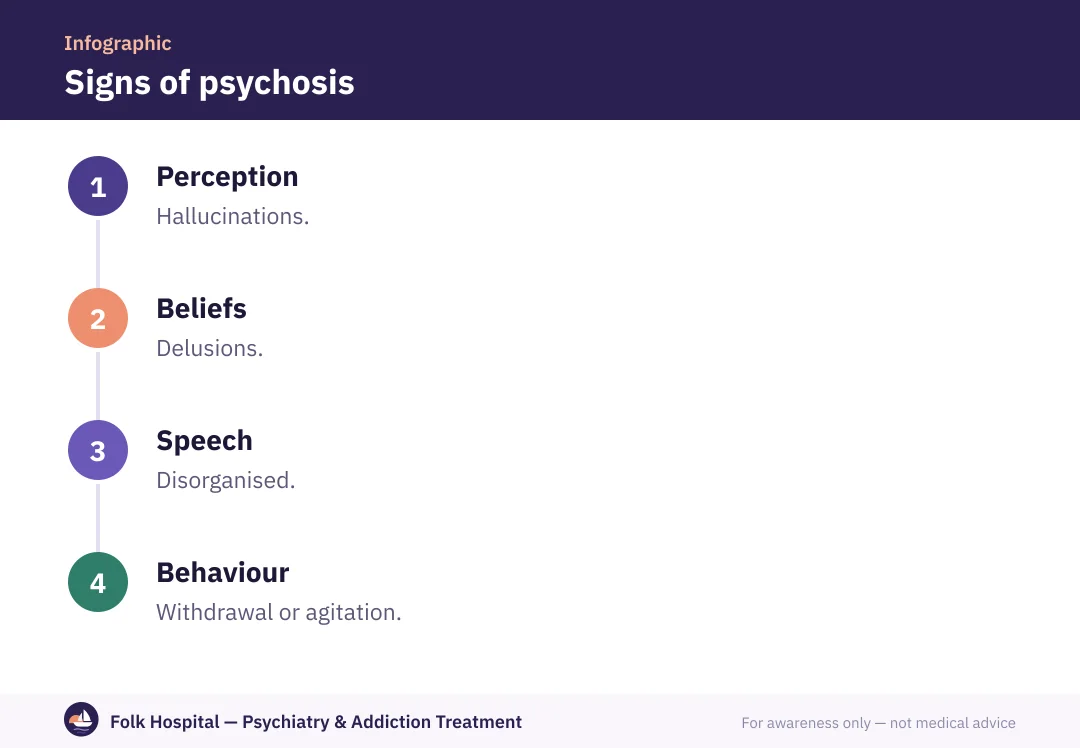
- Auditory hallucinations: voices commenting, commanding or talking among themselves.
- Visual, tactile or smell hallucinations: less common, and may point to a physical cause or substance.
- Persecutory delusions: conviction that someone is watching or wants to harm them.
- Delusions of reference: believing the TV or strangers send them special messages.
- Grandiose delusions: conviction of extraordinary powers or a mission.
- Disorganised speech: jumping between ideas or incomprehensible talk.
- Disorganised behaviour: strange or unpredictable actions.
02Negative symptoms
- Flat emotions and few facial expressions.
- Little speech and brief answers.
- Lost motivation and interest in activities.
- Withdrawal from family and friends.
- Neglected hygiene and appearance.
These are clearer in schizophrenia and can be mistaken for laziness.
03Early warning signs
| Area | What the family may notice |
|---|---|
| Sleep | Staying up late or a reversed sleep pattern |
| Relationships | Withdrawal and drifting from friends |
| Thinking | Odd ideas; sudden preoccupation with religion, philosophy or conspiracies |
| Mood | Suspicion, anxiety and irritability without clear reason |
| Performance | Slipping at school or work |
| Perception | Heightened sensitivity to sounds or colours |
04Telling psychosis apart from other things
- Hallucinations when falling asleep or waking are common and normal.
- Religious or cultural beliefs shared in a person's community aren't delusions.
- Visual hallucinations with confusion and fever may point to a physical cause or alcohol withdrawal. Read hallucinations.
- Threats to harm themselves or others, or talk of suicide.
- Acting on commands the person hears.
- Severe agitation or refusing food and drink.
- Confusion with fever or seizures, or after taking a substance.
Mental health hotline: 08008880700.
Ambulance: 123Read psychosis, causes of psychosis and supporting someone with psychosis.
؟Frequently asked questions
What are the first symptoms of psychosis?
Usually vague changes: poor sleep, withdrawal, suspicion, poor concentration and falling performance, with hallucinations or delusions appearing later.
What's the difference between hallucinations and delusions?
Hallucinations are perceiving something that isn't there, such as hearing voices; delusions are fixed false beliefs, such as being persecuted.
Why doesn't a person with psychosis accept they're ill?
Psychosis itself affects the ability to judge one's own state, so hallucinations and delusions feel completely real.
Does everyone who hears voices have psychosis?
No. Some people hear their name as they fall asleep, or after a bereavement, without psychosis. Psychosis usually involves other symptoms and an impact on life.
What are negative symptoms?
A loss of normal functions: little speech, flat emotions, lost motivation and interest, and withdrawal.
When should I seek help?
When you notice a clear change in behaviour and thinking over weeks, and immediately if the person or others are at risk.
Sources and references
- Psychosis — NHS (UK)
- Schizophrenia — National Institute of Mental Health (NIMH)
- Schizophrenia — fact sheet — World Health Organization

A psychiatrist specialising in addiction and mental illness in adults and adolescents, with a focus on dual diagnosis.
For awareness only — not a substitute for medical advice. Editorial policy · View profile