01What is psychosis?
Psychosis is a state in which a person loses part of their contact with reality, with hallucinations (hearing or seeing things that aren't there) or delusions (fixed false beliefs such as persecution), along with disordered thinking and speech. It's a symptom, not a final diagnosis, and it can have different causes. Read about the symptoms of psychosis and its causes.
02Step one: finding the cause
| Possible cause | Examples |
|---|---|
| Drugs | Shabu, cannabis, Strox and hallucinogens. Read about drug-induced psychosis |
| Mental disorders | Schizophrenia, bipolar disorder and psychotic depression |
| Physical causes | Infections, gland disorders, brain diseases or medicine side effects |
So assessment includes blood tests, a drug screen and sometimes brain imaging.
03Elements of treatment
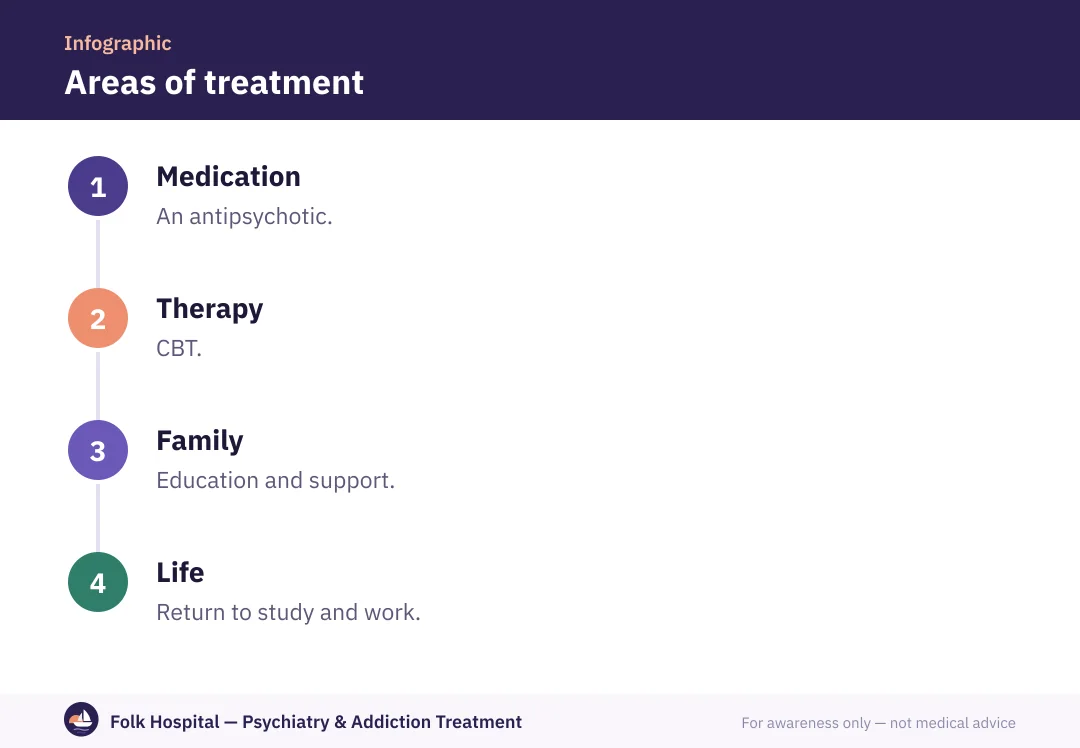
- Safetya calm setting, assessment of risk to self or others, and admission when needed.
- Antipsychoticsat the lowest effective dose, with side effects monitored.
- Stopping drugsa basic condition for preventing future episodes.
- CBT for psychosisfor coping with hallucinations and distressing thoughts.
- Family therapy and educationto understand the illness and the signs of relapse.
- Returning to lifestudy or work, gradually, with follow-up.
04How long does treatment last?
After a first episode, medication usually continues for one to two years after improvement; the doctor may then reduce it gradually with close follow-up. With repeated episodes, longer treatment is needed. Stopping suddenly is one of the commonest causes of relapse.
05Early intervention
International guidelines indicate that treating a first episode early, and shortening the period of untreated psychosis, improves long-term outcomes. So don't wait if symptoms appear.
06When is admission needed?
When there's danger to self or others, refusal to eat or drink, severe agitation, or treatment isn't possible at home. See our psychiatric hospital.
- An attempt to harm oneself or others.
- Severe agitation or dangerous action driven by hallucinations.
Read how to deal with someone with psychosis and psychosis versus schizophrenia.
؟Frequently asked questions
How long is psychosis treated?
After a first episode, treatment usually continues for one to two years, with the doctor setting the length case by case.
Does psychosis mean schizophrenia?
No. Psychosis is a symptom that can occur in schizophrenia, bipolar disorder or severe depression, or because of drugs or a physical illness. Diagnosis determines the cause and the plan.
Can the patient recover fully?
Many patients recover well after a first episode, especially with early treatment, adherence and stopping drugs.
Why won't the patient accept they're ill?
Poor insight is part of psychosis itself, so it takes patience and calm conversation, and sometimes medical intervention when there's danger.
Sources and references
- Psychosis and schizophrenia in adults (CG178) — National Institute for Health and Care Excellence (NICE)
- Schizophrenia — National Institute of Mental Health (NIMH)
- Schizophrenia — fact sheet — World Health Organization
- Mental Health Medications — National Institute of Mental Health (NIMH)

A psychiatrist specialising in addiction and mental illness in adults and adolescents, with a focus on dual diagnosis.
For awareness only — not a substitute for medical advice. Editorial policy · View profile