01Vulnerability and trigger
Doctors often understand psychosis as two factors meeting: vulnerability that makes the brain more susceptible, and a trigger that pushes it over the threshold. Two people may use the same hashish, and only one develops psychosis because their vulnerability differs.
02The main causes
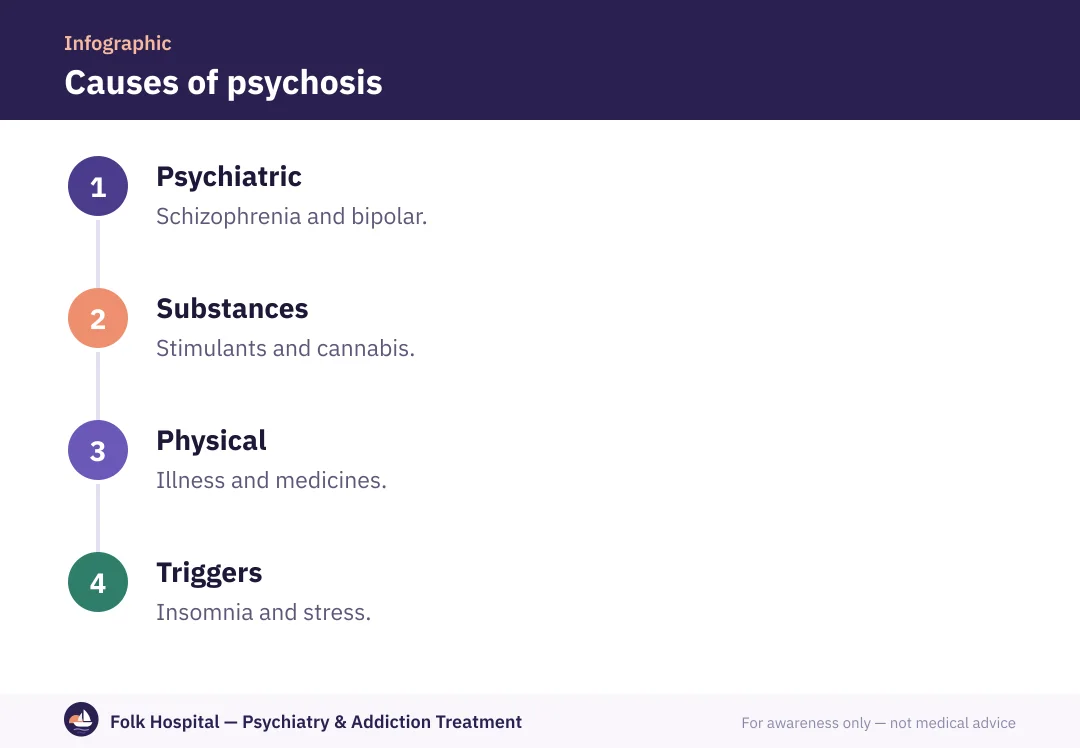
| Category | Examples |
|---|---|
| Mental disorders | Schizophrenia, bipolar disorder, psychotic depression, schizoaffective disorder, delusional disorder |
| Drugs and substances | Shabu, captagon, hashish, strox, hallucinogens, alcohol withdrawal |
| Physical illness | Brain infections, epilepsy, tumours, dementia, thyroid disorders |
| Medicines | High-dose steroids, some Parkinson's medicines and others |
| Special circumstances | After childbirth; severe sleep deprivation |
03Factors that raise vulnerability
- Genes: a relative with schizophrenia or bipolar disorder. Read mental illness and heredity.
- Hashish use in adolescence, especially high-potency strains.
- Trauma and childhood abuse.
- Pregnancy and birth complications affecting brain development.
- Isolation and chronic stress.
04Common triggers for an episode or relapse
- Sleep lossdays without sleep, especially with stimulants.
- Substancesa large dose or a new, stronger strain.
- Severe stressbereavement, separation or exams.
- Stopping medicationin people already diagnosed.
05Why physical causes are ruled out
First-episode checks
The doctor usually orders blood tests and a drug screen, and sometimes brain imaging or an EEG, especially if psychosis comes with confusion, fever, headache or seizures, or starts after age forty.
- Threats to harm themselves or others, or talk of suicide.
- Acting on commands the person hears.
- Severe agitation or refusing food and drink.
- Confusion with fever or seizures, or after taking a substance.
Mental health hotline: 08008880700.
Ambulance: 123Read drug-induced psychosis, psychosis symptoms and psychosis treatment.
؟Frequently asked questions
What are the most common causes of psychosis?
Schizophrenia, bipolar disorder, psychotic depression and drugs are among the commonest; the order varies with age and circumstances.
Can stress alone cause psychosis?
It can cause a brief psychotic episode in some people after a severe event, but usually acts as a trigger in those already vulnerable.
Does shabu cause psychosis?
Yes. Shabu is among the strongest psychosis-inducing substances, especially at high doses and after days without sleep.
Can a physical illness cause psychosis?
Yes, such as brain infections, epilepsy, some tumours, thyroid disorders, certain vitamin deficiencies and some medicines.
Does postpartum psychosis exist?
Yes. Postpartum psychosis is rare but an emergency, needing immediate treatment to protect mother and baby.
Is stopping the drug enough to treat psychosis?
Drug-induced psychosis may resolve with stopping and treatment, but some cases reveal an underlying disorder needing longer treatment.
Sources and references
- Psychosis — NHS (UK)
- Schizophrenia — National Institute of Mental Health (NIMH)
- Schizophrenia — fact sheet — World Health Organization
- Comorbidity: Substance Use and Other Mental Disorders — National Institute on Drug Abuse (NIDA)
- Cannabis (Marijuana) — research topic — National Institute on Drug Abuse (NIDA)
- Methamphetamine — research topic — National Institute on Drug Abuse (NIDA)

A psychiatrist specialising in addiction and mental illness in adults and adolescents, with a focus on dual diagnosis.
For awareness only — not a substitute for medical advice. Editorial policy · View profile