01A direct comparison
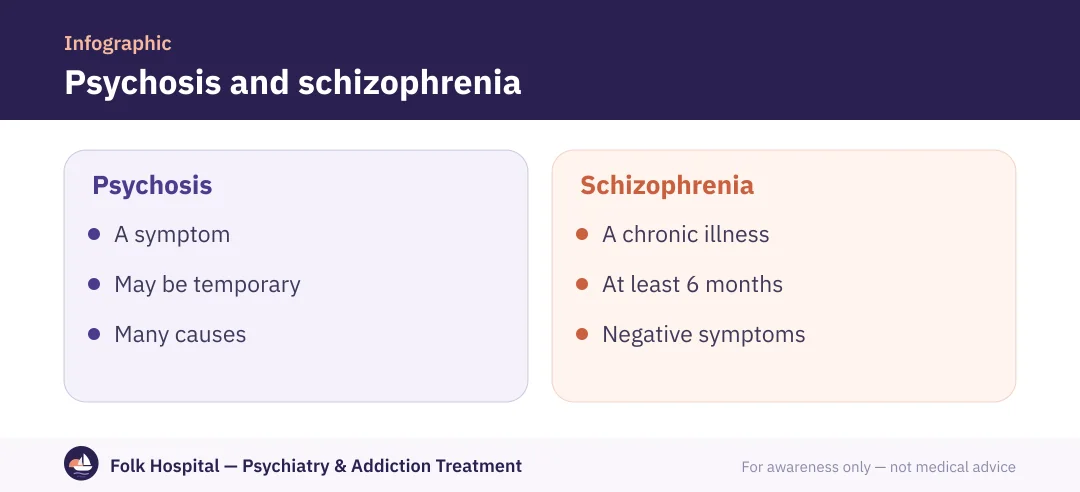
| Aspect | Psychosis | Schizophrenia |
|---|---|---|
| Nature | A symptom or state | A chronic mental disorder |
| Causes | Many: drugs, stress, bipolar disorder, depression, physical illness | A mix of genes, brain chemistry and environment |
| Duration | Can be days or weeks | At least six months to diagnose; often lifelong |
| Symptoms | Hallucinations, delusions, disordered thinking | The same, plus negative symptoms and cognitive decline |
| After an episode | The person may return fully to normal | Symptoms may remain between episodes |
| Treatment | Treating the cause; antipsychotics for a period | Long-term antipsychotics and rehabilitation |
02When is psychosis the start of schizophrenia?
Signs that make the doctor consider schizophrenia
- Symptoms persisting months after stopping substances.
- Clear negative symptoms: flat emotion, withdrawal, little speech.
- A gradual decline in study or work before the episode.
- A family history of schizophrenia.
- No clear cause such as a substance, physical illness or mood disorder.
03Other conditions that resemble both
- Brief psychotic disorder: an episode lasting under a month, then resolving.
- Schizoaffective disorder: psychosis with clear mood episodes.
- Bipolar disorder: psychosis may come during manic or depressive episodes.
- Delusional disorder: a fixed delusion without many other symptoms.
- Drug-induced psychosis: linked to use and usually improves with stopping.
04Why the distinction matters
It determines the length of treatment, the kind of follow-up and expectations. Someone with temporary substance-induced psychosis may need weeks to months of treatment plus stopping the substance, while someone with schizophrenia needs a long plan including medication, rehabilitation and family support. In both, early treatment improves outcomes.
Schizophrenia isn't split personality
The confusion is common, but schizophrenia doesn't mean multiple personalities. Read schizophrenia vs split personality.
Read psychosis, schizophrenia and schizophrenia symptoms.
؟Frequently asked questions
What's the difference between psychosis and schizophrenia?
Psychosis is a symptom meaning loss of contact with reality, with many causes; schizophrenia is a chronic illness that is one cause of psychosis, with negative symptoms and ongoing decline in functioning.
Does psychosis turn into schizophrenia?
Not necessarily. Many psychotic episodes don't, especially when caused by a substance or stress and treated. But some first episodes are the start of schizophrenia.
How long does temporary psychosis last?
Days to weeks, resolving as the cause is removed and treated. If signs persist for a long time, the doctor reassesses.
Is treatment the same?
Both are treated with antipsychotics and psychological support, but schizophrenia needs long-term treatment and follow-up, whereas treatment for temporary psychosis may be tapered after a while.
Is schizophrenia a split personality?
No. Schizophrenia doesn't mean two personalities; «split personality» is a popular misnomer for dissociative identity disorder, a completely different condition.
How does the doctor tell them apart?
Through the history and duration of symptoms, negative symptoms, substance use, physical tests and follow-up over time.
Sources and references
- Psychosis — NHS (UK)
- Schizophrenia — National Institute of Mental Health (NIMH)
- Schizophrenia — fact sheet — World Health Organization

A psychiatrist specialising in addiction and mental illness in adults and adolescents, with a focus on dual diagnosis.
For awareness only — not a substitute for medical advice. Editorial policy · View profile