01Common types
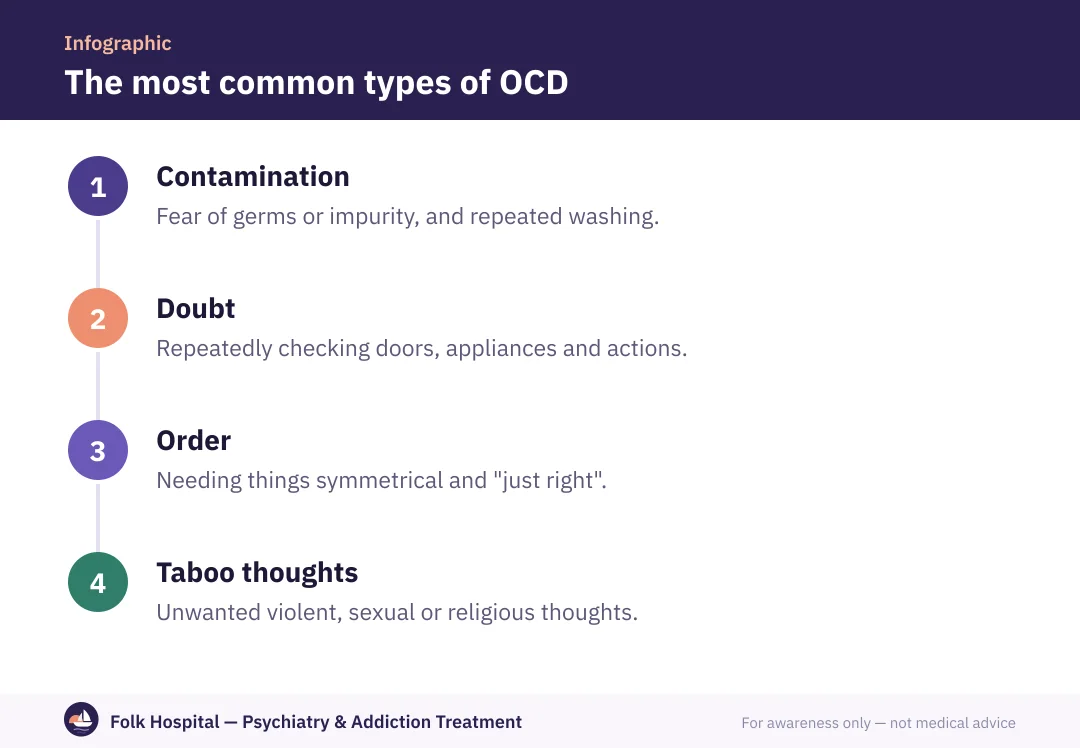
| Type | Obsession | Compulsion |
|---|---|---|
| Contamination | Germs, impurity, illness | Washing, avoidance |
| Doubt | «Did I lock the door?» | Repeated checking |
| Symmetry | Things feeling «not right» | Arranging, repeating |
| Harm thoughts | Fear of hurting someone | Avoidance, reassurance-seeking |
| Religious | Doubts about worship, offensive thoughts | Repeating worship, compulsive seeking of forgiveness |
| Sexual | Unwanted sexual thoughts | Checking feelings, avoidance |
| Relationship | «Do I really love my partner?» | Comparing, reassurance-seeking |
| Health | Fear of serious illness | Checking, searching, doctor visits |
02Why are they all alike?
- A distressing thoughtdiffering in theme.
- Anxiety or a sense of wrongness.
- A compulsion or avoidance.
- Temporary relief.
- The obsession strengthens.
03Related disorders
Read OCD, OCD treatment, types of OCD and the OCD test.
؟Frequently asked questions
What are the types of OCD?
Contamination, doubt and checking, symmetry and ordering, harm thoughts, religious, sexual, relationship and health OCD.
Do thoughts of harming others mean I'm dangerous?
No. These are distressing intrusive thoughts the person strongly rejects; they don't mean desire or real danger.
What is relationship OCD?
Repeated doubt about one's feelings for a partner or whether the relationship is right, with checking and reassurance-seeking.
Can I have more than one type?
Yes, and themes can change over time.
Is treatment the same for all types?
The principle is the same, ERP, adapted to the theme, with medication when needed.
Is compulsive hoarding a type of OCD?
Hoarding disorder is now classified as a separate disorder related to OCD.
Sources and references
- Obsessive-Compulsive Disorder — National Institute of Mental Health (NIMH)
- Obsessive compulsive disorder (OCD) — overview — NHS (UK)
- Psychotherapies — National Institute of Mental Health (NIMH)

A psychiatrist specialising in addiction and mental illness in adults and adolescents, with a focus on dual diagnosis.
For awareness only — not a substitute for medical advice. Editorial policy · View profile