01Common forms
Signs of religious OCD
- Repeating ablution or ritual washing many times.
- Repeating prayer from doubt about its validity.
- Constant doubt about intention.
- Painful offensive intrusive thoughts.
- Compulsive, repeated seeking of forgiveness or prayers.
- Repeatedly asking others whether worship was valid.
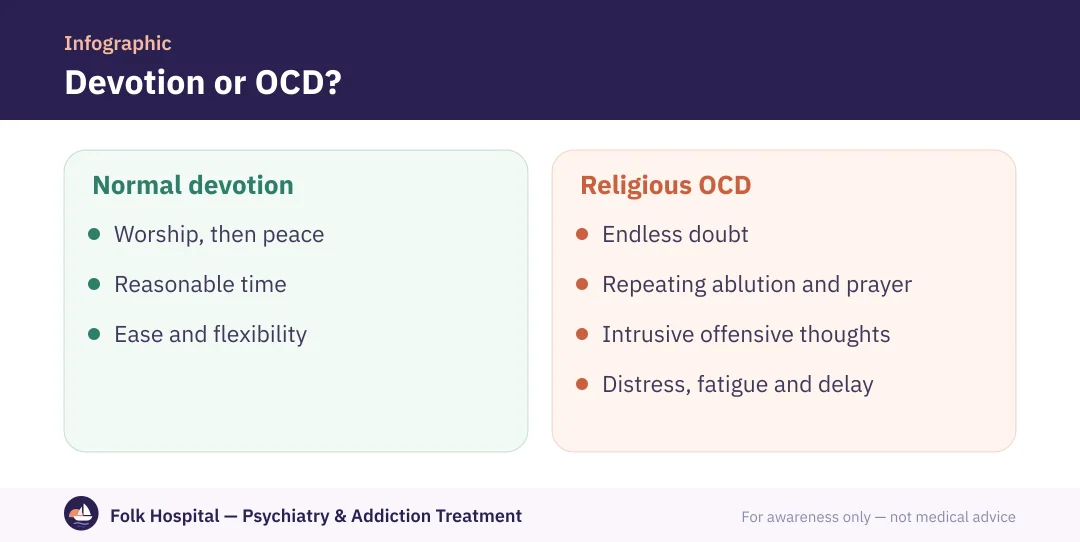
02Religious commitment or OCD?
| Healthy commitment | Religious OCD | |
|---|---|---|
| Feeling | Peace | Anxiety and distress |
| Time | Reasonable | Long and repeated |
| Doubt | Little and passing | Persistent and growing with repetition |
| Effect | Strengthens spiritual life | Exhausts and clouds it |
03Treatment
- UnderstandingOCD is an illness, not a sin.
- Exposureperforming worship once despite doubt.
- Response preventionnot repeating or seeking reassurance.
- Tolerating doubtuntil anxiety settles.
- Cooperationwith a religious adviser who understands OCD when needed.
Read OCD, its types and its treatment.
؟Frequently asked questions
What is religious OCD?
A form of OCD centred on religion, such as doubts about purity and worship, repeating them, and painful offensive intrusive thoughts.
Is religious OCD weak faith?
No. The person suffers because they value their faith, and intrusive thoughts don't reflect their beliefs.
Why do I repeat ablution or prayer?
OCD plants doubt about their validity; repeating relieves briefly, then doubt grows.
Does psychotherapy conflict with religion?
No. Treatment targets OCD, not faith, and helps worship become more peaceful.
How is religious OCD treated?
With CBT using ERP, sometimes medication, and working with a trusted religious adviser can help.
Do offensive thoughts mean I'm bad?
No. They're intrusive thoughts the person rejects, and their distress shows their values.
Sources and references
- Obsessive-Compulsive Disorder — National Institute of Mental Health (NIMH)
- Obsessive compulsive disorder (OCD) — overview — NHS (UK)
- Psychotherapies — National Institute of Mental Health (NIMH)

A psychiatrist specialising in addiction and mental illness in adults and adolescents, with a focus on dual diagnosis.
For awareness only — not a substitute for medical advice. Editorial policy · View profile