01The common picture
Signs of sexual OCD
- Recurring unwanted, distressing sexual thoughts.
- Fear that the thoughts are «real».
- Checking feelings or bodily reactions.
- Avoiding people or places that trigger the thoughts.
- Reassurance-seeking or repeated online searching.
- Intense shame that prevents talking.
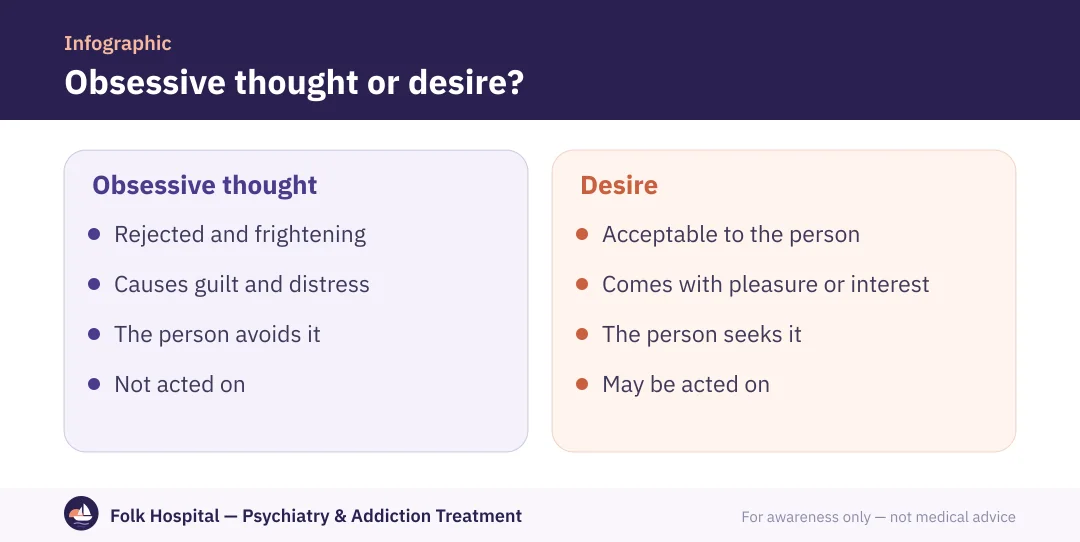
02Obsessional thought versus desire
| Obsessional thought | Genuine desire | |
|---|---|---|
| Feeling | Horror and distress | Attraction or pleasure |
| Stance | Rejection and trying to push it away | Acceptance |
| Behaviour | Avoidance and checking | Seeking |
| Values | Entirely contrary | Consistent |
03Treatment
- Understandingthe thoughts are OCD, not desire.
- Exposurefacing the thoughts without checking.
- Response preventionstopping checking, avoidance and reassurance.
- Tolerating anxietyuntil it settles.
- Medication when needed.
Read OCD, its types and its treatment.
؟Frequently asked questions
What is sexual OCD?
Unwanted intrusive sexual thoughts or images causing intense distress, with checking, avoidance and reassurance-seeking.
Do the thoughts mean I want them?
No. They're obsessional thoughts the person rejects, and their distress shows they're against their desires and values.
Is sexual OCD dangerous?
No. People with it don't act on these thoughts; they avoid what reminds them of them.
Why do I check my feelings?
OCD pushes you to make sure there's no desire, and checking strengthens doubt rather than removing it.
How is it treated?
With CBT using exposure and stopping checking, sometimes with antidepressants.
Can I talk to the doctor about these thoughts?
Yes. Psychiatrists know this type well, and the conversation is confidential and non-judgemental.
Sources and references
- Obsessive-Compulsive Disorder — National Institute of Mental Health (NIMH)
- Obsessive compulsive disorder (OCD) — overview — NHS (UK)
- Psychotherapies — National Institute of Mental Health (NIMH)

A psychiatrist specialising in addiction and mental illness in adults and adolescents, with a focus on dual diagnosis.
For awareness only — not a substitute for medical advice. Editorial policy · View profile