01What's the aim of treatment?
OCD consists of intrusive thoughts that cause intense anxiety, and compulsions the person carries out to ease that anxiety: washing, checking, arranging, asking for reassurance or repeating phrases. The problem is that compulsions bring momentary relief and then strengthen the obsession. Treatment aims to break this cycle. Read about the symptoms of OCD and its types.
02Why does exposure and response prevention work?
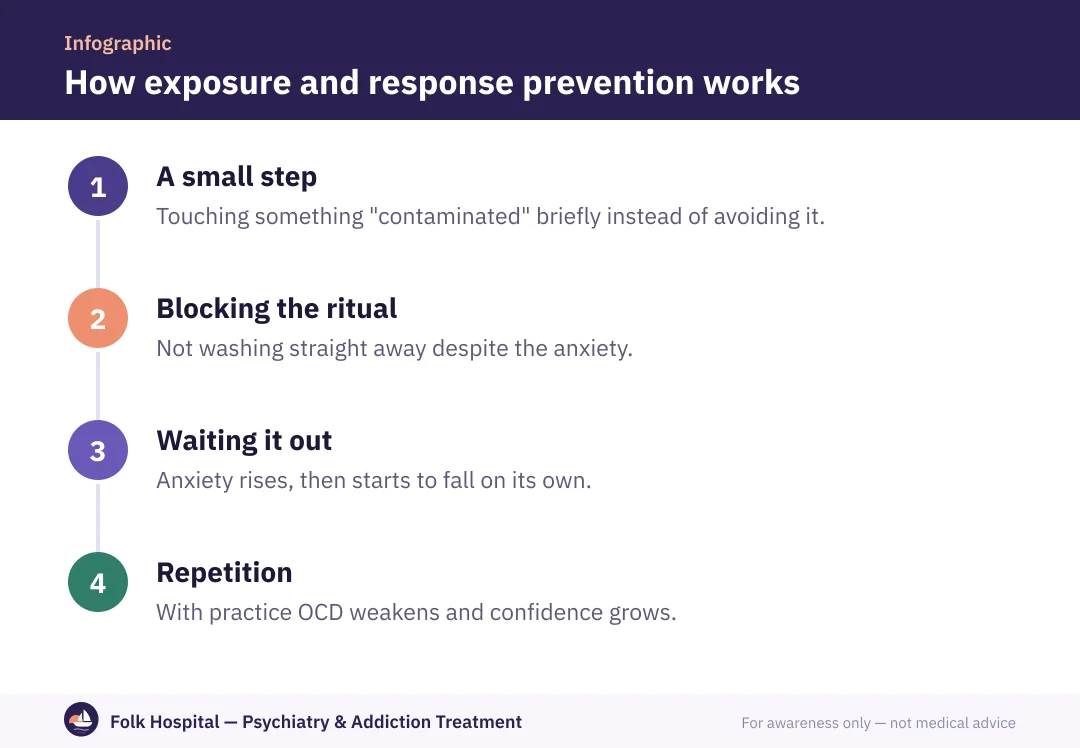
Every time you carry out a compulsion, your brain learns that the thought was a real danger and that you survived thanks to the ritual. When you face the thought without the ritual and see that the anxiety fades on its own, the brain learns a new lesson: "the thought isn't dangerous, and the anxiety passes".
How does treatment work in practice?
- Understandingexplaining the OCD cycle and mapping thoughts and rituals.
- A fear ladderranking triggering situations from easiest to hardest, agreed with the therapist.
- Gradual exposurefacing a situation at the bottom of the ladder without the ritual, and staying until the anxiety settles.
- Daily practicetasks between sessions, because improvement happens in life, not just in the clinic.
- Climbingmoving to harder situations as confidence grows.
- Relapse preventiona plan for symptoms returning at stressful times.
| Example obsession | Example exposure exercise |
|---|---|
| Fear of contamination and repeated washing | Touching a door handle and gradually delaying washing |
| Checking the door is locked many times | Locking the door once and leaving |
| Repeated reassurance questions | Stopping asking, and tolerating doubt |
| Frightening intrusive thoughts | Exposure to the thought in writing without trying to push it away |
03What role do medicines play?
The doctor prescribes antidepressants at doses suited to OCD, which take longer to work, usually 8–12 weeks. In resistant cases another medicine may be added. These medicines aren't addictive but are tapered gradually under medical supervision. Combining medication with therapy helps in moderate and severe cases. Read about psychiatric medicines.
04What role does the family play?
What helps
- Encouraging the person to face their fears.
- Agreeing with the therapist to reduce involvement in rituals.
- Praising every step.
What harms
- Repeatedly answering reassurance questions.
- Carrying out rituals on the patient's behalf.
- Mockery or anger.
Many families take part in rituals out of love: answering the same question dozens of times, or washing things the required way. This brings the patient momentary relief but strengthens the OCD. The answer isn't sudden refusal but an agreed plan with the therapist to reduce involvement gradually. Read about OCD and marriage.
05Types that need particular attention
- Religious OCD: treated with exposure and response prevention while respecting the patient's values.
- Contamination OCD and doubt OCD.
- Sexual intrusive thoughts: distressing thoughts that don't reflect the person's desires.
- OCD in children: needs greater family involvement.
06When is admission needed?
In severe cases that take up most of the day, those with severe depression or suicidal thoughts, or those that haven't responded to outpatient treatment. See our psychiatric hospital.
؟Frequently asked questions
Is exposure and response prevention painful?
It causes temporary anxiety, but it's done gradually and by agreement with the therapist, and you're never asked to do what you can't. Each step makes it easier.
When is admission needed for OCD?
In severe cases that take up most of the day, those with severe depression or suicidal thoughts, or those that haven't responded to outpatient treatment.
How long does OCD treatment take?
Usually 12 to 20 sessions of exposure and response prevention, with daily practice between sessions. Medication, if used, takes 8–12 weeks to show benefit and continues longer after improvement.
Are OCD medicines addictive?
No, but they're tapered gradually under medical supervision and never stopped suddenly.
Is religious OCD treated the same way?
Yes. It's a form of OCD treated with exposure and response prevention while respecting the patient's values, sometimes in cooperation with a trusted religious figure.
Sources and references
- Obsessive-Compulsive Disorder — National Institute of Mental Health (NIMH)
- Psychotherapies — National Institute of Mental Health (NIMH)
- Mental Health Medications — National Institute of Mental Health (NIMH)
- Mental disorders — fact sheet — World Health Organization

A psychiatrist specialising in addiction and mental illness in adults and adolescents, with a focus on dual diagnosis.
For awareness only — not a substitute for medical advice. Editorial policy · View profile