01Common forms
Examples of doubt OCD
- Going back to check the door or gas several times.
- Rereading messages many times before sending.
- Repeatedly checking accounts.
- Mentally reviewing conversations to be sure of not offending.
- Asking others «are you sure I locked it?».
02Why does doubt grow?
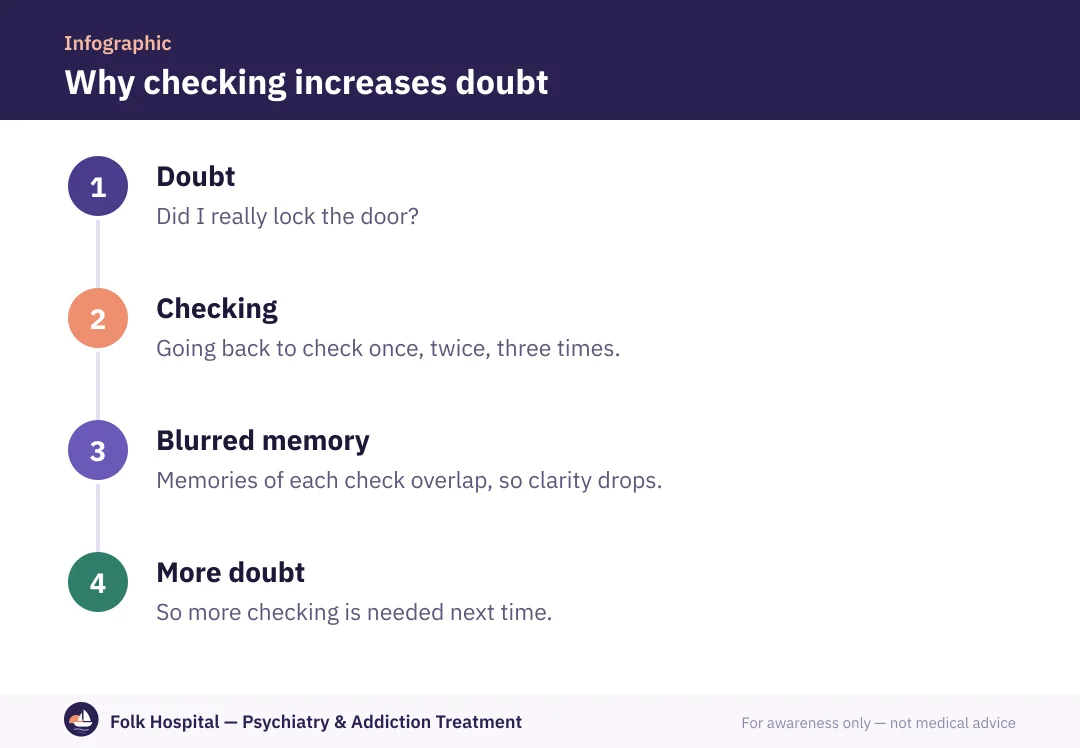
- Doubt«did I lock the door?».
- Anxiety«if I didn't, disaster will happen».
- Checkinggoing back to make sure.
- Temporary reliefthen the doubt returns.
- Weaker trust in memoryso checking increases.
03Treatment
What increases doubt
- Repeated checking.
- Mental reviewing.
- Reassurance-seeking.
- Photographing or recording to be sure.
What helps
- One check, then stop.
- Tolerating doubt without acting.
- Gradually reducing reassurance.
- CBT with exposure.
Read OCD, its types and its treatment.
؟Frequently asked questions
What is doubt OCD?
Repeated doubt about whether actions were completed or correct, leading to repeated checking, reviewing and reassurance-seeking.
Why doesn't checking remove the doubt?
Each check teaches the brain that doubt is dangerous and needs checking, strengthening doubt and weakening trust in memory.
Does doubt OCD mean poor memory?
No. Memory is usually fine, but frequent checking reduces confidence in it.
How do I stop checking?
With a gradual plan with a therapist: check once, then leave the doubt without acting, tolerating anxiety until it settles.
Does asking family for reassurance help?
It relieves briefly but strengthens OCD; it's better to reduce it gradually by agreement with the therapist.
Does it affect work?
Yes. It can cause slowness and redoing tasks, which improve with treatment.
Sources and references
- Obsessive-Compulsive Disorder — National Institute of Mental Health (NIMH)
- Obsessive compulsive disorder (OCD) — overview — NHS (UK)
- Psychotherapies — National Institute of Mental Health (NIMH)

A psychiatrist specialising in addiction and mental illness in adults and adolescents, with a focus on dual diagnosis.
For awareness only — not a substitute for medical advice. Editorial policy · View profile