01What are sedatives and why are they addictive?
Benzodiazepine sedatives are prescribed for anxiety, panic attacks, insomnia and seizures, and include Xanax, Rivotril, Valium, lorazepam and bromazepam. They work quickly and bring clear calm, which makes them useful for short periods and risky if use goes on.
With daily use over weeks, the brain adapts, the same dose has less effect, and anxiety and insomnia appear between doses or when a dose is late. This is when many people raise the dose or obtain it from more than one doctor or pharmacy. Read about signs of sedative addiction.
02Why mustn't you stop suddenly?
A real danger
After long-term use or at high doses, stopping sedatives suddenly can cause seizures, severe confusion or hallucinations. So withdrawal is always gradual and medically supervised, and you should never advise anyone to stop "all at once".
03How is it treated?
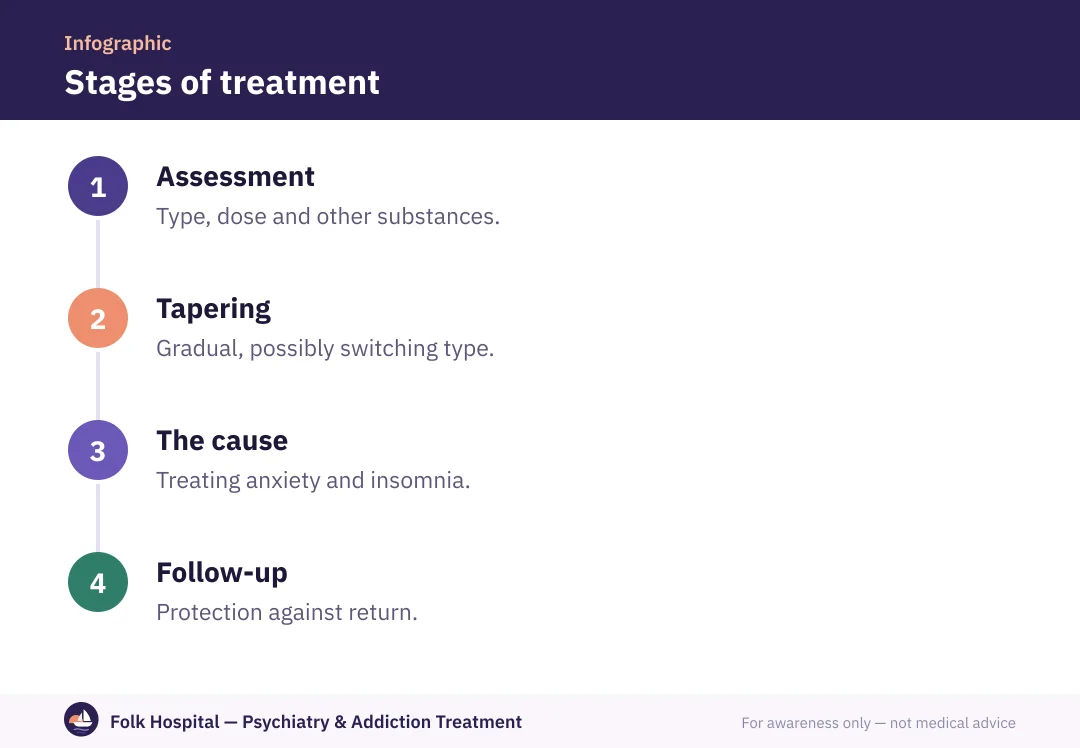
We set a comfortable tapering schedule suited to the type and dose, and teach you skills for handling anxiety and insomnia without a new dependence. Read about the programme that suits your situation.
- Assessmentthe type of sedative, daily dose and length of use, any alcohol, opioids or pregabalin, seizure history and the original reason for the prescription.
- Switching where neededmoving the patient to a long-acting sedative at an equivalent dose to steady blood levels.
- Gradual taperingsmall, regular reductions every one or two weeks, with the option to pause at a difficult step.
- Treating the causetreating anxiety, panic or insomnia with CBT and non-addictive medicines.
- Follow-upsessions until months after the last dose, because some symptoms appear late.
04Pace of tapering: why patience beats speed
| Length of use | Approximate pace | Common overall length |
|---|---|---|
| A few weeks | Relatively faster | Two to four weeks |
| Months | Small steps every one or two weeks | Several weeks to two months |
| Years or high doses | Very small steps with pauses | Several months |
The rule: the patient sets the pace with their doctor. If symptoms become severe, we hold the dose for a week or more before the next step. A slow, comfortable taper succeeds far more often than a fast one that ends in going back.
05Withdrawal symptoms and how we ease them
Common symptoms during tapering
- Anxiety, tension and insomnia.
- Irritability and mood swings.
- Tremor, sweating and palpitations.
- Sensitivity to light, sound and touch.
- Poor concentration and a sense of unreality.
We ease them with a slower taper, sleep routines, breathing and relaxation exercises, physical activity and non-addictive medicines when needed. Read about sedative withdrawal.
06Treating anxiety and insomnia without sedatives
The original problem doesn't disappear when the sedative stops; it may become clearer. So:
- Cognitive behavioural therapy for anxiety and panic, one of the most effective long-term treatments.
- CBT for insomnia: regular sleep times, less time awake in bed and changing thoughts about sleep.
- Non-addictive medicines for anxiety or depression chosen by the doctor.
- Daily habits: less caffeine, regular exercise and daylight exposure.
Read about generalised anxiety disorder and insomnia.
07When other substances are involved
- Sedatives with opioids (tramadol, heroin, methadone), alcohol or pregabalin multiply the risk of extreme drowsiness and slowed breathing. Signs such as difficulty waking, slow breathing or blue lips need an ambulance on 123 immediately.
In these cases we set a detox plan that covers every substance, and residential care is usually the safest option.
Ambulance: 123Read opioid addiction treatment and alcohol addiction treatment.
08Sedatives in older adults
Many older people have taken sleeping pills or sedatives for years, which raises the risk of falls and fractures and memory problems and confusion. Tapering usually benefits them, but it must be very slow and coordinated with their treating doctor, with an alternative plan for sleep.
09Residential or outpatient?
An outpatient taper usually suits
- One sedative at a moderate dose.
- No previous seizures.
- No alcohol or opioids.
- Keeping appointments, with a supportive family.
Residential care is better with
- Very high doses or more than one sedative.
- Previous seizures.
- Mixing with opioids or alcohol.
- Severe depression or thoughts of self-harm.
؟Frequently asked questions
Can I come off sedatives without going into hospital?
Usually yes, with a structured outpatient taper. A residential stay helps with high doses, a history of seizures or mixing other substances.
How long does tapering sedatives take?
It varies widely; a few weeks may be enough after short-term use, while someone who has used them for years may need several months of patient tapering.
Why does the doctor switch me to a different sedative before tapering?
Long-acting types give steadier blood levels, so there are fewer swings and less withdrawal between doses, which makes tapering easier.
What are sedative withdrawal symptoms?
Anxiety, insomnia, irritability, sweating, tremor, sensitivity to light and sound, and sometimes a sense of unreality. Stopping high doses suddenly can cause seizures.
I still have anxiety and insomnia after stopping. Is that normal?
Some people have mild symptoms for weeks or months after stopping, which improve gradually. CBT for anxiety and insomnia helps a great deal during this time.
I'm older and have taken a sleeping pill for years. Should I stop?
Tapering is usually beneficial in older adults because sedatives raise the risk of falls, fractures and memory problems, but it must be slow and supervised by the doctor.
Can sedatives be addictive even on prescription?
Yes. Daily use for more than a few weeks can cause physical dependence even at prescribed doses, and addiction develops when the dose rises and control is lost.
Sources and references
- Prescription Medicines — research topic — National Institute on Drug Abuse (NIDA)
- Anxiety Disorders — National Institute of Mental Health (NIMH)
- Mental Health Medications — National Institute of Mental Health (NIMH)
- Treatment Approaches for Drug Addiction — DrugFacts — National Institute on Drug Abuse (NIDA)
- Drug misuse in over 16s: psychosocial interventions (CG51) — National Institute for Health and Care Excellence (NICE)

A psychiatrist specialising in addiction and mental illness in adults and adolescents, with a focus on dual diagnosis.
For awareness only — not a substitute for medical advice. Editorial policy · View profile