01Types of benzodiazepines and when withdrawal starts
| Type | Examples | Approximate onset of withdrawal |
|---|---|---|
| Short-acting | Xanax and lorazepam | Within hours to a day |
| Long-acting | Valium and Rivotril | After two to several days |
02Symptoms
| Severity | Symptoms |
|---|---|
| Common | Anxiety, panic, insomnia, tremor, sweating, irritability and poor concentration |
| Sensory | Sensitivity to light and sound, tingling and a sense of unreality |
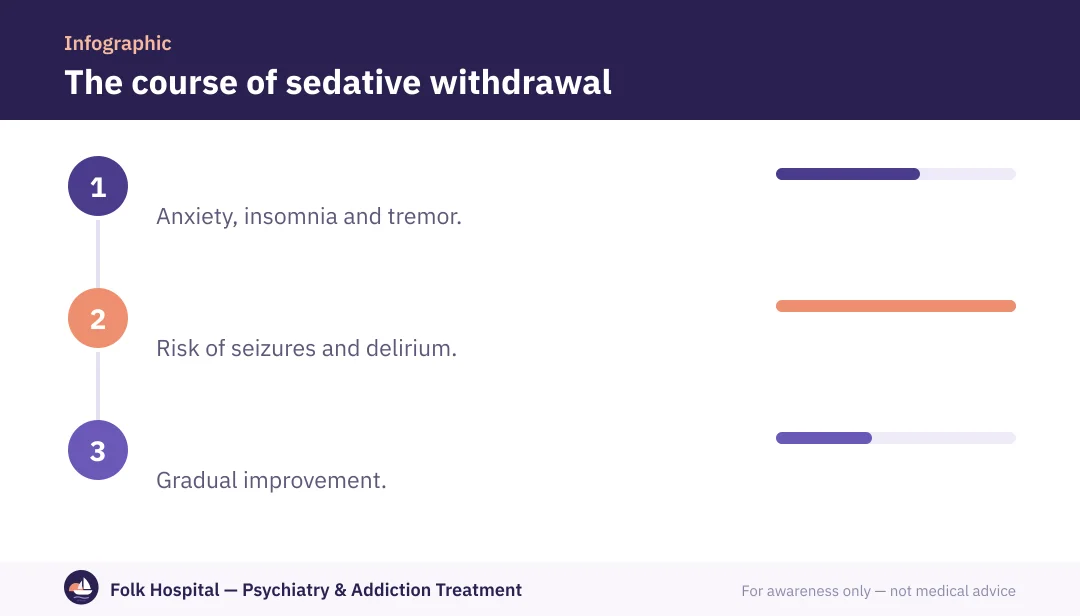
| Serious | Seizures, hallucinations and delirium |
03Safe detox
- Assessmenttype of medicine, dose, duration and other substances.
- A reduction plansmall steps over weeks set by the doctor.
- Treating anxiety and insomniawith means that don't cause dependence.
- Cognitive behavioural therapyskills for handling anxiety without medication.
- Follow-upadjusting the pace to the symptoms.
- Especially with high doses or mixing with alcohol or pregabalin. For seizures or severe confusion: ambulance 123.
Read about sedative addiction treatment, the symptoms of sedative use and their harms.
؟Frequently asked questions
Is sedative withdrawal life-threatening?
It can be when high doses are stopped suddenly, because of seizures and delirium, which is why it needs medical supervision.
How long does gradual reduction take?
It varies with dose, duration and type of medicine, usually weeks to months, at a pace the doctor sets and the patient can tolerate.
Will my anxiety come back after stopping?
Temporary rebound anxiety may appear. For the original anxiety there are alternatives that don't cause dependence, such as some antidepressants and CBT.
Should I switch to another type?
Sometimes the doctor switches the patient to a longer-acting type to make reduction easier. Don't do this yourself.
Sources and references
- Prescription Medicines — research topic — National Institute on Drug Abuse (NIDA)
- Treatment Approaches for Drug Addiction — DrugFacts — National Institute on Drug Abuse (NIDA)
- Anxiety Disorders — National Institute of Mental Health (NIMH)

A psychiatrist specialising in addiction and mental illness in adults and adolescents, with a focus on dual diagnosis.
For awareness only — not a substitute for medical advice. Editorial policy · View profile