01What's the aim of treatment?
Generalised anxiety isn't just "worrying too much" but persistent, hard-to-control worry that moves from topic to topic, with physical tension, insomnia and fatigue. The aim of treatment isn't for anxiety to vanish completely, since anxiety is a normal part of life, but for it to return to a normal size so it doesn't control your day and your decisions. Read about the symptoms of generalised anxiety.
02How does CBT help?
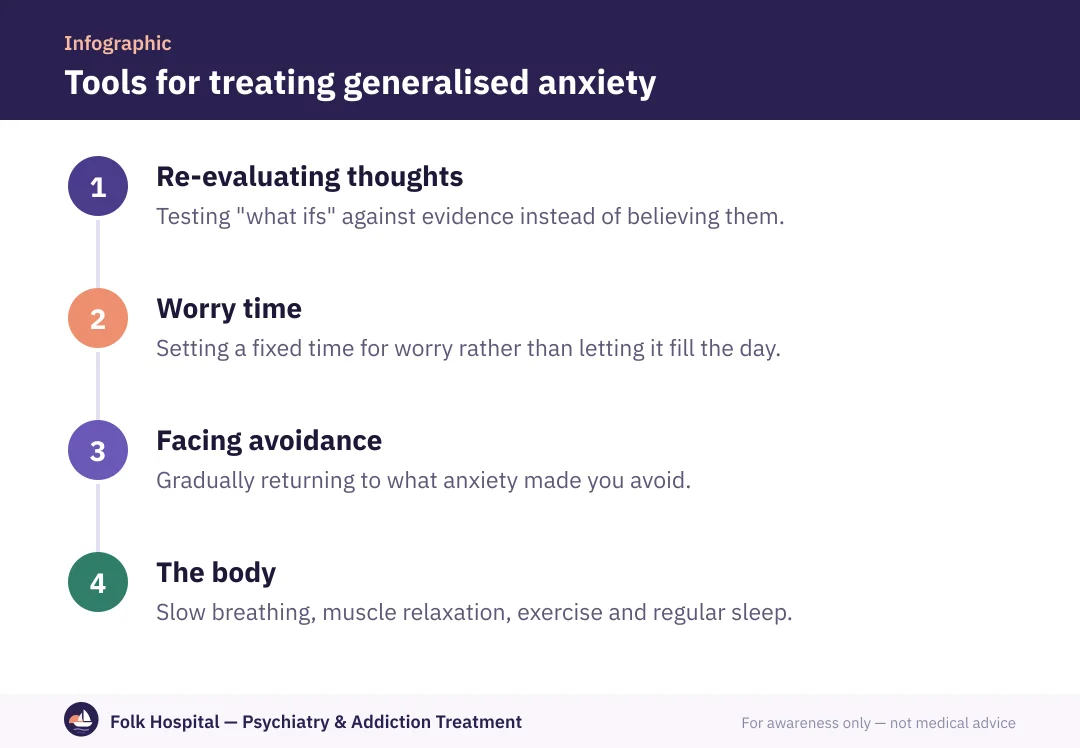
Treatment doesn't try to convince you that "everything will be fine"; it teaches you to live with uncertainty, test exaggerated thoughts, and stop the behaviours that feed anxiety, such as avoidance and repeatedly seeking reassurance.
- Understanding the anxiety cyclehow a "what if" thought becomes physical tension, then avoidance, so the anxiety grows.
- Scheduled worry timepostponing worrying to a set time each day instead of letting it fill the whole day.
- Testing thoughtswhat's the evidence? What's the real likelihood? What would I do if it happened?
- Reducing reassurance and avoidancegradual steps to face what you avoid.
- Relaxation and breathingskills to calm the body.
- Preventing returna plan for warning signs and difficult situations.
Read about cognitive behavioural therapy.
03What role do medicines play?
When needed, the doctor prescribes medicines used for long-term anxiety treatment that aren't addictive, with benefit appearing within weeks. Don't start or stop any medicine without your doctor. Read about pregabalin and anxiety.
Long-term anxiety medicines
- Usually not addictive.
- Take weeks to show benefit.
- Used for several months after improvement.
- Tapered gradually with the doctor.
Fast-acting sedatives
- Relief within minutes.
- Risk of dependence with regular use.
- Used with caution and very short-term, if at all.
- Don't treat anxiety in the long run.
A warning
Calming anxiety with sedatives, cannabis or alcohol gives temporary relief, but increases anxiety in the long run and can lead to addiction. Read about anxiety and addiction.
04Habits that support treatment
| Habit | Why it helps |
|---|---|
| Regular physical activity | Reduces tension and improves sleep |
| Less caffeine | Reduces palpitations and physical tension |
| Regular sleep | Lack of sleep magnifies anxiety |
| Less news and screen time | Fewer "what if" triggers |
| Connecting with others | Less isolation and a different perspective |
Read about anxiety at night.
05When do you need a prompt assessment?
If anxiety comes with severe depression or thoughts of self-harm, you've started relying on sedatives or substances to calm it, or it stops you going out or working, seek a psychiatric assessment soon. There may be another condition, such as panic disorder or social anxiety, that needs its own plan.
؟Frequently asked questions
How long does treatment for generalised anxiety take?
Many people notice improvement within weeks of CBT, and sessions usually continue for a few months. If medication is used, it usually continues for several months after improvement.
Can anxiety be cured completely?
Anxiety is a normal part of life; the aim is for it to return to a normal size so it doesn't control your day. Many people achieve that and keep it with the skills they've learned.
Are anxiety medicines addictive?
Most medicines used for long-term anxiety treatment aren't addictive. Benzodiazepine sedatives can cause dependence, so they're used with caution and for short periods.
Does exercise help anxiety?
Yes. Regular physical activity reduces tension and improves sleep; it's an important support for treatment, though not a replacement in moderate and severe cases.
Why is my anxiety worse at night?
Because quiet leaves room for thoughts, and tiredness weakens your ability to handle them. Specific techniques for this are part of treatment. Read about anxiety at night.
Sources and references
- Anxiety Disorders — National Institute of Mental Health (NIMH)
- Anxiety disorders — fact sheet — World Health Organization
- Psychotherapies — National Institute of Mental Health (NIMH)
- Mental Health Medications — National Institute of Mental Health (NIMH)

A psychiatrist specialising in addiction and mental illness in adults and adolescents, with a focus on dual diagnosis.
For awareness only — not a substitute for medical advice. Editorial policy · View profile